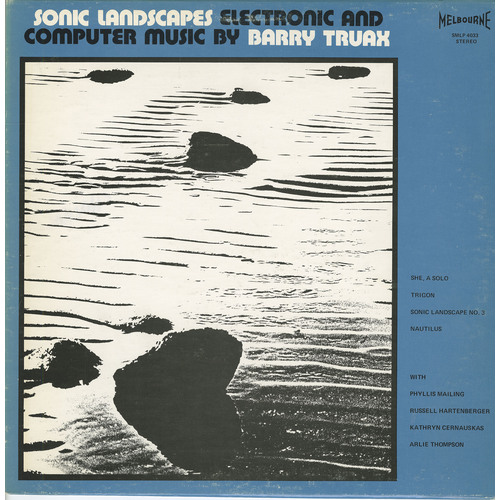
Insight
Recording of Barry Truax's Sonic Landscape No. 3 for four computer-synthesized soundtracks. The work is divided into three sections, each of which organizes the timbral and textural component in different ways. Familiar percussion timbres occur in the first section. In the second section, less familiar timbres are introduced in heavier densities such that the interaction of entire groups of timbres and events are perceived. In the final section, individual events are not perceived as much as a single, complex texture composed of related broad-band elements. The work was realized with the composer's POD programs for computer sound synthesis and composition at Simon Fraser University. The synthesis method is that of Chowning's frequency modulation timbral synthesis. The programs run on a Hewlett-Packard 2116 minicomputer with 12-bit D/A converter and digital magnetic tape unit. The sound structures are initially composed interactively with the POD6 program that utilizes real-time monophonic synthesis. The compositional model involves the selection of sound objects to be distributed in a random, Poisson-determined frequency/time field whose density and frequency range are variable in time. For each structure, two or four random variants are calculated and stored; each later occupies a different track on magnetic tape. Most of the sound structures used in the composition are synthesized with the POD7 program for non-real-time synthesis at fixed sampling rate. Envelopes are allowed to overlap in this version, creating a multi-phonic texture. The possibility of digital reverberation allowed by this program is not utilized in this particular composition. Four-channel mixing of the resultant tapes arrives at the final composition. The work, originally realized in 1975, was revised and largely re-synthesized in early 1977 at Simon Fraser University, and mixed in the Sonic Research Studio of the Department of Communication.
Gallery
Images
4 images
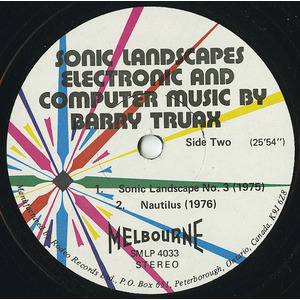
Barry Truax-Sonic Landscapes LABEL 02
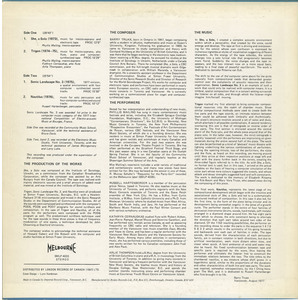
Barry Truax-Sonic Landscapes BACK
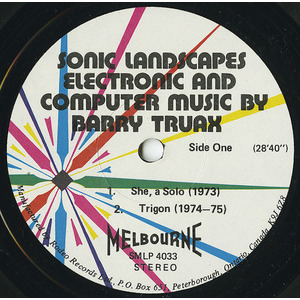
Barry Truax-Sonic Landscapes LABEL 01
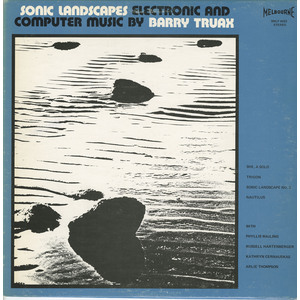
Sonic Landscapes
Media
Videos
0 videos
No videos available for this title.
Credits
In Transit
No Comments