
Insight
Stretch Marks emerged from Winnipeg in the early 1980s as one of the most ferocious, disciplined, and outward-looking bands to rise from Canada’s first hardcore wave. At a time when Winnipeg unexpectedly became a breeding ground for uncompromising punk—alongside Personality Crisis, Artificial Life, Beach Mutants, Lowlife, Something Evil, and Unwanted—Stretch Marks quickly distinguished themselves through speed, precision, and an unusually organized approach that set them apart from many of their peers.
The band began as a two-piece formed by brothers Bill and Kelly Jackson, writing fast, blunt songs before expanding into a full lineup with the addition of vocalist Dave McCombe (soon known as Dik Savage) and bassist Mark Langtry, who adopted a revolving cast of aliases including Sikbee, Sicby, Terror, and Mark Stretch. From the outset, Stretch Marks combined the velocity and austerity of early American hardcore with a distinctly Canadian sensibility shaped by Cold War anxiety, nuclear dread, and an intolerance for posturing—inside punk as much as outside it. Their music was confrontational, but never humourless; absurdity, satire, and self-awareness were integral to their identity.
Visually, the band were as imposing as they were loud. Often described as looking more like professional wrestlers than musicians, Stretch Marks leaned fully into that imagery. Wrestling fandom became a defining through-line, most memorably crystallized in “Turnbuckle Stomp” and the band’s cartoon alligator mascot—an emblem that captured both their menace and their refusal to take themselves too seriously. This fusion of brutality and wit helped them connect with audiences far beyond Winnipeg, including a surprising international following that extended into wrestling subcultures overseas.
Determined to maintain control over their output, Stretch Marks formed their own imprint, Headbutt Records. Their debut EP, Who’s In Charge (1983), was self-financed, pressed in Toronto in small runs, and assembled by hand. Recorded with Mitch Funk and Richard Duguay involved in the production orbit—and engineered under difficult conditions by Scott Gibson—the EP captured the band at their most volatile: short, explosive songs attacking political hypocrisy, nuclear paranoia, and hollow rebellion. Tracks such as “Professional Punks,” “Dogs World,” and “Another Tragedy” became underground staples, while the EP’s rapid sell-through confirmed that Stretch Marks were operating at a level well beyond most of their peers.
By 1984, relentless touring had sharpened the band into a formidable live unit. That summer they travelled to Los Angeles to record their only full-length album, What D’Ya See, at a high-end studio—an unusual move for a Canadian hardcore band at the time. Released through Better Youth Organization (BYO), with Headbutt acting as the Canadian distribution arm, the album documented Stretch Marks at their peak. Still aggressive and fast, it also revealed a band beginning to stretch beyond pure hardcore orthodoxy. Songs like “Another Tragedy,” “Lookin’ for Danger,” and “Preacher” introduced more dynamic structures, while maintaining the intensity that had made their reputation.
Touring was central to Stretch Marks’ identity. They crossed Canada and the United States repeatedly, often under chaotic conditions—sleeping on floors, surviving on door money, navigating with worn atlases, and relying on a sprawling underground network of promoters, fans, and fellow bands. They toured with and were deeply influenced by CH3, Youth Brigade, and the Stern brothers, whose professionalized approach to punk left a lasting impression. These tours transformed Stretch Marks from a regional force into international ambassadors of western Canadian hardcore at a time when very few bands from the Prairies were making that leap.
Internal changes followed. Mark Langtry departed in 1985 and was replaced by Pat “Yoda” Kavanagh, marking the beginning of a stylistic shift away from strict hardcore toward a heavier, roots-inflected sound. Although the band continued to write and perform, this later incarnation—sometimes operating under the name The Hellcats—was short-lived. Stretch Marks effectively concluded their run in the late 1980s, with a final performance tied to Dik Savage’s wedding social, after which members dispersed into other projects and careers.
In the decades that followed, Stretch Marks’ influence only grew. Their recordings circulated widely through tape-trading networks, compilations such as BYO’s Something To Believe In, and legendary live recordings, including a long-lost CBC Brave New Waves session. In 2016, their complete studio output was finally assembled as Who & What: The Complete Studio Recordings, remastered and issued by Sounds Escaping. The release was accompanied by extensive liner notes drawn from firsthand accounts by manager Matt Vinet and historian Chris Walter, cementing Stretch Marks’ place as one of the most important and uncompromising hardcore bands Canada ever produced.
-Robert Williston
Musicians
Dave McCombe a.k.a. Dik Savage: vocals
Bill Jackson: guitar, backing vocals
Mark Langtry: bass, backing vocals
Kelly Jackson: drums
Production
Produced by The Stretch Marks and The BYO
Engineered by John Carter
Recorded July 1984 at Track Record, Los Angeles, California
Mastered at The Lacquer Channel Limited
Pressed by World Records WRC1-3628
Licensed from Better Youth Records, Los Angeles, California, United States
Made in Canada, 1984
Artwork
Album concept and layout by Mark Stern and Matt V.
Insert artwork by Glen Dunits
Front and back cover photography by Doug Humiski
Back cover photography by Phil Spud
Songwriting
All songs written by Jörg Evers
‘Lookin’ For Danger’ words and music © 1978 Edition Lollipop / Lambda Musik GmbH
‘Bad Moon’ ℗ Jondora Music
Notes
Track ‘Lookin’ For Danger’ originally performed in 1978 by the German band PACK
Track ‘Bad Moon’ originally recorded by Creedence Clearwater Revival
Printed lyric insert included
Gallery
Images
6 images
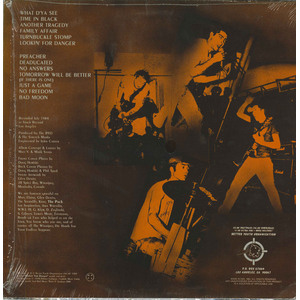
Stretch Marks-What DYa See BACK
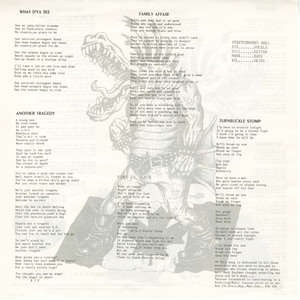
Stretch Marks - What D'Ya See INSERT SIDE 01
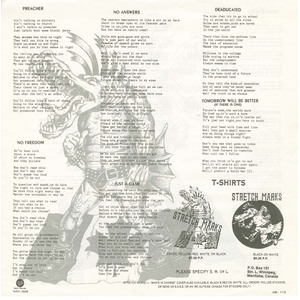
Stretch Marks - What D'Ya See INSERT SIDE 02
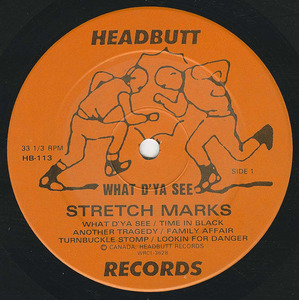
Stretch Marks - What D'Ya See LABEL 01
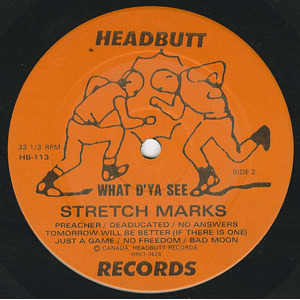
Stretch Marks - What D'Ya See LABEL 02
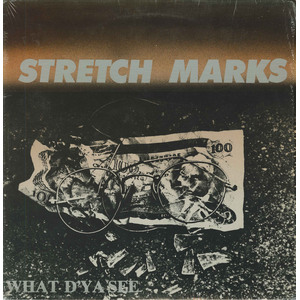
What D'ya See
Media
Videos
0 videos
No videos available for this title.
Credits
In Transit
No Comments