
Insight
Something Evil were a Winnipeg punk band active in the middle of the 1980s. The lineup on their only record was Ron Ravage on vocals and guitar, Grant Simmons on guitar, Randy Horoshock on bass and John Jacobs on drums. That record is the 1986 single 'Die Children Die' backed with 'The Great Winnipeg Riot', issued on Headbutt Records, and it is now among the hardest Canadian punk 45s of the decade to find.
Headbutt came out of Winnipeg's first wave of hardcore. Stretch Marks started the label to release their own records, beginning with the Who's In Charge EP in 1983 and carrying on with What D'Ya See in 1984, and it widened quickly to take in other bands from the city, among them Some Weird Sin and the Unwanted. Maximum Rocknroll had been reviewing Headbutt releases since 1983, so when Something Evil arrived on the label in 1986 they were stepping into a catalogue American readers already knew.
The single was cut in December 1985 at Wayne Finucan Studios on Sargent Avenue, with Scott Coates producing, Glen Axford engineering and Clive Perry handling the mix. Finucan had commissioned the room in 1976 and ran it as a full commercial operation, a 28 by 32 foot studio with an MCI console and multitrack and film work on the books, and its client list over the years took in the Guess Who and Crash Test Dummies. It became Channels Audio and Post Production in 1991 and continues today as Stereobus, the longest-running recording facility in the city. Axford was chief engineer and co-owner of Roade Recording on Grosvenor Avenue before that, where he cut sessions for players as established as Greg Leskiw of the Guess Who. Perry was on Finucan's own engineering staff, and went on to a long career in Winnipeg film sound, working on Guy Maddin's Tales from the Gimli Hospital and Archangel before opening his own room, Perry Audio and Recording. The sleeve photograph carries a single credit, to Humidity.
None of that professional pedigree turns up in the grooves. 'Die Children Die' and 'The Great Winnipeg Riot' are fast, loud and deliberately crude, with a guitar tone heavy enough to brush against metal and a vocal that growls its way through both sides. Tim Yohannan reviewed the single in Maximum Rocknroll in September 1986. He heard the metal in the beat and in the voice, gave the guitar credit for its weight without the metal edge, and filed the whole thing as “power punk a la ’77.” It was the last Headbutt release the magazine covered, closing a run that had opened with Stretch Marks three years earlier.
The B side almost certainly reaches back to 1919. On 15 May that year more than thirty thousand workers walked off the job and shut the city down for six weeks. The federal government ordered the strike leaders arrested on 17 June, and four days later a crowd of some twenty-five thousand gathered outside city hall on Main Street. Mayor Charles Gray read the Riot Act, the Mounted Police charged the crowd on horseback and began firing, special constables worked the surrounding streets with clubs and wagon spokes, and a streetcar was pushed off its tracks and set alight. Two men were dead by evening, dozens were injured, more than eighty were under arrest and federal troops held the streets. Winnipeg has called it Bloody Saturday ever since.
Almost nothing else about the band has survived. No second release has surfaced, no gig listing, no interview, and no record of what the four members did before or after. What remains is the record, a ferocious and now exceptionally scarce Winnipeg punk 45, cut in the last weeks of 1985 and out the following year on the label that carried the city's punk records through the first half of the decade.
-Robert Williston
Gallery
Images
4 images
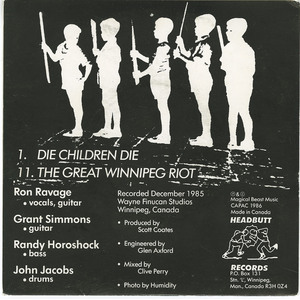
45-Something Evil-The Great Winnipeg Riot BACK
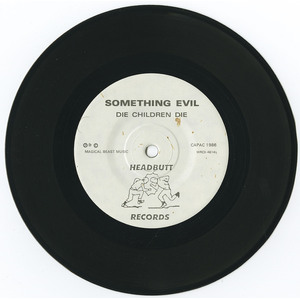
45-Something Evil-Die Children Die VINYL 01
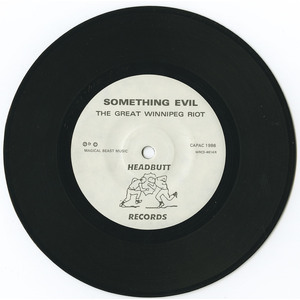
45-Something Evil-Die Children Die VINYL 02
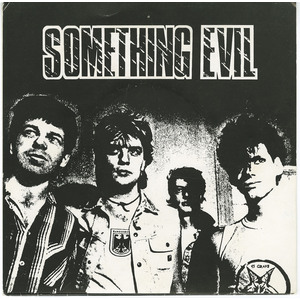
Die Children Die b/w The Great Winnipeg Riot
Media
Videos
0 videos
No videos available for this title.
Credits
Musicians
Ron Ravage: vocals, guitar
Grant Simmons: guitar
Randy Horoshock: bass
John Jacobs: drums
Production
Produced by Scott Coates
Technical
Engineered by Glen Axford
Mixed by Clive Perry
Recorded December 1985 at Wayne Finucan Studios, Winnipeg, Manitoba
Artwork
Photography by Humidity
Release
Headbutt Records, 1986
℗ & © Magical Beast Music
CAPAC
Made in Canada
Manufactured by World Records
Matrix numbers
Side A: WRC3-4614-L 1A2HZ DM-91
Side B: WRC3-4614-R 1A2HZ
No Comments