Insight
The first Solstice album carries the catalogue number CAD 1001. That is not an accident of alphabetical luck. Solstice sat at the front of Les Disques Cadence because the people in Solstice helped build the label, having worked out that nobody else was going to release the kind of music they were making.
The group had come together by 1976 around guitarist and composer Daniel Lafrance, bassist Daniel Mathieu, clarinetist Michel Martineau and drummer Gilles Dozois. Lafrance had been playing professionally since 1969, starting out in a jazz combo, and by the Solstice years he was doing considerably more than playing guitar. He booked the shows, handled the promotion and was already producing other people's records, among them work by Conventum, L'Orchestre Sympathique and Pierre Moreau.
He had to. Solstice ran straight into the wall facing most ambitious instrumental music in Québec at the end of the 1970s. Writing about the band in February 1980, Le Devoir described a group making original and demanding music in a market where stages were scarce and record companies were indifferent. The audience existed. The musicians existed. The industry was looking elsewhere. Cadence was the answer to that, and by early 1980 the label had six albums out by young Québec jazz artists. Nébu took CAD-1002, Conventum's second record became CAD-1005, Solstice came back at CAD 1007 and Nébu's Motus followed as CAD-1008. A small home for Montréal instrumental and experimental music had been assembled more or less from scratch.
Mirage was recorded and mixed at Listen Audio in Montréal, Québec in March and April 1978, with Daniel Mathieu producing in the studio and Jack Winters and Pierre Groulx engineering. The band was still four players, and the thing that gives the record its face is what is missing from it. There are no keyboards and no vocals. Martineau's clarinet carries lines that any other fusion group of the period would have handed to an electric piano or a synthesizer, and it changes the whole colour of the music.
Lafrance wrote four of the six pieces, Equinoxe, Aromat, Stress and the nine and a half minute Nu-Pieds. Martineau wrote the title track at just under eight minutes and Dozois wrote Cybernetique. The music was built with room in it. Solstice could hold a tight arrangement and then open the piece up without losing its shape, which is the trick that separates a composing band from a jam.
They worked. Contemporary listings put Solstice on Montréal stages through the late 1970s, including Studio 30 in September 1979, and Yves Nadeau later remembered the group playing hundreds of shows across Québec over more than three years, with television appearances along the way. The two records account for a small part of what the band actually was.
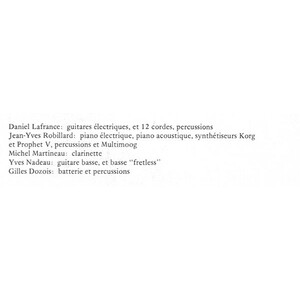
By the time they returned to a studio the lineup had shifted. Daniel Mathieu left, going on to play bass on Jacques Tom Rivest's 1979 solo album alongside musicians from Pollen. Yves Nadeau came in on bass and fretless bass, and Jean-Yves Robillard joined on electric piano, piano, Korg, Prophet V and Multimoog synthesizers and percussion. Lafrance, Martineau and Dozois stayed. The quartet had become a quintet, and the keyboard layer that Mirage had deliberately done without was suddenly there.
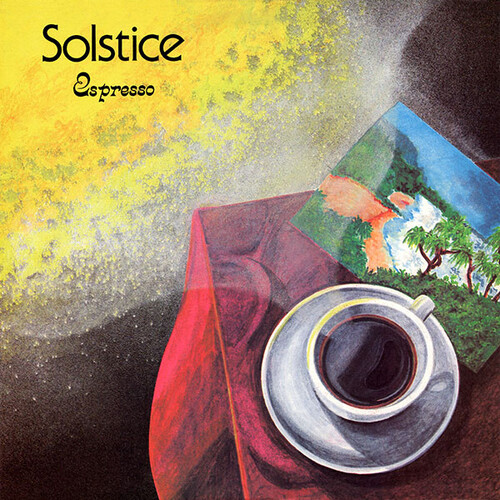
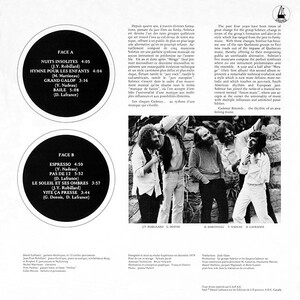
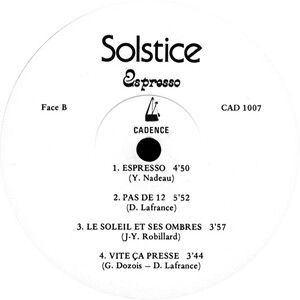
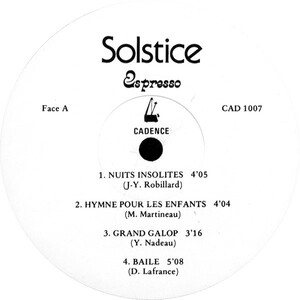
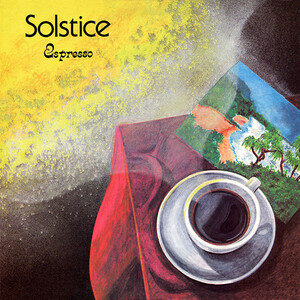
Espresso was recorded and mixed at Studio Expérience in December 1979 and released on Cadence as CAD 1007 in 1980. The writing had spread out across the whole band. Robillard brought Nuits Insolites and Le Soleil Et Ses Ombres, Nadeau wrote Grand Galop and the title track, Martineau wrote Hymne Pour Les Enfants, and Lafrance contributed Baile and Pas De 12 and shared Vite Ça Presse with Dozois. Where Mirage was a composer's record with a band around him, Espresso is five people bringing finished ideas into the room.
On July 5, 1980 Solstice played the first Festival International de Jazz de Montréal. They appeared at the Kiosque International at Terre des Hommes on a jazz-rock evening sponsored by CHOM, sharing it with Orpheus. That inaugural festival ran from July 2 to 10 and carried Ray Charles, Chick Corea and Gary Burton, Maneige with Ramsey Lewis and Vic Vogel's big band. Solstice was on the bill in year one, before the festival became the institution it is now, and that placement says more about where the band stood in Québec music than the size of its discography ever will.
There was no third album. Mirage and Espresso are the whole of it, and they document two genuinely different bands, the spare quartet built on guitar and clarinet in 1978 and the five-piece with fretless bass and synthesizers at the end of 1979.
The musicians scattered into the same scene they had come from. Nadeau formed his own jazz group, borrowing the name Espresso from the Solstice album track he had written, and brought it to the Montréal jazz festival in 1984. He has remained a working Montréal jazz musician since.
Daniel Lafrance played less and less and moved further into the side of the business he had been learning since 1976. He worked in production, artist management and publishing, with Francine Raymond and UZEB among the artists he handled. When UZEB split in 1992 he committed to publishing altogether, going to France with Daniel DeShaime to help develop Ze Publisher!, rights-management software that ended up in use by more than fifty European publishers. In 2000 Rosaire Archambault and Michel Bélanger brought him in to establish Éditorial Avenue, which grew into one of Québec's major independent music publishers, managing large Canadian and international catalogues. Lafrance became a founding member and longtime officer of APEM, worked with SOCAN and Music Publishers Canada, took publisher of the year honours repeatedly, and received the Christopher J. Reed Award in 2013. In 2025 Music Publishers Canada gave him its Lifetime Achievement Award. Their account of his fifty years in the industry starts with Solstice, with the guitarist who was booking his own shows and doing his own promotion.
The records themselves got a second life. In 2010 the Swiss label Take 5 put Mirage and Espresso together on a single CD, and both albums went out to jazz-rock and progressive collectors well beyond the small original Cadence pressings.
So the story of Solstice is not really the story of two hard-to-find albums. A group of Montréal musicians could not get anyone to release original instrumental music, so they helped build a label that released six of them, put their own record out first, played hundreds of shows, and stood on the stage at the first Montréal jazz festival. The skills that took to acquire turned one of them into a national figure in music publishing. The band left two records. It also left the machinery that carried a lot of other people's.
-Robert Williston
Gallery
Images
5 images
Expresso Back cover
Expresso Face B
Expresso Face A
Expresso Highlight note
Espresso
Media
Videos
0 videos
No videos available for this title.
Credits
Musicians
Yves Nadeau: bass guitar, fretless bass
Michel Martineau: clarinet
Gilles Dozois: drums, percussion
Daniel Lafrance: electric guitar, 12-string guitar, percussion
Jean-Yves Robillard: electric piano, piano, Korg synthesizer, Prophet V synthesizer, Multimoog, percussion
Production
Produced by Solstice
Recorded and mixed at Les Studios Expérience, December 1979
Songwriting
“Nuits Insolites” written by Jean-Yves Robillard
“Hymne Pour Les Enfants” written by Michel Martineau
“Grand Galop” written by Yves Nadeau
“Baile” written by Daniel Lafrance
“Espresso” written by Yves Nadeau
“Pas De 12” written by Daniel Lafrance
“Le Soleil Et Ses Ombres” written by Jean-Yves Robillard
“Vite Ça Presse” written by Daniel Lafrance and Gilles Dozois
Release notes
Canada
Rights society: CAPAC
Matrix and runout
Side A: CAD-1007A-1L 1A
Side B: CAD-1007B-1L 1A
No Comments