Insight
Red Shea was one of the defining guitar voices in Canadian folk, country, and early rock and roll. Born Laurice Milton Pouliot in Prince Albert, Saskatchewan on May 9, 1938, Shea became best known as Gordon Lightfoot’s first great lead guitarist, but his career stretched well beyond that role, from rockabilly and country television work to major folk recordings, studio sessions, and long-running national television appearances.
Shea was a self-taught musician whose early life had a rough, restless edge. According to music writer Nicholas Jennings, Shea had worked in a travelling carnival, hopped freight trains, and eventually made his way east with his brother Les Pouliot, also a guitarist, in 1957. In Toronto, the Pouliot brothers began finding their way into the city’s country and television scene. With bassist Bill Gibbs, they formed the Red and Les Trio, appearing on CBC’s popular country music program Country Hoedown. It was there that Shea first crossed paths with a young Gordon Lightfoot, then performing as part of the show’s Singin’ Swingin’ Eight.
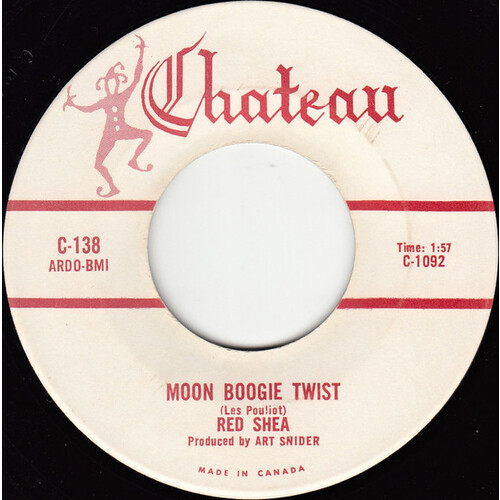
The Red and Les Trio recorded for Regency Records, including the 1958 single 'Marlene', and Shea soon became part of Toronto’s growing pool of reliable studio and television musicians. He also recorded under his own name for Chateau, the Toronto label operated by Art Snider. His 1961 single 'Moon Boogie Twist' / 'Cottonwood' stands as an early showcase of his sharp, twanging guitar style. Both sides were written by Les Pouliot, produced by Art Snider, and featured Chuck Daniels on bass. With its lean rockabilly drive and instrumental attack, 'Moon Boogie Twist' captures Shea before the folk boom, already displaying the clean tone, economy, and rhythmic bite that would later make him such an important sideman.
By the early 1960s, Shea was working regularly in television. In 1963, when CBC launched Music Hop, he became guitarist in the house band, the Rhythm Rockers, alongside Norm Amadio on piano, Don Thompson on tenor sax, Alex Lazaroff on drums, and John Stockfish on bass. The group backed the show’s guests and performers, including host Alex Trebek, the resident vocal group The Girlfriends, and rising Canadian pop acts such as Robbie Lane, Pat Hervey, Shirley Matthews, and Gordon Lightfoot.
In 1965, Lightfoot hired Shea and Stockfish as his regular sidemen, establishing one of the most recognizable early sounds in Canadian folk music. Shea’s guitar work became a crucial part of Lightfoot’s recordings and live performances through the second half of the 1960s and into the 1970s. His playing can be heard on albums including The Way I Feel, Did She Mention My Name, Back Here on Earth, Sit Down Young Stranger, Summer Side of Life, Sundown, Cold on the Shoulder, and Gord’s Gold. His lead work on 'Canadian Railroad Trilogy', especially in live performance, remains one of his most admired contributions to Lightfoot’s catalogue.
Shea’s style was never flashy for its own sake. He played with clarity, restraint, and a distinctive melodic sense, adding colour and movement without crowding the song. That quality made him ideal for Lightfoot, whose music depended on space, texture, and storytelling. Alongside John Stockfish’s bass, Shea helped create the early Lightfoot sound: elegant, disciplined, unmistakably Canadian, and deeply influential.
After leaving Lightfoot’s regular touring band, Shea continued to work with him in the studio and returned for selected performances. He also worked with Ian and Sylvia Tyson and became associated with Great Speckled Bird, later serving as musical director for The Ian Tyson Show. In the 1980s, Shea became band leader for The Tommy Hunter Show, bringing his guitar and arranging skills to one of Canadian country music’s longest-running television institutions.
Shea was admired by generations of Canadian musicians. Randy Bachman and Burton Cummings name-checked both Red Shea and John Stockfish in The Guess Who’s 'Lightfoot', a tribute to the sound they helped build around Gordon Lightfoot. Bachman later described Shea as the kind of guitarist who added sparkle and magic to a song, enhancing the performance without overpowering it.
Red Shea died of pancreatic cancer on June 10, 2008, just one month after his 70th birthday. Though widely remembered for his work with Gordon Lightfoot, his own story runs much deeper: Saskatchewan-born, Toronto-seasoned, rooted in country, rockabilly, folk, and television, he was one of the great Canadian guitar accompanists — a player whose touch helped shape the sound of an era.
-Robert Williston
Gallery
Images
2 images
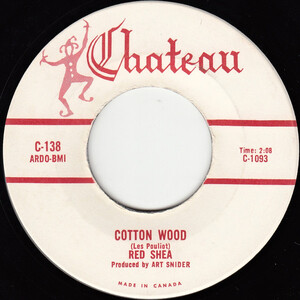
Red Shea – Moon Boogie Twist Cottonwood (1)
Moon Boogie Twist b/w Cottonwood
Media
Videos
0 videos
No videos available for this title.
Credits
Musicians
Red Shea: guitar
Chuck Daniels: bass
Songwriting
'Moon Boogie Twist' written by Les Pouliot
'Cottonwood' written by Les Pouliot
Production
Produced by Art Snider
Publishing
ARDO-BMI
Manufacturing
Made in Canada
No Comments