Album / Title
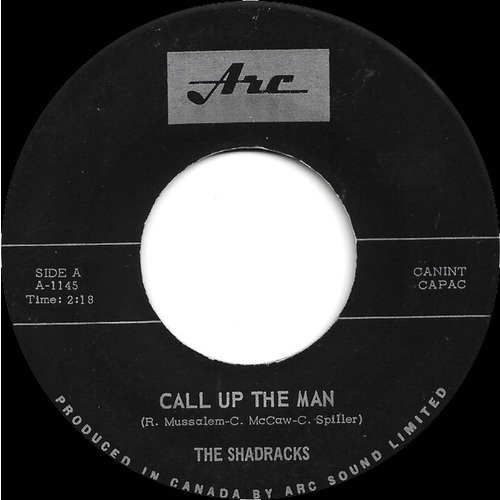
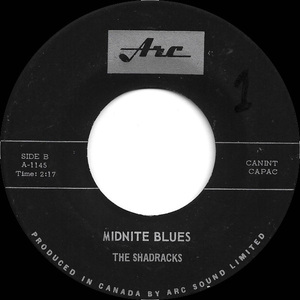
Call Up the Man b/w Midnite Blues
By: The Shadracks
Origin: Kelowna, British Columbia, 🇨🇦
Insight
The Shadracks formed in Kelowna, British Columbia, in 1962, when the Okanagan Valley supported a busy circuit of teen dances, community halls, Regatta shows and high-school sock hops. Kelowna had the Nocturnals, Pharaohs, Shades, Continentals and Cavaliers; Kamloops had the Henchmen, Coachmen and Esquires; Penticton and Vernon had the Syllables, Drifters and Rebels; and Kootenay groups like the Epics and Regents regularly crossed into Okanagan territory. Bands from Vancouver and Washington State came through on weekends, bringing new songs with them. Within a few years the Shadracks were the top band in Kelowna.
The first lineup had Rick Mussalem singing lead, Craig McCaw on guitar, Bob Verge on bass and backing vocals, Warren Dunaway on drums and Glenn Chidlow, who remembers himself as the band's bass player, though some accounts put him on rhythm guitar. When Chidlow and Dunaway left, Clive Spiller came in on second guitar. Joe Stolz drummed for a few gigs before the job went to Claudette Skrypnyk, a Saskatchewan-born drummer who played barefoot. A woman behind the kit was almost unheard of in a western Canadian rock band of the early 1960s, and she drew comparisons to Anne 'Honey' Lantree of England's Honeycombs. The band's quick tempos and harmonies earned a comparison of their own, to Australia's Easybeats.
Their regular stage in town was the Aquatic, headquarters of the Kelowna Regatta. Whenever Vancouver bands played the Okanagan, McCaw went to see them. One of the best was Little Daddy and the Bachelors, with Tommy Chong on guitar and Floyd Sneed on drums. They were friends with Mussalem, and the Shadracks would drop by their motel after shows. McCaw later recalled that Chong handed him his first joint there, around 1962 or 1963. When the Chessmen came to Kelowna, McCaw went to the show with John Tanner and met their guitarist, Terry Jacks.
Tanner was McCaw's closest friend, a high-school classmate who was already working a late-night shift at a Kelowna radio station while still in his teens. McCaw would hitchhike over near sign-off with his guitar case full of stubby beer bottles, and the two would dig through the station's junk bin, where the rhythm and blues records and anything too strange for the playlist ended up. That bin gave them Freddie King's 'Hide Away' and Frankie Ford's 'Sea Cruise', and the records went home with them. Tanner moved to Vancouver in 1964 and landed a job at CFUN.
In 1966 the Shadracks cut their only single, 'Call Up The Man' backed with 'Midnite Blues', for Toronto's Arc Records. The A-side was a band original by Mussalem, McCaw and Spiller, a fast, lovesick rocker in which the singer tells his departing girl she might as well phone the crazy house to come and take him away. The flip was Charlie Rich's 'Midnite Blues', a 1962 Phillips International side, which the band reworked into an arrangement well removed from Rich's original.
The session took place in Vancouver at Robin Spurgin's studio, behind Kelly Deyong's, and Spurgin got his sounds any way he could. According to McCaw, one echo came from a length of garden hose with a small speaker at one end and a microphone at the other; another came from an empty garage behind the studio, with a loudspeaker in one corner and a microphone across the room. Afternoon sessions picked up an extra element when kids walking home from school heard music coming out of the garage and threw rocks at the door. McCaw called it an interesting percussive effect.
Arc issued the single as A-1145 in late summer 1966. CFUN added it to its C-Funtastic Fifty at No. 45 on September 10, the same week the station launched its All-Canadian Top Ten, where the Shadracks entered at No. 5. In RPM's October 3 radio report, CFUN disc jockey Daryl B. listed it among his picks. The record climbed through 30, 19, 12 and 8 and peaked at No. 7 on October 15, sitting between Dusty Springfield and Johnny Rivers. On the All-Canadian Top Ten it held No. 1 for two weeks, October 8 and 15, ahead of the Townsmen and 3's A Crowd. It left the main chart in early November after eight weeks, still No. 6 on the Canadian list. Rival station CKLG left it off its Boss 40 during the record's peak, which made 'Call Up The Man' a CFUN hit through and through, played on the station where Tanner now worked.
The Shadracks had broken up by 1967. McCaw went to San Francisco that spring and lived in Haight-Ashbury, where he remembered every house as a kind of shrine, painted up psychedelically, with incense, beads, Indian prints and the smell of patchouli. Back in Vancouver he moved in with Tanner. They stayed roommates until 1977, ending at a house on Arbutus Street that McCaw kept living in until it was torn down in 2005.
McCaw then started playing with Terry and Susan Jacks as a trio called the Powerline, named after a bar in Whistler. On afternoon gigs there McCaw would ski down to the cafeteria deck, kick off his skis and play for an hour while the Jackses hauled his amplifier up the hill. Terry Jacks found the name the Poppy Family while leafing through an encyclopedia, and McCaw, taken with the sitar on the Beatles' Revolver, brought in a young tabla player named Satwant Singh. The Poppy Family's 'Beyond The Clouds' reached No. 2 on CKLG in 1968, and 'Which Way You Goin' Billy?' became an international hit. After the group played the Canadian pavilion at Expo 70 in Osaka, McCaw and Singh both left that fall.
McCaw went on to play in Sixty Six Six in the mid-1970s, taught music and scored for film and television. For decades he and Tanner created music and laser shows for Roundhouse Productions at the H.R. MacMillan Space Centre and Planetarium. McCaw left the planetarium in 2012 and Tanner retired in 2015.
Claudette Skrypnyk joined Three To One, formed in Vancouver in late 1966 by John Renton, Brian Russell and Derek Norris. Renton recalled that when they auditioned her, she blew them away. The band moved to Toronto, took a house on Jameson Avenue and worked the Ontario club circuit, including Ronnie Hawkins' Hawk's Nest upstairs from Le Coq d'Or on Yonge Street and the Club Pav in Orillia. In September 1967 Arc released their 'See Emily Play' b/w 'Give Me Love', possibly the first Pink Floyd cover on vinyl. The following year the same four became Raja, an Eastern-flavoured psychedelic act, and released 'Realize' b/w 'Drifting In The Wind' in August 1968. Her old bandmates have since lost track of her.
In 1985 'Call Up The Man' was included on the compilation The History Of Vancouver Rock And Roll Volume 2.
-Robert Williston
Gallery
Images
2 images
Shadracks - Call Up The Man bw Midnite Blues (1)
Call Up the Man b/w Midnite Blues
Media
Videos
0 videos
No videos available for this title.
Credits
Musicians
Rick Mussalem: vocals
Craig McCaw: guitar
Clive Spiller: guitar
Bob Verge: bass, backing vocals
Claudette Skrypnyk: drums
Songwriting
‘Call Up The Man’: Rick Mussalem, Craig McCaw, Clive Spiller
‘Midnite Blues’: Charlie Rich
Production
Recorded at Robin Spurgin’s studio, Vancouver, British Columbia
Produced in Canada by Arc Sound Limited
Release
1966: Arc Records, A-1145
7-inch, 45 RPM, Canada
Publishing: Canint, CAPAC
Chart History
‘Call Up The Man’: No. 7, CFUN C-Funtastic Fifty, October 15, 1966 (8 weeks)
‘Call Up The Man’: No. 1, CFUN All-Canadian Top Ten, October 8 and 15, 1966
Compilations
‘Call Up The Man’: The History Of Vancouver Rock And Roll Volume 2 (1985)
Notes
Earlier members: Glenn Chidlow (bass by his own account; also listed as rhythm guitar), Warren Dunaway (drums), Joe Stolz (drums, a few gigs). Rick Mussalem also appears as Mussellam; Claudette Skrypnyk also appears as Scriatnik and Scritnik.
No Comments