Insight
Sex was a Montréal hard-rock band whose brief recording career captured a pivotal moment in Québec music: the point at which the province’s garage, psychedelic and heavy-blues traditions began developing into the more ambitious progressive rock that would flourish during the 1970s. Although the musicians were francophone Québécois, they wrote and sang in English, working within the international heavy-rock language of the period while retaining a distinctly local identity.
Their music was forceful, exploratory and sometimes deliberately provocative, built around distorted guitar, muscular rhythms, prominent bass and commanding vocals. Flute, harmonica and percussion broadened the group’s original power-trio sound, while the later addition of saxophone helped transform Sex into a more expansive progressive ensemble.
The group’s roots extended deep into Montréal’s 1960s rock scene. Guitarist Yves Rousseau had played with Mystic Eyes from 1964 to 1968 before joining Sound Defections with drummer Serge Gratton and Yves Bellefeuille. Singer Robert Trépanier, previously associated with Le District Ouest, later joined Sound Defections. Réal Bujold subsequently became the group’s bassist, allowing Trépanier to concentrate more fully on singing. When Bujold departed, Rousseau, Gratton and Trépanier continued together as a trio under the new name Sex.
Trépanier’s earlier work connected Sex directly with Montréal’s garage and psychedelic movement. He had joined Le District Ouest while still a young singer, performing material influenced by the Animals, Vanilla Fudge and Procol Harum alongside the group’s original compositions. Le District Ouest recorded for Les Disques Soleil before Trépanier left in 1968 to join the heavier formation that would eventually become Sex. Both groups were associated with manager Pierre Gravel, who later managed Sex during the period surrounding its second album.
The original trio consisted of Rousseau on guitar, Gratton on drums and percussion, and Trépanier on lead vocals, bass, flute and harmonica. All three participated in the songwriting.
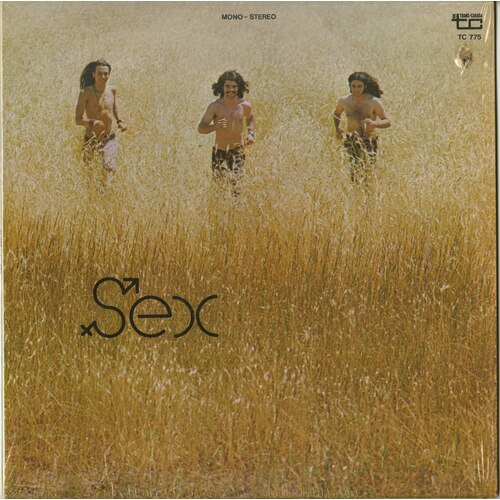
Their self-titled debut, Sex, was released by Trans-Canada in 1971. Produced by Joey Galimi and realized through Franco Disque Inc., the album presented a stripped-down and highly physical sound. Rousseau’s electric guitar moved between heavy riffs and extended solo passages, Gratton’s drumming supplied much of the record’s weight, and Trépanier alternated between forceful English-language vocals, bass, flute and harmonica.
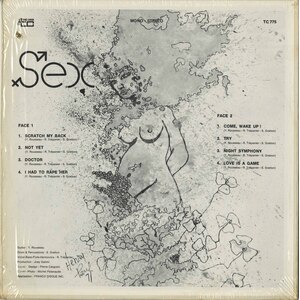
All eight compositions were jointly credited to Rousseau, Trépanier and Gratton. The opening side established the group’s uncompromising character through ‘Scratch My Back’, ‘Not Yet’, ‘Doctor’ and the confrontationally titled ‘I Had to Rape Her’. The second side broadened the instrumental vocabulary. ‘Come, Wake Up!’ introduced flute within the trio’s heavy setting, ‘Try’ featured harmonica, and ‘Night Symphony’ moved toward a more expansive psychedelic structure. ‘Love Is a Game’ closed the album with one of the group’s longest pieces, allowing Rousseau and the rhythm section to stretch beyond the compact structure of a conventional rock single.
The band’s name, album imagery and some of its lyrics embraced the era’s increasingly provocative attitudes toward sex and popular culture, but the music was not merely designed for shock. Beneath the presentation was an experienced working trio with a collective songwriting process and a willingness to move beyond standard blues-rock forms.
Sex has frequently been compared with British heavy groups such as Black Sabbath and Budgie. Its music also reflected the blues-based power-trio tradition established by Cream, the Jimi Hendrix Experience and the heavier side of late-1960s psychedelic rock. What distinguished Sex was the way those influences were filtered through the musicians’ francophone background, Montréal experience and emerging Québec-rock environment.
‘Not Yet’ and ‘Come, Wake Up!’ were selected for the group’s first Trans-Canada single in 1971.
That year, Sex appeared at one of Québec’s notable early heavy-rock gatherings, Top Festival II, held at Montréal’s Centre Paul-Sauvé on May 22. Headlined by Dionysos, the event also included Benjamin, Performance, Someone, Match and God Bless. The appearance placed Sex within an emerging network of Québec groups experimenting with hard rock, blues and progressive music.
The band’s concert presentation could extend beyond the three-man studio lineup. For some live performances, Sex recruited Réjean Ruel, formerly the organist with 25e Régiment. His participation suggests that the group’s stage sound could incorporate keyboards alongside the guitar, bass, drums, flute and harmonica heard on the debut. Québec-rock chronicler Yves Monast later recalled seeing Sex perform several times between 1971 and 1973, confirming that the group remained active onstage throughout the period encompassing both albums.
Sex expanded to a quartet for its second album, The End of My Life. Pierre ‘Pedro’ Ouellette joined Rousseau, Trépanier and Gratton, introducing natural and electric saxophone and flute into the arrangements.
Released by Trans-Canada in 1972, The End of My Life was again produced by Joey Galimi for Franco Disque Inc. Yves Martineau engineered the sessions at D.B.M. Studio, while Daniel Poulin supplied the photography.
Ouellette’s arrival changed both the sound and the writing structure of the group. Whereas every composition on the debut was credited to the original trio, the second album used several combinations of Rousseau, Trépanier, Gratton and Ouellette. Rousseau played electric and acoustic guitar, Trépanier remained the principal vocalist and bassist, Gratton expanded his percussion work to include congas and xylophone, and Ouellette’s reeds and flute became central to the album’s broader progressive character.
The album opened with ‘Born to Love’, followed by ‘I’m Starting My Life Today’ and the extended ‘Emotions’. These pieces retained the first record’s heavy foundation while making greater use of contrast, longer development and instrumental colour.
On the second side, ‘Pleasure’ and ‘See’ led into ‘Syphilissia’, one of the group’s darkest compositions. The extended title track, ‘The End of My Life’, closed the record with a meditation on mortality, spirituality and release.
The original lyric insert reveals a band reaching well beyond the provocative presentation associated with its name. ‘Born to Love’ expressed an idealistic vision of peace and human connection. ‘I’m Starting My Life Today’ dealt with renewal and escape, while ‘Emotions’ explored desire, rejection and self-destructive drinking. ‘The End of My Life’ turned toward death and the possibility of spiritual transformation.
The result was an album whose title suggested finality but whose music documented considerable artistic growth.
Ouellette later remembered Trépanier as both a valued musician and composer during the making of The End of My Life. Photographs from the period show the four musicians together, and Ouellette’s recollections confirm that the second album represented a genuine group collaboration rather than the original trio simply employing an additional instrumentalist.
‘I’m Starting My Life Today’ and ‘The End of My Life’ were paired on the group’s second Trans-Canada single in 1973. It became the final known release in Sex’s original catalogue: two albums and two singles, all issued by Trans-Canada.
Although the recording career of Sex was brief, its members remained active.
Trépanier and Gratton later participated in Paquet Voleur, the musical revue created by François Guy. Ouellette recalled that their final performance together in that production took place on August 28, 1977, at the Évêché of the Hôtel Nelson in Montréal’s Place Jacques-Cartier. The production also involved François Guy, Louise Portal, Céline Lomez and Lise Durocher.
Trépanier and Rousseau subsequently worked together again in the retro trio Juke Box, joined by drummer Pierre Lavoie. Rousseau continued as a guitarist, entertainer and performer, while Trépanier remained active in music for decades.
Robert Trépanier gave what was described as his final performance in Pointe-aux-Trembles in September 2022. He died on June 12, 2023, at the age of 74. At a memorial gathering attended by former colleagues, Ouellette praised Trépanier’s musicianship and songwriting during their work together in Sex. Gratton, Ouellette and musicians from other periods of his career gathered to remember him.
Yves Rousseau died in 2025. Accounts of his career recalled his work with Mystic Eyes, Sound Defections and Sex, as well as his later activities as a guitarist and entertainer. His death left Serge Gratton and Pierre Ouellette as the surviving members of the quartet heard on The End of My Life.
For many years, the original Trans-Canada albums became increasingly difficult to find and circulated primarily among collectors of Canadian heavy psych, proto-metal and early progressive rock. Unofficial European editions reproduced or combined the material, but authorized Canadian reissues eventually returned both albums to circulation.
Return to Analog reissued Sex in 2018 and The End of My Life in 2020, introducing the group’s music to a new generation of listeners.
Sex left behind a compact catalogue, but its significance exceeds the number of records it made. The group connected the directness of Montréal’s 1960s garage scene with the weight of early hard rock and the instrumental ambition of Québec progressive music. Its francophone musicians chose English as their performing language, absorbed international influences and reshaped them through their own experiences and musical environment.
The debut preserved the sound of a seasoned power trio discovering how heavy and expansive it could become. The second album showed the same musicians broadening their songwriting and adding saxophone, flute, acoustic guitar and percussion to create something more adventurous.
Together, the two records document a Québec band in rapid development—raw, provocative, unvarnished and increasingly ambitious.
Sex occupied a distinctive place between eras. The group emerged from the province’s garage and psychedelic past, participated in the first wave of Québec heavy rock and pointed toward the progressive experimentation that followed. More than half a century later, Sex and The End of My Life remain vivid records of that transition and of four musicians who helped give early Québec hard rock one of its most unusual and enduring voices.
-Robert Williston
Gallery
Images
4 images
Sex - ST
Sex - ST LABEL 01
Sex - ST LABEL 02
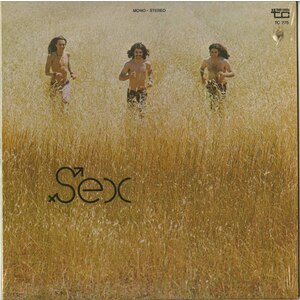
ST
Media
Videos
0 videos
No videos available for this title.
Credits
Musicians
Yves Rousseau: guitar
Serge Gratton: drums, percussion
Robert Trépanier: vocals, bass, flute, harmonica
Songwriting
‘Scratch My Back’: Yves Rousseau, Robert Trépanier and Serge Gratton
‘Not Yet’: Yves Rousseau, Robert Trépanier and Serge Gratton
‘Doctor’: Yves Rousseau, Robert Trépanier and Serge Gratton
‘I Had to Rape Her’: Yves Rousseau, Robert Trépanier and Serge Gratton
‘Come, Wake Up!’: Yves Rousseau, Robert Trépanier and Serge Gratton
‘Try’: Yves Rousseau, Robert Trépanier and Serge Gratton
‘Night Symphony’: Yves Rousseau, Robert Trépanier and Serge Gratton
‘Love Is a Game’: Yves Rousseau, Robert Trépanier and Serge Gratton
Production
Produced by Joey Galimi
Realized by Franco Disque Inc.
Artwork
Cover design by Pierre Casgrain
Cover photo by Michel Patenaude
Back cover illustration by Henry Paul
Matrix
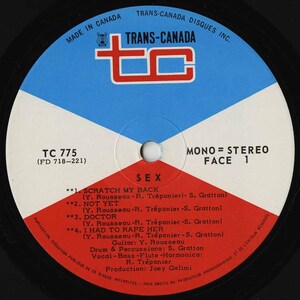
Matrix number, side one label: FD 718-221
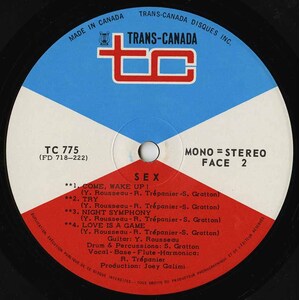
Matrix number, side two label: FD 718-222
Other: Mono = Stereo
Other: Made in Canada
No Comments