Insight
Tim Ray was one of the earliest and most intriguing figures to emerge from Vancouver’s first punk and new wave generation, a songwriter, guitarist and visual artist whose recordings between 1978 and 1984 captured a city undergoing a profound musical transformation. Although never as widely recognized as some of his contemporaries, Ray occupies an important place in Canadian independent music history. As the creative force behind Tim Ray and A/V, he produced a body of work that combined punk urgency with art-rock ambition, melodic intelligence and a restless refusal to remain within any single style.
Ray emerged during the late 1970s, just as Vancouver musicians were beginning to break decisively from the conventions of the city’s established bar-rock scene. According to guitarist Bill Napier-Hemy, who later became a founding member of Pointed Sticks, Ray had already sensed by 1977 that something new was developing. That awareness soon found expression in early recordings such as “Dying in Brooklyn” and “1/4 To 8.”
“1/4 To 8” appeared on the landmark 1979 compilation Vancouver Complication, placing Tim Ray and A/V directly within the city’s formative punk, new wave and independent underground. While Ray’s music was less overtly confrontational than some of the compilation’s harder-edged contributions, the recording demonstrated that he was already exploring the angular rhythms, compressed arrangements and art-conscious sensibility that would characterize his later work.
Ray was never punk in the blunt-force manner associated with D.O.A. and the harder edge of the Vancouver scene. He nevertheless belonged unmistakably to the same cultural moment. His music absorbed punk’s urgency, independence and rejection of convention while moving toward something more atmospheric and conceptually shaped. His songs could be abrasive and tightly wound, but they could also be melodic, spacious, humorous and unexpectedly sophisticated.
The earliest version of A/V was short-lived. Napier-Hemy, who had known Ray since their school days in Langdale, British Columbia, went on to help form Pointed Sticks, while Ray continued developing music under the Tim Ray and A/V name. Rather than maintaining one permanent group, Ray appears to have treated A/V as a flexible creative vehicle, assembling musicians according to the requirements of individual songs and recording sessions.
A central figure in that process was recording engineer and producer Ron Obvious, who worked with Ray throughout much of the 1978-1984 period. Obvious was part of the engineering staff at Vancouver’s Little Mountain Sound Studios from 1976 until 1991, during the years when the facility developed into one of Canada’s most important recording centres.
His extensive engineering work connected him with artists spanning Vancouver’s original independent underground and the broader Canadian music industry, including D.O.A., UJ3RK5, Pointed Sticks, the Cover Boys, Popular Front, Actionauts, Go Four 3, the B-Sides, Bif Naked, The Tragically Hip, Spirit of the West, Valdy, 54-40 and Bryan Adams.
That breadth of experience places the Tim Ray sessions within a much larger musical history. Obvious was not simply an engineer brought in to document Ray’s songs; he was one of the studio figures who helped capture Vancouver’s rapidly evolving musical culture, from its first punk and new wave recordings through folk-rock, alternative music and internationally successful mainstream productions. His ability to work across widely different musical settings made him particularly well suited to Ray’s unconventional and continually changing approach.
Most of Ray’s surviving recordings were made at Little Mountain Sound Studios in Vancouver. One session was recorded at Ocean Sound in North Vancouver by Bob Coulter. The recordings were made on analog 16- or 24-track Studer machines, with mixes performed manually by Obvious, Ray and Napier-Hemy. Transfers and digital mastering of the original master tapes were later completed at the Warehouse Studio in Vancouver.
The sessions gave Obvious unusual freedom to experiment with arrangements, recording techniques, textures and combinations of musicians. His own interests extended beyond conventional punk into progressive rock, art-rock and the more adventurous edges of new wave. He later compared Ray’s sensibility less to blunt punk minimalism than to artists such as Talking Heads and Ultravox, music built around tension, atmosphere, design and sharply defined ideas.
Ray’s recordings were created with a substantial and shifting group of collaborators. The musicians documented on History Lessons 1978-1984 include drummers Ron Cargill and Colin Griffiths; bassists Marty Higgs, Barry Muir and Martin Brown; guitarists Tim Ray, Bill Napier-Hemy, Alex Varty, Colin Griffiths, Jay Knutsen and Bob Coulter; keyboard players Bill Barclay, Peter Helliwell, Reed Eurchuck, Annie Muir and Randy Paar; saxophonist Chris Grove; and violinist Danise MacLeod. Ray performed the principal vocals, supplemented by background vocals from various band members.
Ron Cargill played drums on many of Ray’s recordings, while Napier-Hemy remained an important musical and production collaborator. Precise personnel listings for the individual tracks were not preserved. The retrospective’s notes explain that the musicians worked for the love of Ray’s songs, contributing additional ideas as the arrangements developed.
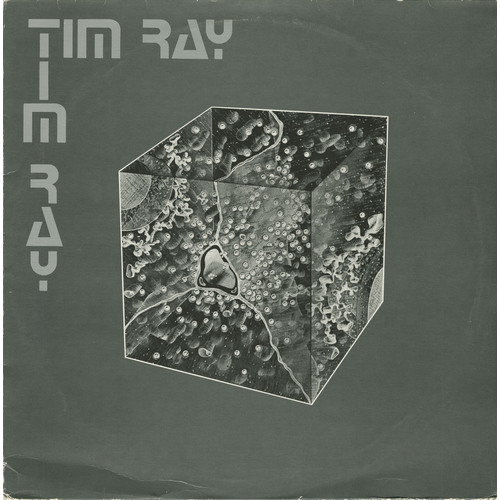
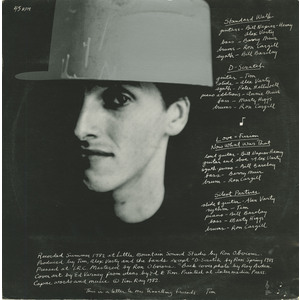
A concentrated example of Ray’s approach appeared on his self-titled five-song 12-inch release, containing “Standard Walk,” “D-Scratch,” “Love = Fusion,” “Now What Was That!” and “Silent Partner.” Recorded at Little Mountain Sound, the record presented a compact but highly distinctive cross-section of his music. Its changing personnel and production credits reinforce the impression that A/V was less a conventional band than an evolving studio and performance project organized around Ray’s songwriting.
The wider archive reveals that the 12-inch represented only a small portion of his work. Tim Ray and A/V: History Lessons 1978-1984 contains 25 selections drawn from more than 40 surviving recordings. The collection encompasses Ray’s earliest punk-era material as well as later recordings that moved increasingly toward post-punk, art-pop and new wave. The April 1981 recording listed on the retrospective as “Scene A Fight” also appeared under the title “Seen a Fight” on the 48-track compilation Last Call: Vancouver Independent Music 1977-1988. Compiled and produced by Grant McDonagh for Zulu Records, the collection placed Ray within a broad survey of Vancouver independent music spanning the city’s first punk recordings through the alternative scene of the late 1980s.
The recordings demonstrate how difficult Ray’s music is to reduce to a single category. There is punk immediacy, but also an unusual attention to space, construction, tone and emotional ambiguity. Some tracks are tense and sharply rhythmic; others move closer to melodic new wave, experimental pop or art-rock. Ray appeared less interested in conforming to a scene than in discovering what each song could become.
That independence may help explain why his work was never fully incorporated into the most familiar history of Vancouver punk, which has often emphasized the city’s loudest, fastest and most confrontational groups. Ray’s music occupied a less easily defined territory between punk’s first disruption and the broader possibilities opened by post-punk and new wave.
Evidence of the music’s lasting reach appeared decades later. During Pointed Sticks’ first Japanese tour in 2006, Napier-Hemy was standing backstage at one of the band’s Tokyo shows when the opening act, Liquid Screen, unexpectedly began performing “Dying in Brooklyn.” More than two decades after the song had been recorded, a band in Japan was playing it on the other side of the world. The performance demonstrated that Vancouver’s earliest underground recordings had travelled farther, and taken root more deeply, than many of their creators could have anticipated.
By the 2010s, Obvious had spent years safeguarding and revisiting Ray’s original tapes. With assistance and input from Napier-Hemy and others, he eventually assembled Tim Ray and A/V: History Lessons 1978-1984. The collection was not merely a reissue project. It was an act of preservation undertaken by someone who had participated directly in the creation of the music and remained convinced of its importance.
“It was such good music but few people ever heard it,” Obvious told Vancouver music writer Tom Harrison in 2017. “Putting this record out closes a chapter. It brings me real joy.”
Ray’s sister Jane Ray also played an important role in bringing the retrospective to completion. According to Obvious, she urged him to finish the work, telling him: “It’s time we got this Tim thing finished. Let’s get this thing done for Tim.” Her encouragement helped transform decades of preserved tapes and memories into a coherent historical collection.
Ray left Vancouver during the mid-1980s, living for periods in New York and later Paris before eventually returning to the West Coast. Painting became an increasingly important part of his creative life, and he continued producing visual art after settling again in Vancouver’s West End.
His later years were difficult. Friends and collaborators recalled that Ray had endured serious physical, psychological and substance-related struggles and was no longer the same person they had known during his early musical career. He eventually received substantial support from his sister while continuing to paint and pursue his visual art.
History Lessons 1978-1984 restores Tim Ray to the history of Vancouver music not as a peripheral curiosity, but as a missing link between the city’s first punk rupture and the more exploratory language of post-punk, new wave and independent art-rock. His recordings document a songwriter who recognized the possibilities of the emerging movement but never allowed its boundaries to define him.
Obvious later summarized the unrealized potential surrounding Ray’s career with characteristic bluntness:
“Tim could have been great. I really believe he wasn’t because he was in Vancouver at that time.”
-Robert Williston
Gallery
Images
2 images
Tim Ray - ST BACK
ST
Media
Videos
0 videos
No videos available for this title.
Credits
Musicians
Alex Varty: guitar (tracks: ‘Standard Walk’, ‘Love = Fusion’, ‘Now What Was That’, ‘Silent Partner’), slide guitar (tracks: ‘Standard Walk’, ‘D-Scratch’, ‘Silent Partner’)
Bill Napier-Hemy: guitars (tracks: ‘Standard Walk’), lead guitar (tracks: ‘Love = Fusion’, ‘Now What Was That’)
Barry Muir: bass (tracks: ‘Standard Walk’, ‘Love = Fusion’, ‘Now What Was That’)
Marty Higgs: bass (tracks: ‘D-Scratch’, ‘Silent Partner’)
Ron Cargill: drums
Bill Barclay: synth (tracks: ‘Standard Walk’, ‘Love = Fusion’, ‘Now What Was That’), piano (tracks: ‘Love = Fusion’, ‘Now What Was That’, ‘Silent Partner’)
Peter Helliwell: synth (track: ‘D-Scratch’)
Annie Muir: piano additions (track: ‘D-Scratch’)
Tim Ray: rhythm guitar (tracks: ‘D-Scratch’, ‘Silent Partner’)
Songwriting
Words and music written by Tim Ray, 1982
Production
Produced by Tim Ray and Alex Varty (tracks: ‘Standard Walk’, ‘Love = Fusion’, ‘Now What Was That’, ‘Silent Partner’)
Produced by Ron Obvious (track: ‘D-Scratch’)
Recorded summer 1982 at Little Mountain Sound Studios, Vancouver, British Columbia
Recorded and mastered by Ron Obvious
Artwork
Artwork by Roy Arden
Cover artwork by Ed Varney
Notes
Pressed by Imperial Record Corp. Ltd.
Printed by Intermedia Press
This is a letter to my travelling friends. Tim
No Comments