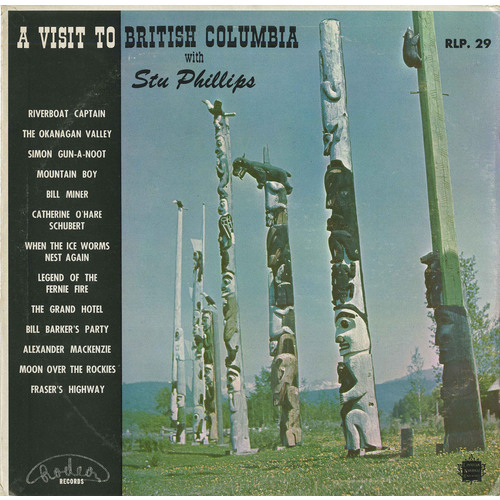
Album / Title
A Visit to British Columbia
By: Stu Phillips
Origin: St-Eustache, Québec → Calgary, Alberta, 🇨🇦 → Goodlettsville, Tennessee, 🇺🇸
Insight
Stu Phillips: The Travelling Balladeer
Stu Phillips (born January 19, 1933, in St-Eustache, Quebec) is a Canadian-American country singer, songwriter, broadcaster, and ordained minister whose career spans more than seven decades across radio, television, and stage. Often known as The Travelling Balladeer, Phillips earned acclaim for his heartfelt vocals, deep love of Canadian history, and international contributions to country music.
Raised in Calgary, Alberta, Phillips was drawn to music from an early age. Inspired by distant broadcasts of the Grand Ole Opry he picked up on a crystal radio, he began singing on amateur radio shows in Montreal and Verdun as a teenager. By age 16, he was touring across western Canada, performing at local rodeos and fairs.
His first major breakthrough came in Canadian broadcasting. During the 1950s, Phillips hosted a string of popular radio programs including Stu for Breakfast, Town and Country, and Cowtown Jamboree. By the early 1960s, he had become a familiar face on CBC Television, where he starred in The Outrider and later hosted Red River Jamboree from 1960 to 1964. These shows helped bring country music into homes across Canada at a time when the genre was still developing mainstream visibility north of the border.
A talented songwriter with a passion for national folklore, Phillips released a series of historically themed LPs in 1957, including Echoes of the Canadian Foothills (Rodeo RLP 17), Visit Old Québec (Rodeo RLP 20), and A Visit to British Columbia (Rodeo RLP 29) which blended original ballads with traditional tunes celebrating early Canadian settlers, Indigenous stories, and legendary landmarks. His lyrical storytelling and gentle delivery became a signature style, setting him apart from Nashville contemporaries.
In 1965, Stu Phillips moved to Nashville, Tennessee, signing with RCA Victor under the legendary producer Chet Atkins. There, he recorded a string of hit singles including “Bracero,” “The Great El Tigre,” “Juanita Jones,” and “Vin Rose.” His albums Singin’ (1966) and Grassroots Country (1967) received wide praise and solidified his place in American country music circles.
In 1967, Phillips was inducted as a member of the Grand Ole Opry, where he would become a frequent performer. He later toured extensively through Asia, Africa, and the Middle East, where he received gold records and widespread acclaim.
Beyond his musical career, Phillips pursued a spiritual calling. In the 1980s, he earned a divinity degree from the University of the South in Sewanee, Tennessee, and was ordained as an Episcopal minister. Balancing both ministries and music, he has continued to perform into his later years, including occasional appearances at the Opry.
Phillips became a naturalized U.S. citizen in 1998 alongside his wife Aldona, with whom he has shared a long and stable family life. In 1993, Bear Family Records issued A Journey Through the Provinces, a compilation celebrating his early Canadian folk recordings. That same year, he was inducted into the Canadian Country Music Hall of Fame.
Today, Stu Phillips is recognized as a foundational figure in Canadian country music, bridging the traditions of the North with the sounds of the American South. His storytelling, rich baritone, and commitment to cultural heritage continue to inspire generations of musicians and fans alike.
-Robert Williston
Liner notes
Stu Phillips is a serious-minded young Calgary television announcer dedicated to producing, in ballad form, the stories and legends of the early history of Canada.
Unheralded, almost undiscovered, this is one folk singer who is really going to get the plays for his albums thanks to the Canadian fraternity of disc jockeys.
Phillips entered radio in Montreal doing school broadcasts at CJAD, and was also heard on CFCF and CKVL. In 1950, he arrived in Edmonton driving a Model “A” convertible. He quips:
“The car expired as I hit the city limits, and I felt obligated to at least push it to its final resting place — in the city dump.”
He worked briefly for the now-defunct Edmonton Bulletin before catching on as a morning DJ at CFRN. It was here that he discovered a growing audience for his folk singing. By late 1952, station management decided folk music didn’t quite fit between regularly scheduled news and commercials, and Phillips moved on.
He relocated west to CJIB in Vernon, B.C., where he became supervisor of production and continued his research into regional history. Many of the songs on this album — especially those centered on the Okanagan Valley — were inspired by this time.
Canada’s Western Wonderland
BRITISH COLUMBIA
The third-largest province in Canada, British Columbia shares the roof of the Rockies with Alberta. Unlike Alberta, however, its mountains do not descend into the plains, but instead continue marching westward for over 400 miles to the Pacific.
Even the ocean cannot hold them; they reappear as a chain of green islands along the Inside Passage to Alaska, one of the world’s most scenic water routes, carved with bays and fjords, and lined with glaciers, forests, and towering peaks.
Vancouver, nestled between the sea and mountains, is the province’s commercial capital and third-largest city. It reflects British Columbia’s mix of modernity and wilderness through unique architecture, Stanley Park, and a lifestyle intertwined with nature.
Victoria, the legislative capital of the province, is a floral city on Vancouver Island, with a history dating to 1843 as a Hudson’s Bay Company trading post.
Cover Photo: Totems — Kitwanga, British Columbia
Photographs and Notes Courtesy of Canadian Pacific Railway
Cover design by Rudy Assaly
Distributed in Canada by London Records of Canada Ltd.
Gallery
Images
4 images
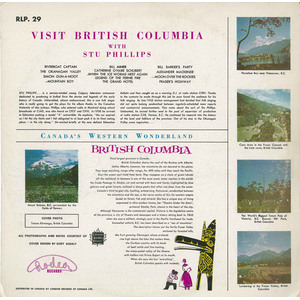
Stu Phillips-A Visit to British Columbia BACK
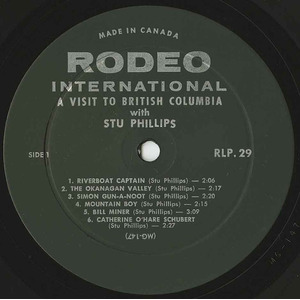
Stu Phillips-A Visit to British Columbia LABEL 01
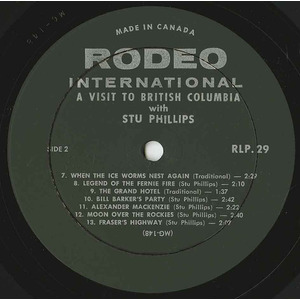
Stu Phillips-A Visit to British Columbia LABEL 02
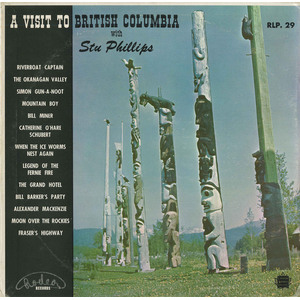
A Visit to British Columbia
Media
Videos
0 videos
No videos available for this title.
Credits
In Transit
No Comments