Insight
The Perth County Conspiracy emerged from Stratford, Ontario at the end of the 1960s, taking its name from the rural county surrounding one of Canada’s most distinctive theatre towns. The group was centred around Cedric Smith, a British-born singer, actor, and folk musician, and Richard Keelan, an American musician from Michigan who had previously recorded with the psychedelic folk-rock group The Spike Drivers. Around them gathered a shifting circle of musicians, friends, family members, poets, actors, and fellow travellers, making the Conspiracy less a fixed band than a communal folk-theatre ensemble.
Stratford was central to the group’s identity. The town’s annual theatre festival brought artists and audiences into a small agricultural community, while Harry Finlay’s Black Swan Coffee House became a late-night meeting place for hippies, theatre people, musicians, students, and travellers. Smith had known Finlay and the Black Swan since the early 1960s, and when he returned to Stratford in 1968 after time on the North American folk circuit, he connected with Keelan. The two began working up material at the Black Swan, where their different voices, backgrounds, and instincts helped shape the group’s unusual sound.
The Perth County Conspiracy formed in 1969. Early members included Smith, Keelan, guitarist and vocalist Terry Jones, bassist Michael Butler, and pianist and vocalist George Taros, with others joining as the group evolved. Their performances mixed folk songs, original material, poetry, humour, political commentary, theatrical readings, and long communal sets that could stretch deep into the night after Stratford Festival performances. The group also played beyond Stratford, including Toronto clubs, universities, and larger venues, but the Black Swan remained their spiritual centre.
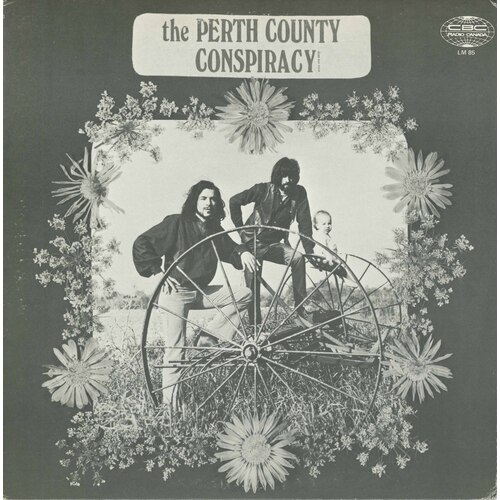
Their first release was Mushroom Music, issued in 1969 on the independent Rumour label. The album placed the group within the emerging Canadian underground of acid folk, communal music, and handmade counterculture releases. In 1970, the CBC followed with a self-titled promotional transcription album recorded at Studio G in Toronto on August 14 and 15. Pressed in only a small quantity, usually cited at around 250 copies, the CBC LP included original material alongside interpretations of songs by Donovan, Bob Dylan, and Smokey Robinson. Its scarcity helped turn it into one of the great collector pieces of Canadian psych-folk.
The CBC album helped build the group’s reputation, but it was their signing to Columbia Records of Canada that brought them into wider public view. Columbia was then taking a more adventurous interest in Canadian talent, and in 1970 the label released The Perth County Conspiracy Does Not Exist. Produced by John Williams and engineered by Terry Brown at Toronto Sound Studios, the album did not simply remake the earlier material. Instead, it presented a new set of songs and spoken passages, shaped by the group’s live Black Swan performances and expanded into a studio work that blended folk-rock, poetry, theatre, and psychedelic arrangement.
The Columbia album was built around Cedric Smith, Richard Keelan, and Michael Butler, with Fred W. Baue contributing ukelin to the closing track, ‘Crucifixation Cartoon.’ Smith’s credits included guitar, vocals, readings, maracas, and “tangents,” while Keelan’s included guitar, vocals, tympani, keyboards, “fire,” dulcimer, and pennywhistle. The record opened with the multi-part ‘Midnight Hour,’ which incorporated Dylan Thomas, and moved through ‘Epistle To The Borderliner,’ ‘Easy Rider,’ ‘Truth And Fantasy,’ ‘Don’t You Feel Fine,’ ‘You Have The Power,’ ‘Lady Of The Country,’ ‘Listen To The Kids,’ ‘Excerpt From “As You Like It”,’ and ‘Crucifixation Cartoon.’ Christopher Logue and William Shakespeare appeared alongside the group’s own writing, reinforcing the sense that the album was as much a theatrical folk document as a rock record.
Columbia issued singles from the album, including ‘You’ve Got To Know’ and ‘Listen To The Kids,’ but the group’s music was never built for conventional radio. Even so, The Perth County Conspiracy Does Not Exist reached the Canadian album chart, and the group’s singles later registered modest national chart placements. The album’s reputation grew more slowly, especially among collectors and psych-folk listeners drawn to its mix of acoustic warmth, countercultural politics, literary reference points, and communal looseness. Later writers have compared its atmosphere to the Incredible String Band and other acid-folk groups, while also noting how distinctly Southern Ontario the record feels.
In 1971, Columbia released Alive, a double live album recorded at Bathurst Street United Church in Toronto, again produced by John Williams. Rather than rely on familiar material, the album presented another body of songs and performances, including contributions from Terry Jones. As with their studio work, Alive captured the group as a loose, expanding organism rather than a polished commercial act. It also showed why the Conspiracy’s strongest reputation was built in performance, where song, spoken word, audience energy, and communal theatre could merge.
After Columbia, the group continued independently. By 1973, Bob Burchill had joined on guitar, replacing Terry Jones, and the band returned to Rumour for What School Bus Tour?, a live album assembled from performances in Ottawa, Sudbury, and Winnipeg. The record again featured largely new material, including songs associated with Burchill and settings connected to poet Milton Acorn. A stand-alone single, ‘Black Creek,’ followed in 1974.
The Perth County Conspiracy’s later work took on an increasingly political and international dimension. Breakout To Berlin was recorded in the German Democratic Republic and also appeared there under the title Kanada, connected to the group’s role representing Canada at the Fifth International Festival of Political Song. The album reflected the Conspiracy’s long-standing interest in activism, public performance, and folk music as a vehicle for social commentary.
By the later 1970s, the original moment that had produced the Perth County Conspiracy had begun to fade. The group’s communal folk-theatre world belonged to a particular intersection of Stratford counterculture, coffeehouse idealism, Canadian nationalism, anti-war politics, and post-1960s experimentation. Cedric Smith later became widely known as an actor, including major television work in Road To Avonlea and Anne of Green Gables, while other members continued in music, theatre, and related creative work.
Former members later reunited around Black Swan Coffee House revival events in Stratford in support of local homelessness initiatives, and in 2011 the CBC revisited the group’s story through its Inside The Music documentary feature. For collectors, Mushroom Music, the CBC transcription LP, and The Perth County Conspiracy Does Not Exist became key Canadian psych-folk artifacts. For Canadian music history, the group remains a record of a time when Stratford’s theatre culture, rural Ontario, folk music, poetry, politics, and communal experiment briefly formed their own conspiracy.
-Robert Williston
Gallery
Images
4 images
Perth County Conspiracy - ST on CBC
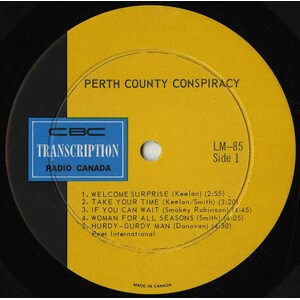
Perth County Conspiracy-ST (CBC) LABEL 01
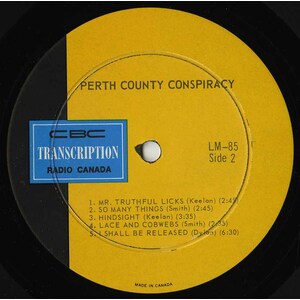
Perth County Conspiracy-ST (CBC) LABEL 02
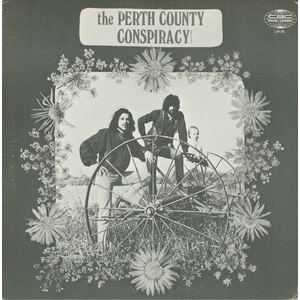
ST
Media
Videos
0 videos
No videos available for this title.
Credits
Musicians
Cedric Smith: artist
Richard Keelan: artist
Michael Butler: artist
Production
Produced by Dave Bird
Recorded by Ian Jacobson
Repertoire consultant: Gary McGeehan
Recorded at Studio G, CBC Toronto, Toronto, Ontario, August 14 and 15, 1970
Remastering
Remastered by Eric Mosher with Sidechain™ at The Warehouse Studio
Artwork remastered by Brent Lunney
CBC Production
CBC production coordinator: John Rahme
Series curator: Gary Corben
Notes
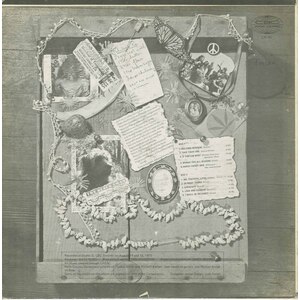
Originally produced by CBC as part of its late-1960s and early-1970s Canadian artist transcription series, pressed in limited quantities and distributed on vinyl to broadcast affiliates in Canada and North America. Original pressings were produced in runs of approximately 250 copies.
Original copies have reportedly sold for upwards of $1,500.
Later remastered from the original tapes where available, or restored from mint vinyl originals, with original artwork.
Pressed on 180-gram heavyweight black vinyl.
A Canadian psych-folk artifact recorded before the group’s commercial Columbia Records career.
No Comments