Insight
Pepper Tree: A Canadian Rock Chronicle
Pepper Tree was a Halifax-based psychedelic rock band whose ambitious blend of pop, prog, and acid-tinged harmony rock became a memorable fixture of the Canadian music scene in the late 1960s and early 1970s. Formed in 1967, the group emerged from a melting pot of local bar bands and forged a sound that was both regionally grounded and sonically adventurous, despite their brief commercial lifespan.
The Early Days and First Recording (1967–1969)
The seeds of Pepper Tree were sown when Tim Garagan, a drummer from the band Friends of the Family, teamed up with guitarist Ritchie Richmond and bassist Lenny Brennan, who had recently exited Lost Children. Guitarist Tony Argent (ex-Outcasts) and lead vocalist Bonnie Oulton completed the original lineup. Performing as The Pepper Tree, their first gig took place at the Shore Club in Hubbards, Nova Scotia in 1967.
As their sound matured, Oulton was replaced by powerhouse singer Doug Billard in 1968. Billard had already built a solid reputation in the Halifax scene, fronting groups such as The Soul Patrol, The Beavers, and The Five Sounds, the latter of which released the single "Loadin' Coal" / "Baby, Please Don’t Cry" on Epic Records—later described by the label as a “lost gem” that deserved more attention. In 1966, he also recorded as Doug Billard and The Soul Patrol, releasing the single "Genuine Jade" b/w "Emily" on Parkway P-126 (USA). He later performed with the experimental Central Nervous System and, following his time in Pepper Tree, would appear in the ambitious Canadian Rock Theatre project, released in 1972.
Argent was swapped out for keyboardist Bob Quinn, whose harmonically rich playing style ushered in a more psychedelic and progressive sound. During this period, they developed a tight, organ-driven live act that caught the attention of talent scouts in the region. RPM would later describe Billard's career as one that "spanned the continent" and confirmed his early involvement with Pepper Tree (RPM, Feb. 24, 1973).
In 1969, Pepper Tree made their first recorded appearance on a CBC split album with American pop vocalist Bobby Arvon. This obscure release featured several Pepper Tree tracks, likely recorded that same year, including the standout “The Gypsy,” which featured guest vocals by Penny MacAuley. The band's lineup for this recording was:
Doug Billard (Doug Billard And The Soul Patrol, The Beavers, The Five Sounds, Central Nervous System, Canadian Rock Theatre): vocals
Lenny Brennan: guitar
Jim White: guitar, backing vocals
Ritchie Richmond: bass
Tim Garagan: drums, vocals
Bob Quinn: keyboards, backing vocals
Penny MacAuley: vocals on “The Gypsy”
Breakthrough and Capitol Records Era (1969–1971)
Shortly after the split LP, a talent scout urged the band to record a demo. The resulting basement tape impressed Wayne Paton at Capitol Records, who signed them in 1969 and sent them to Toronto to record under legendary producer Jack Richardson (The Guess Who, Alice Cooper, Bob Seger).
Their debut single, “Everywhere” / “Mr. Pride,” was released in April 1970 and credited all five core members—Billard, Quinn, Richmond, Brennan, and Garagan—as co-writers. It made waves regionally and marked the final appearance of Brennan, Richmond, and Billard, who all left shortly after its release. RPM tracked the single’s progress across Canada, eventually reaching the national Top 20 (RPM, June 6 & 13, 1970), and praised its flip side as an emerging favorite among DJs.
The band’s early success caught the attention of Capitol’s national promotions team, leading to widespread airplay across stations from Halifax to Vancouver (RPM, June 13, 1970). A glowing feature declared Pepper Tree "ready to go international," highlighting their growing national appeal (RPM, July 18, 1970).
In February 1971, Pepper Tree returned with “Shine Light Shine” / “Hometown Girl,” their second single, recorded after the group had relocated to Toronto. With this release, the band had solidified its “Capitol-era” lineup: Tim Garagan (now also taking on lead vocals), Bob Quinn, Jim White, and Chris Brockway.
You're My People: The Definitive Statement
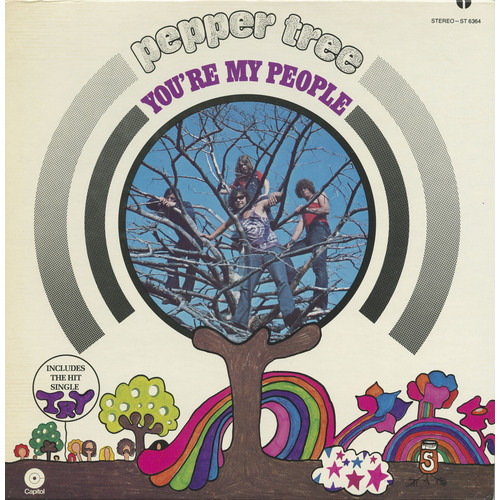
Now operating simply as Pepper Tree, the band moved into a farmhouse in Alliston, Ontario to write and rehearse. In May 1971, they released “Try” / “How Many Times,” the first single pulled from their upcoming LP, which was also issued in France (Capitol – 2C 006-80908 M), marking their first international release. The single was enthusiastically championed by Capitol's Roly Legault, who noted the band was "hot" and "headed for the top" (RPM, April 10, 1971). Music critic Ritchie Yorke was similarly impressed, describing the group's sessions as “original and innovative.”
In August 1971, the band released “You’re My People” / “From a Candle,” their second LP-derived single. Later that year, they released their full-length debut You're My People, recorded at RCA’s Toronto Studio and once again produced by Jack Richardson. The album was a stylistic tour-de-force, weaving together Hammond organ flourishes, guitar-driven rock, folk-inspired harmonies, and psychedelic overtones. It received simultaneous Canadian and U.S. release with substantial promotion by Capitol Records (RPM, Sept. 11 & 18, 1971).
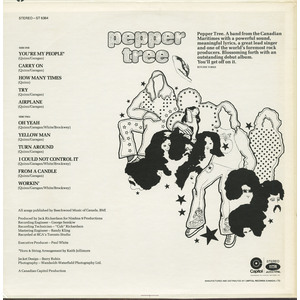
"Pepper Tree. A band from the Canadian Maritimes with a powerful sound, meaningful lyrics, a great lead singer and one of the world’s foremost rock producers. Blossoming forth with an outstanding debut album. You’ll get off on it." — Ritchie Yorke (RPM, Oct. 2, 1971 and back of album)
With Garagan now also handling lead vocals, the LP featured standout tracks like the extended jam “Airplane,” the moody title cut “You’re My People,” and the beautiful ballad “From a Candle.” Horn and string arrangements were handled by Keith Jollimore, and all but one of the album’s songs were written or co-written by Quinn and Garagan.
Though the record did well critically and was even released in the U.S., lineup shifts continued. Jim White exited the band before the American release, and Joel Zemel (Halifax) was mistakenly credited on U.S. pressings as guitarist.
Later Years and Decline (1971–1974)
Capitol Records insisted the band bring in a dedicated frontman, leading to a brief stint by Matt Minglewood (ex-Universal Power), followed by Terry Hatty. Both left within months. Garagan resumed lead vocal duties as Zemel recorded the single “Love Is A Railroad” (1972), before being replaced by Rick Edgett, who was then succeeded by Paul Butler.
From 1972–1973, a flurry of new singles were released:
“Love Is A Railroad” / “Workin’” (1972) – continued promotion through summer tour and Ontario Place shows (RPM, July 8, 1972)
“Midnight Lady” / “Teach Me How to Fly” (February 1973), also released in France (Capitol – 2C 006-81.399). The single was produced by Wayne Patton at Thunder Sound Studios and remained in the RPM 100 for several months (RPM, Feb.–Apr. 1973).
“Put a Smile Upon Your Face” / “Funky Music” (July 1973) – part of Capitol's "Summer Festival" push and included in their national sampler for radio promotion (RPM, July 28 & Aug. 11, 1973). The single was certified as MAPL-compliant Canadian content.
In 1973, Pepper Tree was also featured on the Maple Music Junket (MMJ) compilation LP alongside April Wine, Bruce Cockburn, Lighthouse, and others—distributed via Columbia Record Club and Longines Symphonette Society to recoup touring deficits (RPM, May 5, 1973).
The band’s live reputation remained strong. Notably, they opened for Grand Funk Railroad at Toronto’s Maple Leaf Gardens (Oct. 9, 1971) and performed at Capitol-sponsored shows at Ontario Place and the Toronto Fair that same year (RPM, Aug.–Oct. 1971).
These tracks showcased strong songwriting from both Quinn and Garagan, but none replicated the momentum of their earlier material. Midnight Lady was the last single to feature Garagan and Quinn, who both left the group in spring 1973.
The final lineup featured:
Chris Brockway: bass
Brian "Too Loud" MacLeod: drums (ex-Garrison Hill)
Ralph Parker: keyboards (also ex-Garrison Hill)
Paul Butler: guitar
This Newfoundland-based version of the band carried on into early 1974 before folding entirely.
Legacy and Post-Pepper Tree Careers
Tim Garagan and Bob Quinn joined Molly Oliver and later pursued songwriting, session work, and production. Quinn wrote for Roger Whittaker and launched Quincepts Productions Ltd.
Chris Brockway performed with Rhinegold (featuring Lawrence Gowan), Wrabit, Hanover Fist, and Lee Aaron.
Brian MacLeod became a Juno-winning producer and a member of Chilliwack and The Headpins before his untimely death in 1992.
Doug Billard had a modest solo hit with I’ve Lost My Place b/w Don't Fight the Feeling on United Artists UAXW 572X in 1974 followed by Baby Come and Dance b/w Sweet Sweet Love in 1978 on Epic E4-8261.
Joel Zemel and Rick Edgett remained active musicians in Halifax. Zemel also worked in CD production and graphic design with SVP Productions.
Ritchie Richmond became a session player and later an ordained minister.
Matt Minglewood went on to lead Cold Duck and launch a successful solo career.
Though Pepper Tree never broke into the mainstream, their work stands as a testament to the talent bubbling up from Nova Scotia in the late ’60s. Their recordings continue to captivate collectors and psychedelic rock enthusiasts alike, with You're My People considered a hidden gem of early Canadian progressive pop-rock.
-Robert Williston
Musicians
Tim Garagan: drums, lead vocals
Chris Brockway: bass, backing vocals
Jim White: guitar, backing vocals
Bob Quinn: keyboards, backing vocals
Keith Jollimore: horns and strings
Songwriting
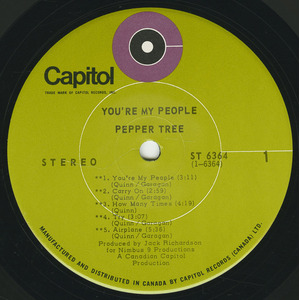
‘You’re My People’ written by Bob Quinn and Tim Garagan
‘How Many Times’ written by Bob Quinn and Tim Garagan
‘Airplane’ written by Bob Quinn and Tim Garagan
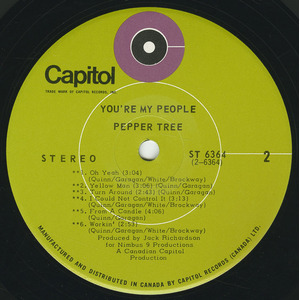
‘Yellow Man’ written by Bob Quinn and Tim Garagan
'Turn Around’ written by Bob Quinn and Tim Garagan
‘From a Candle’ written by Bob Quinn and Tim Garagan
‘Carry On’ written by Bob Quinn
‘Try’ written by Bob Quinn
‘Oh Yeah’ written by Bob Quinn, Tim Garagan, Jim White, and Chris Brockway
'I Could Not Control It’ written by Bob Quinn, Tim Garagan, Jim White, and Chris Brockway
‘Workin’’ written by Bob Quinn, Tim Garagan, Jim White, and Chris Brockway
Production
Horn and strings arranged by Keith Jollimore
Produced by Jack Richardson
Engineered by George Semkiw, assisted by Gary Starr and Rick Starks
Remixed by Jack Richardson and Cub Richardson
Recorded at RCA’s Toronto Studio
Paul White: executive producer
Artwork
Back cover design by Barry Richson
Photography by Wansbrough-Waterfield Photography Ltd.
Gallery
Images
4 images
Pepper Tree - You're My People BACK
Pepper Tree - You're My People LABEL 01
Pepper Tree - You're My People LABEL 02
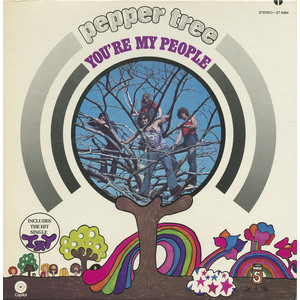
You're My People
Media
Videos
0 videos
No videos available for this title.
Credits
In Transit
No Comments