Insight
Gordon Pendleton was the professional name used for much of the recording career of Gordon Wallace Budd, a Saskatchewan singer-songwriter, guitarist, producer and studio operator whose musical life ran from Saskatoon's mid-1960s rock scene through decades of recording and performing in Saskatchewan and British Columbia. Born in Saskatoon on August 15, 1951, he took the surname Pendleton after his mother remarried, and later returned to the Budd surname.
He was playing in Saskatoon bands by 1965, while still in his teens. His early associations included Rik and the Ravens, The Warloks and Renaissance, and musicians who knew him also place him in Organized Confusion. By the end of the 1960s he was with Jr. & Dudley Dean, the Saskatoon group that had started life in 1966 as the Pig Bristle Brush Blues Band.
He left the band in 1970 and began appearing on his own. Over the winter of 1970-71 he played The Crypt several times, and also worked the Cellar Club on the lower floor of the Memorial Union Building at the University of Saskatchewan. His sets combined original songs with material by Gordon Lightfoot, James Taylor and Cat Stevens, and he recalled covering 'Ribbon of Darkness', 'Early Morning Rain' and 'Sixteen Miles'.
The Crypt appearances led to a management contract with Allen Shectman, who also managed Humphrey and the Dumptrucks. In January 1971 Pendleton travelled to Vancouver and cut the originals 'After You'd Gone' and 'Used Up All My Rainy Days' at Tom Northcott's Studio 3. While Shectman worked on a label deal, he recorded two more of his own songs, 'So Glad You Came Around' and 'Find A Way', at Century 21 Studio in Winnipeg. One song from each session was paired for 'So Glad You Came Around' b/w 'Used Up All My Rainy Days', released by Boot Records as BT 059 in 1972, with Thunder Sound in Toronto also involved in the finished sides. RPM reported that November that Boot had signed him for two singles and an album to be recorded the following January, distributed in Canada through London. Neither the album nor the second single appeared.
By 1974 Beaver Mountain Music, his publishing operation, was listed in industry directories at a Saskatoon post office box under his own name. The name stayed with him for years and eventually became Beaver Mountain Music Studios.
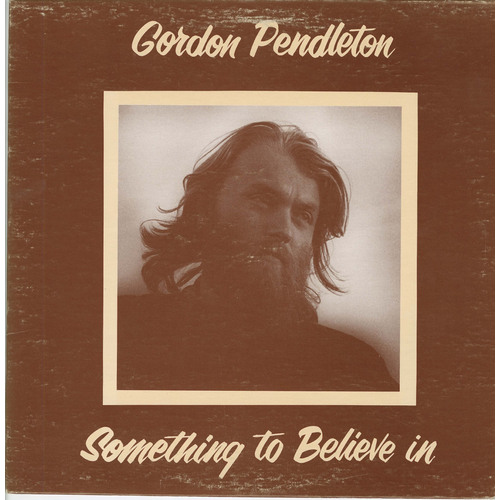
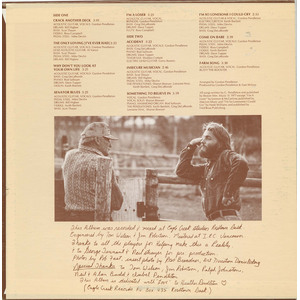
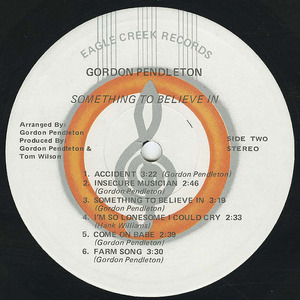
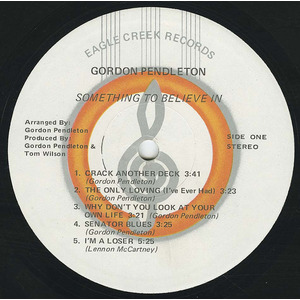
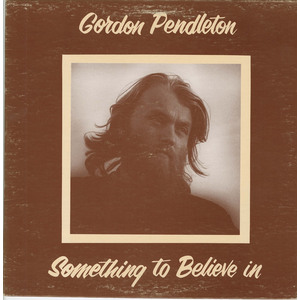
Pendleton's 1977 album Something to Believe In was recorded and mixed at Eagle Creek Studios in Rosetown, Saskatchewan, and issued on the Eagle Creek label as ECRA 1. Produced by Pendleton and Tom Wilson, it brought together musicians including Al Vance, Gerry Bowers, Greg DeLaRonde, Scott Thayer, Ross Campbell, Mike Devlin, Rod Salloum, Bill Higbee, Dave Tupper, Keith Bartlett and Sheldon Corbett. Sharon Bowyer and Lorraine Hirst were among the vocal contributors, with Bowyer taking the featured vocal solo on the title song. Pendleton handled vocals, acoustic guitar and bongos and arranged the album himself.
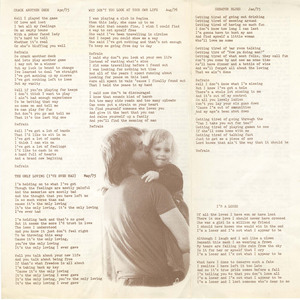
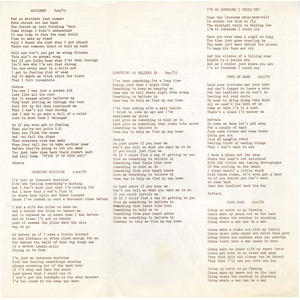
Most of the record is his own writing. Relationships, insecurity, drinking, work, family, music and faith move through the songs with an informal directness. Two covers sit among them, a slow rural reading of the Beatles' 'I'm A Loser' and Hank Williams' 'I'm So Lonesome I Could Cry'. The spiritual themes in the title song and 'Farm Song' grew more prominent in his later writing, while 'Senator Blues', 'Insecure Musician' and 'Why Don't You Look At Your Own Life' stayed with everyday life and the experience of a working musician. Among friends Pendleton called the record “The Brown Album,” after its brown cover.
In 1982 The Gord Pendleton Band released Beggars Can Be Choosers on Newmark Records, NMR01, its songs including 'Oh My Jesus', 'Brother', 'Eternity Song', 'Bossa Gospel', 'Trinity' and 'I Can't Stand Up Alone'. The same year Pendleton coordinated Century Saskatoon 1882-1982, the city's centennial album, and the band contributed 'Bossa Gospel' and 'Change' to it. Gordie Brandt & Friends also had two songs on the record.
In 1989 he entered C95-FM's annual Cityworks competition in Saskatoon, and 'Waitin' on the Lord' was chosen as one of the winners. The recording appeared on Cityworks '89 / Z99 Streetrock '89, the joint Saskatoon-Regina compilation pairing C95 selections with material chosen by Z99 in Regina.
For 'Waitin' on the Lord', Pendleton sang lead and supplied background vocals, Dwayne Harder played keyboards, Jeff Wilkie played drums, Greg Derkson played guitar, and Faith Gaertner and Tom Zimmerman joined Pendleton on background vocals. Pendleton wrote and produced the track, with publishing credited once again to Beaver Mountain Music.
By the mid-1990s Beaver Mountain Music Studios was working as a studio, with Pendleton engineering and producing. One project brought in his sons Judah and Dallas Pendleton as The Acoustic Horror Club, whose track on the 1996 compilation Home Grown Volume 2: Saskatoon's Hottest New Talent he engineered himself.
Pendleton later settled in British Columbia and again became known as Gordie Budd. After time on Salt Spring Island, he opened Gordie's Music on Pandora Avenue in Victoria in 1998, selling records and instruments and handling repairs, and kept producing, recording and playing around the city.
His later work included the folk and roots group The Chattering Class, whose 2003 self-titled album appeared on Beaver Mountain with Gordie Pendleton credited among the composers and as producer. The group also included Graeme Card, which put Pendleton back in the Saskatchewan circle around Humphrey and the Dumptrucks and Saskatoon's old folk and coffee-house scene. He later performed with Victoria-area musicians including BackBeat and helped other songwriters develop and record their material.
Family accounts describe a catalogue much larger than what is documented, including numerous singles and at least a dozen albums.
Gordon Wallace Budd died in Victoria on December 27, 2023, aged 72.
-Robert Williston
Gallery
Images
6 images
Gordon Pendleton - Something To Believe In BACK
Gordon Pendleton-Something to Believe In LABEL 02
Gordon Pendleton-Something to Believe In LABEL 01
Gordon Pendleton-Something to Believe In INSERT SIDE 02
Gordon Pendleton-Something to Believe In INSERT SIDE 01
Something To Believe In
Media
Videos
1 video
Credits
Musicians
Gordon Pendleton: vocals, acoustic guitar, bongos
Al Vance: lead acoustic guitar
Gerry Bowers: electric lead guitar
Scot Thayer: bass
Greg DeLaRonde: bass
Ross Campbell: fiddle, flute
Mike Devlin: pedal steel
Rod Salloum: piano, Hammond organ
Bill Higbee: drums
Dave Tupper: drums
Keith Bartlett: violin, fiddle, electric Gretsch guitar
Sheldon Corbett: tenor saxophone
Sharon Bowyer: vocal solo on ‘Something to Believe In’
Rusty the Rooster: rooster on ‘Farm Song’
The Pendletones
Sharon Bowyer: backing vocals
Lorraine Hirst: backing vocals
Keith Bartlett: backing vocals
Greg DeLaRonde: backing vocals
The Pendletones appear on ‘Insecure Musician’ and ‘Something to Believe In’.
Songwriting
‘Crack Another Deck’ written by Gordon Pendleton.
‘The Only Loving (I’ve Ever Had)’ written by Gordon Pendleton.
‘Why Don’t You Look at Your Own Life’ written by Gordon Pendleton.
‘Senator Blues’ written by Gordon Pendleton.
‘I’m a Loser’ written by John Lennon and Paul McCartney.
‘Accident’ written by Gordon Pendleton.
‘Insecure Musician’ written by Gordon Pendleton.
‘Something to Believe In’ written by Gordon Pendleton.
‘I’m So Lonesome I Could Cry’ written by Hank Williams.
‘Come on Babe’ written by Gordon Pendleton.
‘Farm Song’ written by Gordon Pendleton.
Production
Arranged by Gordon Pendleton
Produced by Gordon Pendleton and Tom Wilson
Engineered by Tom Wilson and Jim Robertson
Recorded and mixed at Eagle Creek Studios, Rosetown, Saskatchewan
Mastered at I.R.C., Vancouver, British Columbia
Pre-production by George Tennant and Neil Strayer
Publishing
All Gordon Pendleton compositions published by Beaver Mtn. Music, © 1977
‘I’m a Loser’ published by MacLen Music
‘I’m So Lonesome I Could Cry’ published by Fred Rose Publishing
Artwork
Photography by Rob Fast
Insert photography by Ross Breadner
Art direction by Dennis Wolberg
Special Thanks
Tom Wilson, Jim Robertson, Ralph Johnston, Neil Bauld, Alan Bauld, Mabel Pendleton
Thanks to all the players for helping make this a reality.
Dedication
This album is dedicated with love to Heather Pendleton.
No Comments