Insight
Don Norman is an Ottawa-born Canadian singer, guitarist, and songwriter whose career stretches back to the very beginnings of Canada’s modern rock and pop era. Born and raised in Ottawa, Norman began playing guitar at age 14 and was performing publicly by 15, entering professional studios while still a teenager.
“I started playing the guitar at age fourteen, and by fifteen I could play a few chords,” Norman recalled onstage at the Amherst Island Folk Festival in 2009. “The first group I played in was called The Elgins… we had three guitar players and an upright bass player.” That early group included friends Dave Milliken and Bruce Cockburn, underscoring how tightly knit Ottawa’s early-1960s music scene already was. Norman later emphasized that meeting Milliken in the summer of 1959 was a turning point in his life, noting that the two bonded immediately over their guitars and formed a lifelong friendship rooted in music.
By the early 1960s, Norman had moved rapidly from local bands into the professional circuit. “The first time I was in a professional recording studio was 1961, when I was sixteen years old,” he later noted. According to Norman, he was “born with a very good singing voice” and had developed the ability to closely mimic popular vocalists—an important skill at the time, when teenage audiences wanted live bands to sound like the records they heard on the radio. His growing reputation as a powerful vocalist soon led to his recruitment as lead singer for The Esquires, one of the most important Canadian pop groups of the decade.
The Esquires were signed to Capitol Records in early 1963 with Bob Harrington as lead vocalist, and Norman was asked to replace Harrington in the early fall of that year. With Norman fronting the band, The Esquires evolved into a vocal-driven act with strong harmonies and British-influenced pop sensibilities. Gary Comeau, co-founder of The Esquires, later wrote: “By then the band had a new lead singer, Don Norman. Don sounded like Cliff Richard and it turned into a vocal band with harmonies. That led to the group’s biggest hit, ‘So Many Other Boys.’” During this period, The Esquires became the first Canadian rock band signed to a major label (Capitol Records), won the RPM Award (the forerunner to the Juno Awards), and opened for artists including The Rolling Stones, The Beach Boys, The Dave Clark Five, and Roy Orbison.
Norman departed The Esquires in the mid-1960s following internal tensions and a disputed attempt to continue under the Esquires name. Recalling the moment years later, he said, “I was kinda ambushed by the band one night at a rehearsal session… they just told me I was no longer part of the plan.” Relinquishing any claim to the name, he formed Don Norman & The Other Four, assembling a new Ottawa-based lineup that reflected a heavier, rawer garage-rock sound. The group included former Esquires guitarist Gary Comeau, along with Brian Dewhurst (drums), Bill Hellman (bass), John Matthews (saxophone, vocals), and Ron Greene (organ).
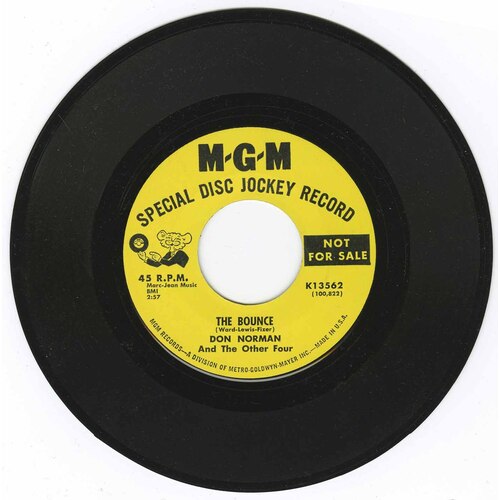
Between 1966 and 1967, Don Norman & The Other Four released a small but now highly regarded run of singles that captured the band’s rapid evolution. Their first release was “All Of My Life” b/w “The Bounce,” issued on Barry Records and briefly picked up for U.S. distribution by MGM. According to Norman, the session also produced unreleased material, including an unheard Capitol-era recording of “The Bounce” by The Esquires, as well as rare stereo mixes of “All Of My Life” and “Low Man,” few of which have ever circulated publicly. Reporting on the band in July 1966, RPM Music Weekly noted that “‘All Of My Life’, and that’s just about what Don Norman and The Other Four put into their first recording session,” adding that the group had already become “one of the most requested acts” on the Leonard Alexander Booking Agency roster.
Dissatisfied with the record’s promotion, the band and manager John Pozer turned to the newly formed Sir John A label, resulting in the release of “Low Man” b/w “Mustang Sally” in late 1966. Written by Norman and reflecting his personal frustrations at the time, “Low Man” introduced a heavier, fuzz-driven sound that would come to define the group’s legacy. Norman later described the song plainly: “‘Low Man’ was autobiographical — it reflected exactly where I was at in 1966.” The follow-up single, “Your Place in My Heart” b/w “Trae Hymn I (eca/lp-Ruoy),” pushed experimentation further, famously presenting the A-side played entirely backwards on the flip. In live performance, Norman’s vocal versatility was equally striking; he recalled that when the band covered Sonny & Cher’s “Baby Don’t Go,” he sang both vocal parts himself. Summing up the band’s impact at the time, RPM concluded: “Don Norman and The Other Four are a group to keep an eye on. They have that ‘tuff’ sound.” Pressed in extremely limited quantities, these records later came to be regarded as touchstones of Canadian garage rock, their impact far outweighing their modest original circulation.
Reflecting later on his long career, Norman described his place in Canadian music history with characteristic modesty: “I’m not very well known these days, but I am considered by some to be a pioneer of the Canadian music business.” He also noted that from his late teens through his forties, he possessed a vocal range of more than four octaves. Former bandmate Gary Comeau observed the irony of the group’s afterlife, noting that “‘All of My Life’ sold online in Denmark for $275 American… They consider the band the beginning of ‘punk’… They love early Canadian bands.” After the 1960s recording era, Norman continued performing, eventually settling in Kingston, Ontario, where he remained active as a respected songwriter and interpreter of American popular standards. Additional biographical details were confirmed in correspondence with Don Norman on December 17, 2025.
Seen in retrospect, Don Norman’s career forms a crucial bridge between Canada’s earliest rock-and-roll infrastructure and the country’s later singer-songwriter tradition — a frontman at the birth of Canadian pop, and a working musician who never stopped playing.
-Robert Williston
Don Norman: vocals
Gary Comeau: lead guitar, vocals
Bill Hellman: bass
Ron Greene: organ
Brian Dewhurst: drums
John Matthews: saxophone
Gallery
Images
2 images
Don Norman & the Other Four - The Bounce b/w All Of My Life

The Bounce b/w All Of My Life
Media
Videos
0 videos
No videos available for this title.
Credits
In Transit
No Comments