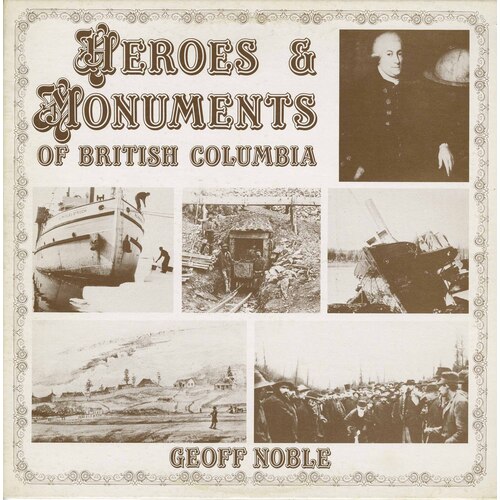
Album / Title
Heroes & Monuments of British Columbia
By: Geoff Noble
Origin: Yorkshire, England - Vancouver, British Columbia, 🇨🇦
Insight
Geoff Noble was a Yorkshire-born singer-songwriter, musician, storyteller, and broadcaster whose career bridged British folk traditions and the history, culture, and landscapes of his adopted Canadian home. Born in Yorkshire, England (date not officially published), he began performing in local folk clubs and cabarets at age fifteen, steeping himself in traditional British repertoire, dance, and humour. Before emigrating he became an accomplished Morris dancer in the Bucknell (Cotswold) tradition — a discipline and rhythmic sensibility that would stay with him for life.
Noble moved to Vancouver in 1978, quickly becoming a familiar presence on the West Coast folk circuit. He developed a particular affinity for the province’s past — the explorers, trading routes, vessels, communities, and characters that shaped British Columbia — and gradually built a songbook rooted almost entirely in regional history. He became the resident entertainer at the Vancouver Maritime Museum, turning archival stories into accessible, melodic narratives. His album Heroes and Monuments of British Columbia captured this fascination: a collection of songs about Captain Vancouver, the St. Roch, Fort Langley, the Cariboo Gold Rush, and other defining episodes in B.C. history. On the recording, Noble handled vocals and a range of traditional instruments including guitar, whistle, bodhrán, psaltery, and Jew’s harp, accompanied by Reuben Gurr and Barry Hall.
Although best known for his historical material, Noble’s repertoire extended far beyond B.C. He remained a gifted interpreter of English folk songs, wrote contemporary material reflecting his surroundings, and contributed original work to a federal government cultural project in the 1980s. His warm voice, clarity of narrative, and gentle stage presence made him a favourite at community events, festivals, museums, and cultural organizations across the province.
In the late 1990s his career expanded dramatically when he became the on-camera host and principal songwriter for SteepleChasing, a national television series created with producer Susan Shillingford and broadcast on VisionTV from 1998 to 2003. Over five seasons and 58 episodes filmed throughout the Maritimes, Newfoundland, and Labrador, Noble wrote and performed songs tailored to the themes and stories of each community the series visited. The program blended documentary, travelogue, and music — and Noble’s thoughtful, often quickly composed songs became its emotional backbone.
The partnership led to a larger creative undertaking: Island Lad, an original musical developed by Noble and Shillingford. Conceived in Nova Scotia, Noble contributed an entire suite of new material for the production, continuing his practice of grounding songs in place, memory, and community. Efforts to stage Island Lad publicly continued into the 2020s.
Geoff Noble passed away in February 2025, surrounded by family. Notices circulated among friends, colleagues, and Maritime arts communities in the weeks that followed. His loss was widely felt: remembered for his generous humour, deep curiosity, and the warmth of his singing voice — a presence that became synonymous with the very act of storytelling through song.
His work remains preserved in recordings, television archives, and in the memories of audiences he touched from Vancouver to Newfoundland. Whether chronicling the St. Roch on its Arctic passage, singing in a Nova Scotian chapel for SteepleChasing, or performing at the Maritime Museum, Geoff Noble brought history to life with a compassion and clarity that made him one of Canada’s most quietly enduring folk voices.
-Robert Williston
Singer songwriter and guitar player Geoff Noble performs songs about British Columbia history.
Geoff Noble comes from Yorkshire, England, where he began playing in folk clubs and cabarets at the age of 15. He moved to Vancouver in 1978 and, among other accomplishments, is the resident entertainer at the Maritime Museum. Fascinated by the history of his adopted home, Geoff began writing songs of people, places and events in the history of B.C. In April he released an album entitled Heroes and Monuments of British Columbia. In addition to his historical material and his more contemporary songs, Geoff is a fine interpreter of traditional British music and is also an experienced Morris dancer in the Bucknell (Cotswold) tradition. He is currently using his original material on a project for the federal government.
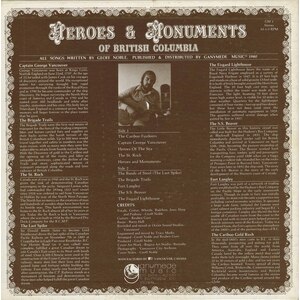
Captain George Vancouver
George Vancouver was born at Kings Lynn, Norfolk, England on June 22nd, 1757. At the age of 15 he sailed with James Cook on his voyages of discovery where he acquired his exceptional talent for seamanship and charting. Rising rapidly through the ranks of the British Royal Navy and in 1790 he became commander of the ship Discovery. He began his survey of the Northwest coast of America and named the river and the island after himself. He honored many of his men, royalty, statesmen and his crew. His lively list at Prestbury Island in a common prayer book, his men are lingered forever in the place names he gave.
The Brigade Trails
The Brigade Trails were the first real means of transport for the future of the trading companies. Men hauled across sacred furs and supplies on narrow ridges and through the slippery mountains. British Columbia as we know it now was woven by travel together and safety in numbers was the price of the business. When the army men marched with the discovery of the gold rush and finally with the opening up of the remote lakes and rivers, the pioneers who gave their surnames to the valleys, mountains, rivers and lakes all transported goods by Brigade Trails and later railways and roads.
The St. Roch
Canada was at war in 1940 and the St. Roch was given the mission of patrolling the Northern Arctic Sea. With an indomitable spirit, Canadian commander Henry Larsen and the small vessel moved onwards against the odds. In 1942 the small wooden ship traveled from Vancouver through the Northwest Passage. In 1950 the ship was retired and is now preserved at Vancouver’s Maritime Museum.
The Last Spike
Sir Donald Smith (later to become Lord Strathcona) drove the last spike at the Canadian Pacific Railway to complete the railroad across Canada. The spike was driven at Craigellachie, Eagle Pass, Revelstoke BC, November 7, 1885. It was a symbolic act as the railway enabled settlement and commercial travel. Crowds of school children in Revelstoke came to witness the event and the narrow gauge railway formed part of the transcontinental railway. Many of the names survive in towns and stations today. It was the spirit and the enterprise of the men who helped fulfill the great Canadian dream.
The Fisgard Lighthouse
The Fisgard Lighthouse bears the name of the Royal Navy Frigate employed in a survey of Esquimalt Harbour in 1847. It is 42 feet high and stands on a base of solid granite 11 feet thick. Built of brick brought around the Horn from England, the lighthouse cost over $19,000. The lantern within the tower was made at Smeaton’s Works in England, weighing 7000 lbs. and finally hoisted into place. For 100 years it warned of danger and bad weather for ships in the Juan de Fuca Strait. The lighthouse was decommissioned in 1957 and now serves as a national historic site.
The S.S. Beaver
The little Beaver as this historic vessel was called, was built for the Hudson’s Bay Company at Blackwall, London in 1835. This ship arrived at Fort Vancouver (near present-day British Columbia) and departed Vancouver on April 18th, 1836, becoming the first steamboat on the Pacific Coast. The Beaver was an agent of transformation in British Columbia and for passenger services and goods movement. The ship was an important link to the colonies. After a long and busy career the Beaver struck a rock in the Narrows near Stanley Park and was wrecked in 1888.
Fort Langley
Fort Langley was part of a network of trading posts established by the Hudson’s Bay Company in the early nineteenth century. This fort, located on the banks of the Fraser River, served as a vital trading post between settlers, First Nations, and fur traders. It helped anchor the economic development of British Columbia’s interior and was a symbol of early settlement. Fort Langley remains a cherished historic site, where reenactments and education programs bring the region’s vibrant past to life.
The Cariboo Gold Rush
The Cariboo Gold Rush brought BC into the fold of Confederation. News of the discovery of gold along the Fraser River in 1858 brought thousands of hopeful miners to the region. The gold fields near Barkerville, Williams Creek, and surrounding areas were famous for their rich deposits. Towns like Barkerville, Yale, Camerontown and Quesnel became boomtowns and British Columbia’s population swelled. Prospectors from around the globe flocked to the Cariboo region and around the world.
Geoff Noble: vocals, guitar, whistle, bodhrán, Jews harp, psaltery
Reuben Gurr: guitars
Barry Hall: banjo
Produced by Geoff Noble
Arranged by Geoff Noble and Reuben Gurr
Engineered and mixed by Tracy Marks
Recorded and mixed at Ocean Sound Studios, Vancouver, British Columbia
Cover artwork by Regina Art Studio, Burnaby, British Columbia
Photographs by Vancouver City Archives
Cover notes by Geoff Noble
Gallery
Images
2 images
Geoff Noble - Heroes & Monuments of British Columbia
Heroes & Monuments of British Columbia
Media
Videos
0 videos
No videos available for this title.
Credits
In Transit
No Comments