Album / Title
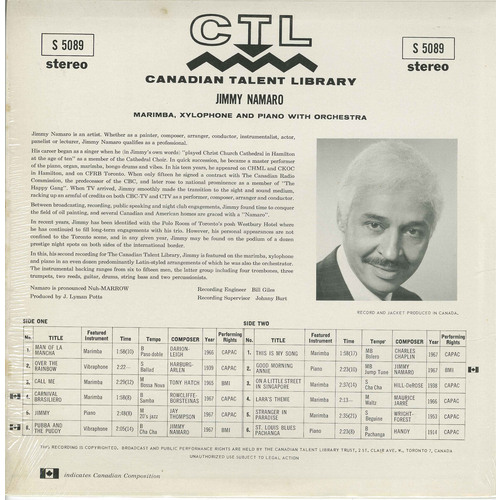
Marimba, Xylophone and Piano with Orchestra
By: Jimmy Namaro
Origin: Columbus, Michigan, 🇺🇸 (or La Rosita, Mexico) → Hamilton, Ontario → Richmond, British Columbia, 🇨🇦
Insight
Jimmy (James) Namaro was one of the most distinctive and versatile figures in Canadian popular music, a musician whose career bridged radio’s golden age, the nightclub era, television variety, jazz, Latin music, and commercial recording. A master of mallet instruments at a time when vibraphone and marimba were still novelties in popular music, Namaro built a reputation not through virtuoso showmanship alone, but through adaptability, taste, and an unerring sense of audience.
Born on 14 April 1913, Namaro’s place of birth is variously cited as La Rosita, Mexico or Columbus, Michigan, reflecting a family history that crossed borders early. In 1921, his family settled in Hamilton, Ontario, where his musical life took shape. He studied piano with Sid Walling and Eric Lewis, grounding himself in harmony and structure before gravitating toward percussion and mallet instruments. By his teens, Namaro was already active on radio, appearing on CHML Hamilton, CFRB Toronto, and eventually the CBC, first as a marimba player and later as a versatile accompanist and arranger.
In 1933, while still in his early twenties, Namaro served as assistant conductor of a marimba band at the Chicago World’s Fair, an early indication of both his technical command and his comfort in large-scale productions. From that point forward, his career followed two parallel paths: as a club musician and bandleader, and as a broadcast professional.
From 1943 to 1959, Namaro was a central musical presence on CBC radio’s immensely popular The Happy Gang, a program that brought him into homes across the country and established him as a familiar and trusted musical voice. He adapted seamlessly as broadcasting moved from radio to television, becoming a regular contributor to CBC-TV and CTV productions as a performer, composer, arranger, and conductor. His work during this period reflects a musician deeply attuned to the demands of live broadcasting: clarity, economy, and stylistic flexibility.
Parallel to his broadcast career, Namaro became a fixture of the nightclub circuit. Nowhere was this more evident than at Toronto’s Westbury Hotel, where he led trios and ensembles in the Polo Lounge for extended engagements beginning in the 1950s. Liner notes from albums recorded at the Westbury reveal a musician who moved fluidly between piano, vibraphone, and marimba, shaping programs that balanced standards, original compositions, Latin material, and contemporary jazz. These were not casual lounge gigs but tightly organized musical environments, often featuring the same core personnel over many years, reinforcing Namaro’s preference for continuity and ensemble cohesion.
Recording followed naturally. Beginning in the late 1950s, Namaro released a steady stream of LPs for Sparton, RCA Victor / Camden, Quality Records, and the Canadian Talent Library. Albums such as With Mallets a Four Thought, Plays Middle-Road Jazz at the Westbury, Marimba, Xylophone and Piano with Orchestra, and We Gotta Get It All Together document an artist in constant motion — shifting instrumentation, expanding ensembles, and experimenting with Latin rhythms, orchestral textures, and contemporary arrangements. His CTL recordings, in particular, show him operating at a high professional level, orchestrating for strings and brass while maintaining the rhythmic identity of a small group leader.
Namaro was also a prolific composer and arranger, writing original material for his albums, countless commercial jingles, and music for CBC radio and television drama, including the series Seaway. His compositional voice favored melody and rhythm over abstraction, a trait echoed in his own liner notes, where he repeatedly emphasized accessibility, groove, and emotional clarity. Beyond music, Namaro was an accomplished painter, working in a primitive style and exhibiting his artwork publicly — another expression of the same instinct to communicate directly rather than intellectually.
In the 1970s, Namaro relocated to the United States, entering a new phase of his career as music director for Frankie Laine, a role he held from approximately 1978 to 1993. Touring extensively across Canada, the United States, and the United Kingdom, Namaro applied decades of experience to large-scale touring productions, once again demonstrating his adaptability and professionalism. In 1987, he moved to Richmond, British Columbia, where he continued composing and collaborating with Laine into his later years.
Jimmy Namaro died in Richmond on 25 April 1998, closing a career that spanned more than six decades. What distinguishes his legacy is not a single hit record or defining moment, but a body of work that reflects the lived reality of a working musician in Canada — one who navigated radio, television, clubs, studios, and touring with equal confidence, and who helped establish mallet instruments as a viable and expressive voice in Canadian popular and jazz music.
-Robert Williston
Musicians
Jimmy Namaro: marimba, xylophone, piano
Orchestra: uncredited (six to fifteen musicians including trombones, trumpets, reeds, guitar, drums, string bass, percussion)
Production
Produced by J. Lyman Potts
Engineered by Bill Giles
Recording supervisor Johnny Burt
Liner notes
Jimmy Namaro is an artist. Whether as a painter, composer, arranger, conductor, instrumentalist, actor, panelist or lecturer, Jimmy Namaro qualifies as a professional.
His career began as a singer when he (in Jimmy’s own words) “played Christ Church Cathedral in Hamilton at the age of ten” as a member of the Cathedral Choir. In quick succession, he became a master performer of the piano, organ, marimba, bongo drums and vibes. In his teen years, he appeared on CHML and CKOC in Hamilton, and on CFRB Toronto. When only fifteen he signed a contract with The Canadian Radio Commission, the predecessor of the CBC, and later rose to national prominence as a member of “The Happy Gang”. When TV arrived, Jimmy smoothly made the transition to the sight and sound medium, racking up an armful of credits on both CBC-TV and CTV as a performer, composer, arranger and conductor.
Between broadcasting, recording, public speaking and night club engagements, Jimmy found time to conquer the field of oil painting, and several Canadian and American homes are graced with a “Namaro”.
In recent years, Jimmy has been identified with the Polo Room of Toronto’s posh Westbury Hotel where he has continued to fill long-term engagements with his trio. However, his personal appearances are not confined to the Toronto scene, and in any given year, Jimmy may be found on the podium of a dozen prestige night spots on both sides of the international border.
In this, his second recording for The Canadian Talent Library, Jimmy is featured on the marimba, xylophone and piano in an even dozen predominantly Latin-styled arrangements of which he was also the orchestrator. The instrumental backing ranges from six to fifteen men, the latter group including four trombones, three trumpets, two reeds, guitar, drums, string bass and two percussionists.
Namaro is pronounced Nuh-MARROW
Gallery
Images
2 images
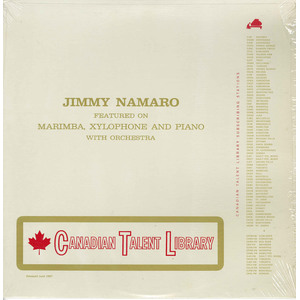
Jimmy Namaro - Marimba, Xylophone and Piano with Orchestra CTL 5089 BACK
Marimba, Xylophone and Piano with Orchestra
Media
Videos
0 videos
No videos available for this title.
Credits
In Transit
No Comments