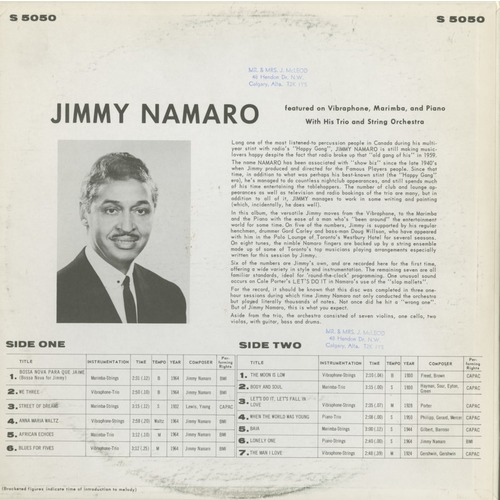
Album / Title
featured on Vibraphone, Marimba, and Piano With his Trio and String Orchestra
By: Jimmy Namaro
Origin: Columbus, Michigan, 🇺🇸 (or La Rosita, Mexico) → Hamilton, Ontario → Richmond, British Columbia, 🇨🇦
Insight
Jimmy (James) Namaro was one of the most distinctive and versatile figures in Canadian popular music, a musician whose career bridged radio’s golden age, the nightclub era, television variety, jazz, Latin music, and commercial recording. A master of mallet instruments at a time when vibraphone and marimba were still novelties in popular music, Namaro built a reputation not through virtuoso showmanship alone, but through adaptability, taste, and an unerring sense of audience.
Born on 14 April 1913, Namaro’s place of birth is variously cited as La Rosita, Mexico or Columbus, Michigan, reflecting a family history that crossed borders early. In 1921, his family settled in Hamilton, Ontario, where his musical life took shape. He studied piano with Sid Walling and Eric Lewis, grounding himself in harmony and structure before gravitating toward percussion and mallet instruments. By his teens, Namaro was already active on radio, appearing on CHML Hamilton, CFRB Toronto, and eventually the CBC, first as a marimba player and later as a versatile accompanist and arranger.
In 1933, while still in his early twenties, Namaro served as assistant conductor of a marimba band at the Chicago World’s Fair, an early indication of both his technical command and his comfort in large-scale productions. From that point forward, his career followed two parallel paths: as a club musician and bandleader, and as a broadcast professional.
From 1943 to 1959, Namaro was a central musical presence on CBC radio’s immensely popular The Happy Gang, a program that brought him into homes across the country and established him as a familiar and trusted musical voice. He adapted seamlessly as broadcasting moved from radio to television, becoming a regular contributor to CBC-TV and CTV productions as a performer, composer, arranger, and conductor. His work during this period reflects a musician deeply attuned to the demands of live broadcasting: clarity, economy, and stylistic flexibility.
Parallel to his broadcast career, Namaro became a fixture of the nightclub circuit. Nowhere was this more evident than at Toronto’s Westbury Hotel, where he led trios and ensembles in the Polo Lounge for extended engagements beginning in the 1950s. Liner notes from albums recorded at the Westbury reveal a musician who moved fluidly between piano, vibraphone, and marimba, shaping programs that balanced standards, original compositions, Latin material, and contemporary jazz. These were not casual lounge gigs but tightly organized musical environments, often featuring the same core personnel over many years, reinforcing Namaro’s preference for continuity and ensemble cohesion.
Recording followed naturally. Beginning in the late 1950s, Namaro released a steady stream of LPs for Sparton, RCA Victor / Camden, Quality Records, and the Canadian Talent Library. Albums such as With Mallets a Four Thought, Plays Middle-Road Jazz at the Westbury, Marimba, Xylophone and Piano with Orchestra, and We Gotta Get It All Together document an artist in constant motion — shifting instrumentation, expanding ensembles, and experimenting with Latin rhythms, orchestral textures, and contemporary arrangements. His CTL recordings, in particular, show him operating at a high professional level, orchestrating for strings and brass while maintaining the rhythmic identity of a small group leader.
Namaro was also a prolific composer and arranger, writing original material for his albums, countless commercial jingles, and music for CBC radio and television drama, including the series Seaway. His compositional voice favored melody and rhythm over abstraction, a trait echoed in his own liner notes, where he repeatedly emphasized accessibility, groove, and emotional clarity. Beyond music, Namaro was an accomplished painter, working in a primitive style and exhibiting his artwork publicly — another expression of the same instinct to communicate directly rather than intellectually.
In the 1970s, Namaro relocated to the United States, entering a new phase of his career as music director for Frankie Laine, a role he held from approximately 1978 to 1993. Touring extensively across Canada, the United States, and the United Kingdom, Namaro applied decades of experience to large-scale touring productions, once again demonstrating his adaptability and professionalism. In 1987, he moved to Richmond, British Columbia, where he continued composing and collaborating with Laine into his later years.
Jimmy Namaro died in Richmond on 25 April 1998, closing a career that spanned more than six decades. What distinguishes his legacy is not a single hit record or defining moment, but a body of work that reflects the lived reality of a working musician in Canada — one who navigated radio, television, clubs, studios, and touring with equal confidence, and who helped establish mallet instruments as a viable and expressive voice in Canadian popular and jazz music.
-Robert Williston
Musicians
Jimmy Namaro: vibraphone, marimba, piano
Gord Carley: drums
Doug Wilson: bass
String orchestra: uncredited (seven violins, one cello, two violas)
Songwriting
‘Bossa Nova Pra Que Jaime (Bossa Nova for Jimmy)’ written by Jimmy Namaro
‘We Three’ written by Jimmy Namaro
‘Street of Dreams’ written by Lewis and Young
‘Anna Maria Waltz’ written by Jimmy Namaro
‘African Echoes’ written by Jimmy Namaro
‘Blues for Fives’ written by Jimmy Namaro
‘The Moon Is Low’ written by Freed and Brown
‘Body and Soul’ written by Heyman, Sour, Eyton and Green
‘Let’s Do It, Let’s Fall in Love’ written by Cole Porter
‘When the World Was Young’ written by Phillips, Gerard and Mercer
‘Bali’ written by Gilbert and Barrasso
‘Lonely One’ written by Jimmy Namaro
‘The Man I Love’ written by George Gershwin and Ira Gershwin
Production
Produced by Canadian Talent Library Trust
Arranged and conducted by Jimmy Namaro
Notes
Performed by Jimmy Namaro with his trio and string orchestra.
Record completed in three one-hour sessions.
Broadcast and public performance rights held by the Canadian Talent Library Trust.
Liner notes
Long one of the most listened-to percussion people in Canada during his multi-year stint with radio’s “Happy Gang”, JIMMY NAMARO is still making music-lovers happy despite the fact that radio broke up that “old gang of his” in 1959. The name NAMARO has been associated with “show biz” since the late 1940’s when Jimmy produced and directed for the Famous Players people. Since that time, in addition to what was perhaps his best-known stint (the “Happy Gang” era), he’s emerged as a versatile lighthearted approacher, and still spends much of his time entertaining the cabarets. The number of club and lounge appearances is well into four figures and the booking of the trio is still heavy and putting him in demand as a lively and engaging personality.
In this album, the versatile Jimmy moves from the Vibraphone, to the Marimba and then to Piano with the ease of a man who’s “been around” the entertainment world for some time. On five of the numbers, Jimmy is supported by his regular henchmen, drummer Gord Carley and bassman Doug Wilson, who have appeared with him in the Polo Lounge of Toronto’s Westbury Hotel for several seasons. On eight tunes, the nimble Namaro fingers are backed up by a string ensemble made up of some of Toronto’s top musicians playing arrangements especially written for this session by Jimmy.
Six of the numbers are Jimmy’s own, and are recorded here for the first time, offering a wide variety in style and instrumentation. The remaining seven are all familiar standards, ideal for “round-the-clock” programming. One unusual sound occurs on Cole Porter’s “Let’s Do It” in Namaro’s use of the slap mallet.
For the record, it should be known that this disc was completed in three one-hour sessions during which time Jimmy Namaro not only conducted the orchestra but played literally thousands of notes. Not one odd note did he hit a “wrong one”. But of Jimmy Namaro, this is what you expect.
Aside from the trio, the orchestra consisted of seven violins, one cello, two violas, with guitar, bass and drums.
Gallery
Images
2 images
Namaro, Jimmy - featured on Vibraphone, Marimba, and Piano With his Trio and String Orchestra
featured on Vibraphone, Marimba, and Piano With his Trio and String Orchestra
Media
Videos
0 videos
No videos available for this title.
Credits
In Transit
No Comments