Insight
Muzion are one of the foundational groups in Canadian and Québec hip-hop, emerging in the mid-1990s at a moment when francophone rap was still fighting for cultural legitimacy beyond underground spaces. Formed in Montréal in 1996, the trio—Jenny Salgado (also known as J.Kyll), Imposs, and Dramatik—developed a sound and identity rooted in the lived realities of Montréal’s Haitian-diaspora neighbourhoods, particularly Saint-Michel and Parc-Extension. Their music blended French rap with Haitian Creole and English, reflecting the multilingual, multicultural fabric of the city while articulating a perspective that was both local and globally informed.
From the outset, Muzion distinguished themselves by treating hip-hop as authored, intentional music rather than novelty or imitation. Their lyrics addressed race, class, identity, media perception, and systemic exclusion with a clarity that was rare in Canadian rap at the time. Jenny Salgado’s role within the group was especially significant: beyond her presence as an MC, she functioned as a founding organizer and musical architect, shaping arrangements and direction during a period when women were rarely afforded creative authority in hip-hop production spaces. This internal structure contributed to Muzion’s coherence and seriousness of purpose.
Their debut album, Mentalité moune morne… (ils n’ont pas compris), released in 1999, marked a turning point for Québec rap. Recorded primarily at Don Valley Sounds in Markham and issued through Attic/LMR, the album arrived fully formed, presenting a confident and uncompromising vision of what Montréal hip-hop could be. Its tone was dense and reflective, pairing street-level reportage with broader social critique, and its linguistic code-switching underscored the group’s refusal to simplify their identity for mainstream consumption. Widely regarded as a landmark release, the album earned Muzion the Félix Award for Hip-Hop Album of the Year and later came to be recognized as a canonical work within Canadian hip-hop history, reinforced by anniversary reissues and continued critical reassessment.
Muzion built on this momentum with their second album, J’rêvolutionne, released in 2002. While maintaining the political urgency and community focus of their debut, the album expanded the group’s sonic palette and sharpened their revolutionary rhetoric. The record again received the Félix Award for Hip-Hop Album of the Year, confirming Muzion not as a one-off breakthrough act but as sustained leaders within the genre. Together, the two albums defined what is often considered the group’s core recorded legacy.
Beyond recordings, Muzion played a crucial role in elevating Québec hip-hop to national and international visibility. They toured extensively, including performances in France, where their work resonated within francophone rap circles connected to groups such as Suprême NTM and the IV My People collective. High-profile collaborations—including work with Wyclef Jean and Corneille—further extended their reach while situating Canadian rap within a broader Black Atlantic cultural dialogue. At home, their success helped legitimize hip-hop within Québec’s cultural institutions, opening doors for subsequent generations of francophone and diasporic artists.
Although members later pursued individual paths, Muzion were never framed simply as a group that dissolved. Periodic reunions and performances reinforced their status as a collective bound by shared history and community responsibility rather than conventional career cycles. Their long-term significance was formally acknowledged when they were included among Canadian hip-hop trailblazers honored by Canada Post, positioning Muzion alongside figures such as Maestro Fresh Wes and Michie Mee in the national narrative of the genre.
Today, Muzion are widely regarded as architects of Montréal’s modern hip-hop identity. Their work stands as a statement of cultural self-definition—music that insisted on complexity, linguistic plurality, and political awareness at a time when Canadian rap was still expected to justify its existence. Within the history of Canadian music, Muzion occupy a central place as artists who did not merely participate in a scene, but helped build its foundation.
-Robert Williston
Musicians / Performers
Madlocks
Muzion
DJ Nykeldon
DJ Majestic
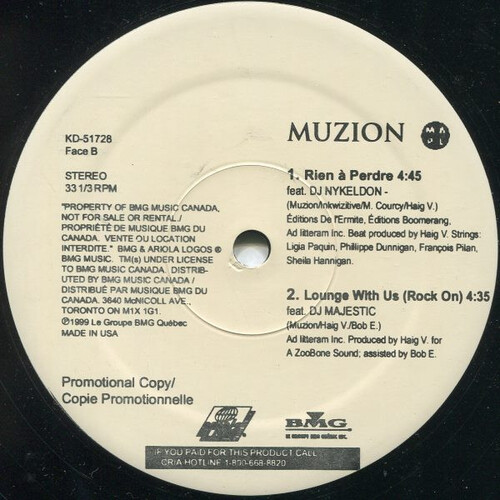
Strings on “Rien à Perdre”
Liga Paquin
Philippe Dunnigan
François Pilon
Sheila Hannigan
Songwriting
“Snake Eyes” written by C. Pinnock and K. Boateng
“Rien à Perdre” written by Muzion, Inkwizitive, M. Courcy, and Haig V.
“Lounge With Us (Rock On)” written by Muzion, Haig V., and Bob E.
Production
Produced by Quattro Cinco for 7 Bills Entertainment (“Snake Eyes”)
Additional programming by Madlocks for Woodworks Music (“Snake Eyes”)
Mixed by Troy “The Captain” Bynoe (“Snake Eyes”)
Beat produced by Haig V. (“Rien à Perdre”)
Produced by Haig V. for A ZooBone Sound (“Lounge With Us (Rock On)”)
Assisted by Bob E. (“Lounge With Us (Rock On)”)
Publishing
Éditions De l’Ermite
Éditions Boomerang
Ad Litteram Inc.
Notes
Promotional release issued by BMG Music Canada.
Not for sale or rental.
Madlocks appear on Side A; Muzion on Side B.
Side A contains album, radio, and instrumental mixes of “Snake Eyes.”
Gallery
Images
2 images
Muzion - Rien a Perdre (split with Madlocks)
Rien à perdre (split with Madlocks)
Media
Videos
2 videos
Credits
In Transit
No Comments