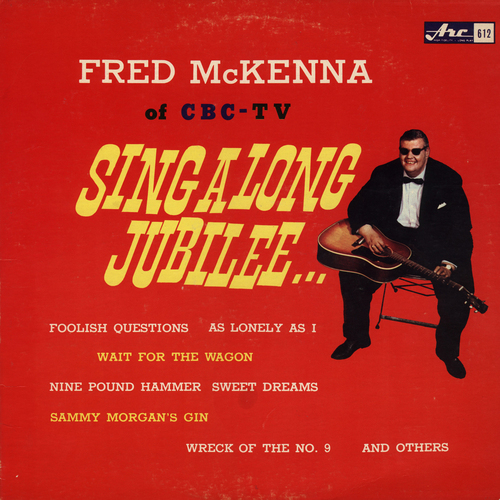
Album / Title
of CBC-TV Singalong Jubilee...
By: Fred McKenna
Origin: Fredericton, New Brunswick, 🇨🇦
Insight
Fred McKenna was a Fredericton-born Canadian country singer, guitarist, mandolinist, fiddler, banjo player, producer, and television musician whose career linked the Maritime country circuit, CBC television, and the national country recording industry. Born in 1934 and blind from birth, McKenna was raised in New Brunswick and educated at the Halifax School for the Blind, where he studied piano before developing the instrumental style that made him one of the most distinctive Canadian country musicians of his era.
McKenna received his first guitar as a child and learned to play it in the Hawaiian lap style, holding the instrument across his knees rather than in the standard position. He adapted that approach into a highly personal three-finger method, fingering chords in reverse and later applying the same inverted technique to mandolin, fiddle, and banjo. By his mid-teens he was already performing at dances and local concerts, and his first professional work came through the Capital Co-op Saturday Night Jamborees broadcast over CFNB.
His early career was shaped by the Maritime country network. New Brunswick country performer Kidd Baker heard McKenna and brought him on the road, giving him valuable professional experience through several years of touring, much of it in Ontario. Wider recognition followed in the late 1950s after McKenna appeared on WWVA’s Jamboree in Wheeling, West Virginia, where his performance attracted the attention of Don Messer. Messer brought him onto Don Messer’s Jubilee, and McKenna’s appearances in 1958 and 1959 drew strong viewer response.
When CBC launched Singalong Jubilee as a summer replacement for Don Messer’s program in 1961, McKenna became a permanent member of the cast. His presence soon became one of the show’s defining elements: a large, dark-glasses-wearing guitarist whose battered instrument, warm voice, and effortless musicianship made him instantly recognizable to viewers across Canada. He remained associated with Singalong Jubilee through its run and continued into its successor program, Countrytime, appearing before national audiences while maintaining his connections to the Maritime country tradition.
McKenna’s recording career extended across Rodeo, Banff, Arc, RCA Victor, RCA Camden, CBC Radio Canada, Quality, and other Canadian labels. His albums included early Maritime recordings with George Beck and The Maritime Playboys, Arc releases such as Fred McKenna of CBC-TV Singalong Jubilee, A Hank Williams Songbook, and Steel Rail Blues, and the 1972 RCA Camden album Plain Old Three Chord Hurtin’ Country Songs. The RCA Camden album placed McKenna in a polished Toronto studio setting with musicians including Georges Hébert, Garth Proude, Bob Lucier, Brian Barron, Jack Lilly, Paul Mason, and The Karen Oxley Singers, while also featuring several of McKenna’s own compositions.
Beyond his work as a performer, McKenna was active as a producer and studio figure. His production credits included work with Canadian country and folk artists, most notably Stompin’ Tom Connors, Harry Hibbs, Stevedore Steve, and Chris Scott. He also worked for Boot Records and became part of the broader Toronto and Hamilton country-production world of the early 1970s.
After his CBC years, McKenna continued on television through Harry Hibbs’ At The Caribou and later became musical director for The George Hamilton IV Show, produced in Hamilton, Ontario. He held that position until his death at his Toronto home on November 18, 1977, at the age of 43.
McKenna’s influence extended beyond his own recordings. Anne Murray later acknowledged him as the person who first introduced her to country music, dedicating one of her albums to his memory. In 2010, he was inducted into the Canadian Country Music Hall of Fame.
-Robert Williston
Gallery
Images
4 images
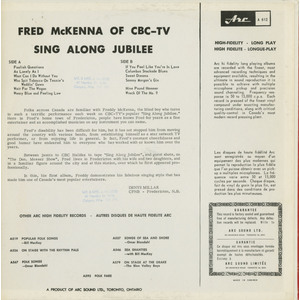
Fred Mckenna - of CBC-TV Singalong Jubilee... BACK
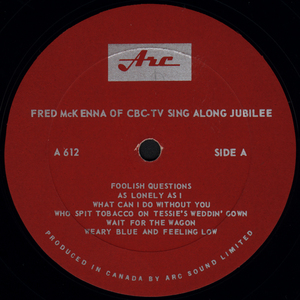
Fred McKenna - of CBC-TV Singalong Jubilee... Side 1
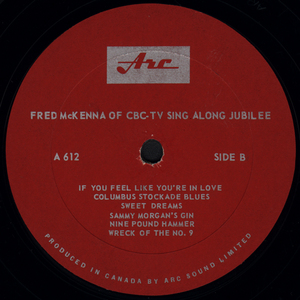
Fred McKenna - of CBC-TV Singalong Jubilee... Side 2
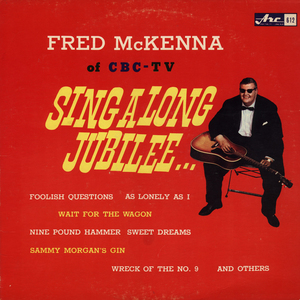
of CBC-TV Singalong Jubilee...
Media
Videos
0 videos
No videos available for this title.
Credits
Liner notes:
Folks across Canada are familiar with Freddy McKenna, the blind boy who turns in such a terrific performance each week on CBC-TV’s popular “Sing Along Jubilee.” Here in Fred’s home town of Fredericton, people have known Fred for years as a fine entertainer and an accomplished musician on any instrument you can name.
Fred’s disability has been difficult for him, but it has not stopped him from moving around the country with various bands, from establishing himself as a star network TV performer, or from enjoying life in general. In fact, Fred’s constant cheerfulness and good humor have endeared him to everyone who has worked with or known him over the years.
Between jaunts to CBC Halifax to tape “Sing Along Jubilee”, and guest shots, on “The Don. Messer Show”, Fred lives in Fredericton with his wife and two daughters, and is a familiar figure around the city and at this station, over which he first appeared professionally.
In this, his first album, Freddy demonstrates his fabulous singing style that has made him one of Canada’s most popular entertainers.
No Comments