Insight
Mickey McGivern was one of the great unheralded guitar figures in Canadian country music: a Pembroke, Ontario-born player whose sound travelled much farther than his name. During the 1960s and 1970s, McGivern became a first-call studio guitarist in Toronto, appearing on hundreds of country sessions for labels including Arc Records, RCA and Quality. Many of those albums were issued during an era when studio musicians were rarely credited, leaving McGivern’s playing deeply embedded in the Canadian country catalogue even when his name was missing from the jacket.
Born in Pembroke in 1931, McGivern began playing guitar as a boy and was already working professionally as a teenager. By the age of 17, he was on the road with The Kidd Baker Show, beginning a life spent moving between dance halls, radio stages, club dates, recording studios and touring bands. His early years included work with Kidd Baker and The Pine Ridge Mountain Boys, and by the mid-1950s he had formed his own group, The Golden River Ramblers. The band later led to radio work in Pembroke, where McGivern’s name became familiar to Ottawa Valley country audiences.
By the late 1950s and through the 1960s, McGivern was fronting Mickey McGivern and The Mustangs, a hard-working country band that toured widely and became a fixture on the Toronto club circuit. The group worked important rooms such as the Edison Hotel and backed visiting Nashville performers including Dave Dudley, Mel Tillis, Del Reeves, Stonewall Jackson, Bob Luman and Johnny Paycheck. That work placed McGivern at the centre of the cross-border country circuit, where Canadian musicians were expected to handle everything from honky-tonk shuffles and truck-driving songs to ballads, instrumentals and western swing material with little rehearsal and no margin for error.
McGivern’s greatest impact may have come in the studio. He became closely associated with producer Ben Weatherby and the Toronto sessions that fed Arc Records’ large country catalogue. His guitar appeared on recordings by Canadian artists such as Dick Nolan, Jimmy James, Dusty King, Irwin Prescott, Freddy McKenna, Artie MacLaren and others, as well as Canadian-issued albums involving American country names including Red Sovine, Donna Darlene and Ramblin’ Lou Shriver. In this role, McGivern helped define the sound of Canadian country records at a time when independent labels were documenting regional singers, touring performers and working musicians at a remarkable pace.
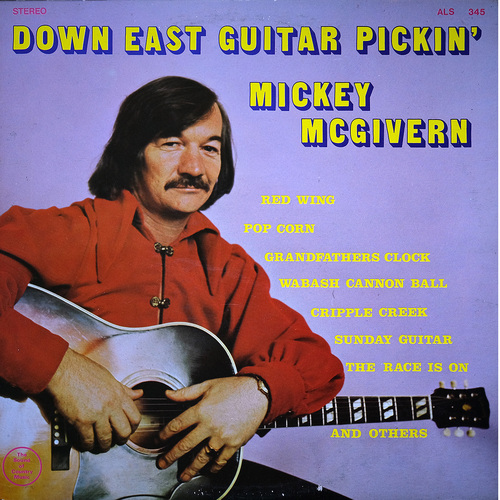
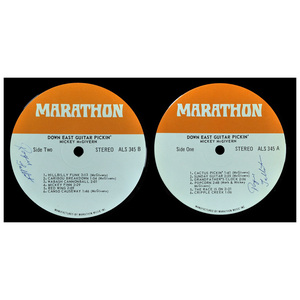
Although best remembered as a session player, McGivern also recorded under his own name. His albums included a duet project with Dean Hutchinson, the instrumental set Twelve String Guitar, and Hard Times with The Mustangs, featuring vocalist Billy Adams. His Marathon LP Down East Guitar Pickin’ brought his guitar to the foreground, mixing traditional country instrumentals with original compositions such as Cactus Pickin’, Sunday Guitar, Hillbilly Funk, Caribou Breakdown and Canso Causeway.
Down East Guitar Pickin’ also preserves something of McGivern’s own story through liner notes by William “Bill” Oja of Canadian Western Rider Magazine. In the notes, McGivern recalls being born in Pembroke, leaving school after his father died, working in Northern Ontario lumber camps, learning guitar from a camp musician nicknamed “Buckshot,” and later moving with his family to Toronto. He also describes his early recording work with Kidd Baker and Hal Lone Pine at CFRB, his East Coast travels, his time around CFCY Charlottetown and CHSJ Saint John, and his years on the road with The Mustangs.
McGivern also left a songwriting trail. His best-known co-write was Down on the Corner at a Bar Called Kelly’s, written with Johnny Paycheck and Aubrey Mayhew. Paycheck recorded the song in 1967, and it later appeared as a single in 1979, reaching the U.S. country chart. It was also recorded by Dick Curless, carrying McGivern’s name into the American country catalogue.
In 1996, McGivern was inducted into the Ottawa Valley Country Music Hall of Fame, formal recognition for a career that had stretched from Pembroke and the Ottawa Valley to Toronto studios, national tours and Nashville-linked club dates. He died in Pembroke, Ontario on June 29, 2018 at the age of 87.
-Robert Williston
Liner notes:
And there I was, in the Lounge at St. Catharine’s Atlanta Hotel, on the shores of beautiful Lake Ontario, listening to the Country Music sounds of the one and only MICKEY McGIVERN, his guitar, and his group, “The Mustangs.”
For years I had been hearing about this McGivern fella and his mastery of the guitar and here was my chance to write my column and maybe learn a thing or two. After introducing myself and explaining my purpose, I asked Mickey to join me for a drink. The interview went something like this:
Bill: So you’re Mickey McGivern.
Mickey: Yes. Would you mind getting me a beer? Kinda warm up on stage. Like to have the odd ale, helps loosen up the vocal cords, you know.
Bill: Waitress, give my friend a glass of beer, please.
Mickey: Kinda small glasses, eh?
Bill: O.K., bring him a mug please. And so, Mickey, let’s start from the beginning. Where were you born and so on.
Mickey: Well, I was born in Pembroke, Ontario. My father died when I was 12 so I quit school and went to work in a lumber camp at Mackey Station up in Northern Ontario, to help support Mother and the other kids.
Bill: And just when did the guitar get into your life?
Mickey: Well, in the winter up north it gets down to about 40 degrees below and we didn’t leave the bunkhouse at night too much. There was this Indian in camp, I think his name was “Buckshot”, who played a little guitar. He let me fool around with his and come Christmas my Mother bought me a “Palm Beach” guitar from the catalogue. After some lessons from “Buckshot” me and him used to go out and call and play square dances at the different lumber camps. Boy, it’s hot in here!
Bill: Would you like another beer? Waitress, bring him a couple of mugs this time, please.
Mickey: Thanks. Well, that lasted about 2 years. Then at 14 Mom took the family to Toronto. That was about 1945 and I was pretty scared of the big city. I played with a number of bands for the next couple of 3 years doing shows such as the “Log Cabin Jamborees” in the area. I joined up with “Kid” Baker and the Pine Ridge Mountain Boys in 1950.
Bill: And how long were you with Baker?
Mickey: About 4 years. It was about 1950 when I worked on my first recording session. You know, those were the days when the only Country Music records produced were done in Nashville. That first session we had “Kid” Baker and the boys and we backed Hal Lone Pine in a studio at C.F.R.B. radio station on a little 2-track machine.
Bill: Waitress, bring him a couple more, please.
Mickey: Thanks, needed that. I remember on a road trip once to the East Coast with Baker I wrote “Canso Causeway.” In 1955, we had our own radio show off CFCY Charlottetown, P.E.I., opposite Don Messer. Then late in ’55 we had our own local T.V. Show on C.H.S.J., St. John’s, New Brunswick. OK, here were up to ’56.
Bill: Well, in 1956 in Toronto, I formed my own band. And get the name, it was the “Golden River Ramblers”. Anyway, after playing around all over the place, music that is, we got our own radio show on C.H.O.V. in Pembroke.
Bill: Yes, O.K. waitress, bring him a couple more.
Mickey: You know, in 1957, I worked with the McFarland Brothers from North Bay at the old Colonial Tavern in Toronto for $4.50 a night. And me married with 3 kids, yet.
Bill: And then?
Mickey: Well, from 1958 to 1968, I travelled about half a million miles with my group. By this time we were called the “Mustangs” and we must have hit every Club in North America.
Bill: Yes, O.K. waitress, it’s only money. Say, Mickey, did you ever run across any of the big names in the music business?
Mickey: Well sure. We worked the Western United States and Mexico with Bob Luman. We backed Mel Tillis and Del Reeves at Mister Ed’s in Nashville. And we always backed Dave Dudley when he played the Edison in Toronto.
Bill: Yes?
Mickey: And then there’s Johnny Paycheck. You know, Johnny’s my best friend and the stories I could tell you about him and me on the road you couldn’t print!
Bill: Could you give me a clue? Paycheck’s pretty hot right now in Country Music.
Mickey: All I can tell you is that Johnny and me did a lot of pickin’ and drinkin’ and fightin’ all over North America. Greatest guy in the world, that Paycheck.
Bill: So that brings us just about up to date. What are you doing now?
Mickey: What the Hell does it look like I’m doing? Playing the Club circuit in Quebec and Ontario with my band. Say, Mac, will you get me another beer before I go back up. Kinda warm in here, you know.
Bill: Say waitress, do you sell beer by the barrel?
Mickey: Sir, you better stick to newspaper writing.
Bill: Why’s that?
Mickey: You can’t hold your booze. Thanks a lot and we’ll be seeing you.
So . . . that was pretty well how the interview went that Saturday afternoon.
A couple of days later I was invited to the Sound Canada Recording Studios in Toronto and watched Mickey McGivern cut his very first, his very own, album. Right up to this session, Mickey had worked on 353 recordings, backing other artists and number 354 was his!
The usual length of time to cut an album is about 30 hours. This, I’m told, is because in studios, musicians get uptight, temperamental, nervous and are on edge.
Mickey and his boys walked into the studio floor, set up, and 3 hours and 50 minutes later McGivern said, “Man, that took a long time, let’s get the Hell out of here and find a beer!”
What he didn’t say was that 29 years of pickin’ and drinkin’ and fightin’ went into these 10 recorded numbers.
You just give a listen to this album and I’m sure you will join me in saying that Mickey McGivern is the finest Country Guitarist in Canada, if not the whole Damn world!
William (Bill) Oja
Music Editor,
Canadian Western Rider Magazine
Gallery
Images
3 images

McGivern, Mickey / Down East Guitar Pickin' BACK
McGivern, Mickey / Down East Guitar Pickin'
Down East Guitar Pickin'
Media
Videos
0 videos
No videos available for this title.
Credits
Musicians
Mickey McGivern: guitar
Songwriting
All songs by Mickey McGivern except “Popcorn” by Mark McGivern and Mickey McGivern.
Production
Recorded at Sound Canada Recording Studios, Toronto, Ontario
Liner notes
William “Bill” Oja: liner notes
Music Editor, Canadian Western Rider Magazine
Audio and Artwork Restoration
Audio Transfer/Restoration by Scott Edward
spinningmywheelsinternational@gmail.com
226-235-6005
No Comments