Insight
Malhavoc were one of the earliest and most singular heavy acts to emerge from Toronto’s underground, a project that spent decades colliding death metal, thrash, industrial, techno, cyberpunk atmosphere, goth textures, and later even rockabilly edge into something uniquely their own. Formed in 1983 by James Cavalluzzo, the band became one of Canada’s true industrial-metal trailblazers long before the hybrid had fully settled into a recognized genre, building a reputation not only for abrasive, shape-shifting recordings but for confrontational live performances that pushed shock theatre, performance art, and underground extremity into the same room.
At the center of Malhavoc throughout every era was Cavalluzzo — later also billed as Jimi LaMort — the band’s founder, vocalist, guitarist, programmer, principal writer, and only constant member. In its earliest phase, Malhavoc operated closer to the raw edge of underground extreme metal, issuing a run of formative demos during the 1980s including The Destruction Starts (1983), The Destruction Continues (1984), Age of the Dark Renaissance (1986), and Shrine (1988). Those recordings document a project in rapid mutation: what began in the realm of primitive metal increasingly absorbed industrial noise, dark ambient passages, experimental electronics, and a cinematic sense of dread. By the time of Shrine, Malhavoc had already begun forging the sonic blueprint that would define the band’s cult legacy.
That restless experimentation carried into the group’s first official releases. The Release arrived in 1990 and effectively introduced Malhavoc’s hybrid vision on record, combining metallic aggression with programmed textures, industrial abrasion, and a more psychologically disorienting atmosphere than most Canadian metal of the period. The album also folded in material from the previously unreleased Shrine sessions, making it both a debut and a retrospective glimpse into the project’s formative evolution. Early lineups around this period included contributors such as Dave Kiner, Rob Wright, Steve Jelliman, and others from Toronto’s heavy underground orbit, but even then Malhavoc functioned less like a conventional fixed band than as a shifting extension of Cavalluzzo’s ideas.
The 1991 EP Punishments sharpened the project further, compressing Malhavoc’s industrial-death aesthetic into one of the band’s most focused early statements. By this point, programming had become an increasingly important part of the attack, and the project’s mechanical edge aligned naturally with the broader Canadian industrial scene. Around the same period, Malhavoc’s orbit intersected with key figures such as Dave “Rave” Ogilvie, whose presence would become increasingly important as the band moved deeper into electronics and studio experimentation. The band’s work from these years helped place them in a very small and very early cohort of Canadian artists actively bridging extreme metal and industrial music before the crossover became fashionable.
Their second full-length, Premeditated Murder (1992), remains one of the defining Malhavoc records. More aggressive and more conceptually ambitious, it pushed the band further into a collision of thrash intensity, programmed electronics, bleak atmosphere, and collage-like studio construction. It also reinforced the sense that Malhavoc were operating outside normal genre boundaries — too strange and mechanized for straight metal, too brutal for orthodox industrial rock. The album later gained a certain notoriety for a sample-clearance issue involving an unauthorized use of The Rolling Stones’ ‘Sympathy for the Devil,’ a controversy that only added to the release’s underground aura. Even in hindsight, Premeditated Murder feels like the work of a band arriving too early for the categories available to describe it.
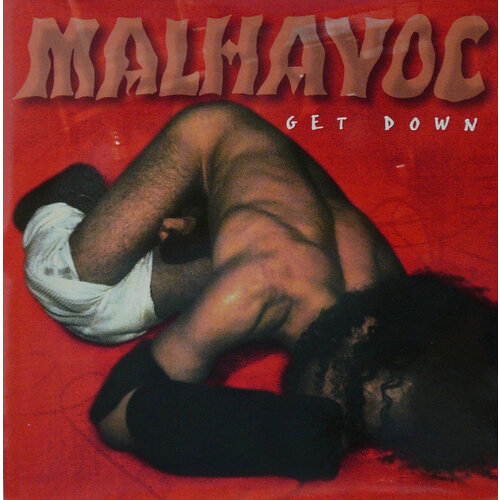
If Premeditated Murder established the blueprint, Get Down (1994) proved Malhavoc were unwilling to stand still. The album pulled harder toward techno, noise, ambient layering, and industrial groove while still retaining the band’s heavy core, broadening the project beyond its death/thrash origins without sacrificing menace. Live drummer John Carss became a more visible part of the era, and the record captured a version of Malhavoc that was simultaneously more accessible, more danceable, and in some ways even more alien. Its impact was significant enough that Get Down earned a 1995 Juno Award nomination for Best Hard Rock Album, a remarkable recognition for a band so rooted in Canada’s darker and more abrasive underground. That nomination remains one of the more fascinating moments in Canadian heavy music history: a project built on transgression, industrial extremity, and anti-mainstream aesthetics briefly acknowledged on the country’s biggest music stage.
But Malhavoc’s history was never a simple upward climb. Internal tensions and label complications during and after the Get Down era led to lineup instability and delays surrounding the long-gestating follow-up, The Lazarus Complex. Much of that material had been recorded by the mid-1990s, yet the album remained trapped in limbo for years before finally emerging as an independent release on Icky-Poo Productions. By the time it appeared, it represented both a continuation and a resurrection — a document of a transitional Malhavoc caught between industrial metal, alternative darkness, and a more expansive, textured songwriting approach. Produced in part with Dave “Rave” Ogilvie and shaped by collaborators including Jimi LaMort, John Carss, Justin Small, Chris Scahill, and others, it stands as one of the band’s most layered and misunderstood works.
Part of what made Malhavoc so compelling — and so difficult to categorize — was that the project never obeyed the expected arc of a metal band. Cavalluzzo treated Malhavoc as a mutable creative vehicle rather than a static lineup, and over time the music absorbed whatever seemed useful: death metal violence, industrial sequencing, techno pulse, cyberpunk futurism, goth melodrama, noise collage, and later unexpected left turns that challenged any purist reading of the catalogue. Their own Bandcamp summary gets to the point succinctly: Malhavoc were among the pioneers who fused death/thrash metal with industrial, then continued evolving into techno, cyberpunk, goth, and rockabilly territory — “if someone plays it, chances are MALHAVOC were there first.” It’s half joke, half mission statement, and not entirely inaccurate.
Just as notorious as the records were the performances. Malhavoc developed a reputation for extreme live theatrics that blurred the lines between concert, confrontation, and underground performance art. Accounts of their stage shows routinely mention nudity, role-playing violence, sadomasochistic imagery, and acts of self-inflicted punishment that made the band controversial even within already extreme scenes. Those elements were not incidental decoration; they were part of Malhavoc’s identity as a project built around discomfort, transgression, and the collapse of polite boundaries. Whether one views that legacy as shocking, provocative, excessive, or all three, it undeniably helped cement the band’s cult mythology.
In later years, Malhavoc became a more sporadic but no less fascinating entity. Cavalluzzo continued reviving the project as circumstances allowed, including the 2004 covers release Human Fly and later live activity in the 2000s with a reconstructed touring lineup. Personnel shifted repeatedly over the decades — among them John Carss, Justin Small, Steve Jelliman, Chris Scahill, Lee McCormack, Jeremy Inkel, Ric H., Bryan Somerville, Tim Hagberg, and others — but the through-line remained Cavalluzzo’s refusal to let the project calcify.
Today, Malhavoc stand as one of the strangest and most important cult names in Canadian heavy music: too metallic for industrial orthodoxy, too electronic for metal conservatism, too theatrical for comfort, and too early for many listeners to fully grasp when the records first appeared. Their catalogue captures a band that never stopped mutating, and in doing so helped sketch out an alternate history of Canadian industrial metal — one where extremity was never just about heaviness, but about imagination, risk, and the willingness to go somewhere uglier, stranger, and more visionary than almost anyone else.
-Robert Williston
Songwriting
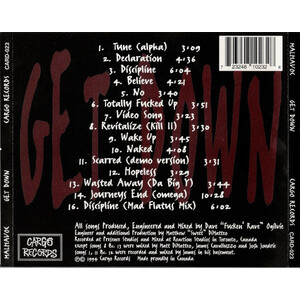
All songs written by James Cavalluzzo, except ‘Untitled (Happy House)’ written by Siouxsie Sioux and Steven Severin
Production
Produced, engineered and mixed by Dave “Fucken’ Rave” Ogilvie
Additional production by Matthew “Sweet” DiMatteo
Recorded and mixed by James Cavalluzzo (tracks 1, 11, 12)
Mixed by James Cavalluzzo, Josh Joudrie, and Matt DiMatteo (tracks 8, 13)
Notes
Glass mastered at Cinram
Gallery
Images
3 images
Malhavoc - Get Down (1)
Malhavoc - Get Down (2)
Get Down
Media
Videos
2 videos
Credits
In Transit
No Comments