Insight
Production
Arranged and conducted by Rick Wilkins
Produced by Dave Bird for the Canadian Broadcasting Corporation
Engineered by Ian Jacobson
Artwork
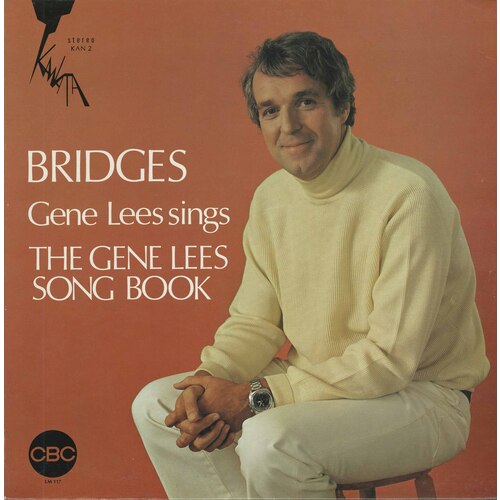
Cover Photo by Ken Bell
Liner notes
Talk about full circle. Gene Lees, who has asked me to write liner notes for this album, is the man who got me my first professional writing job. It was years ago, when we both lived in New York. What glorious fights we used to have about music.
At that time, Gene was the author of two novels (one of them, And Sleep Until Noon, is suddenly selling for no known reason except that it’s very good), endless essays and articles on all subjects, record reviews (he was popular music editor for Stereo Review and later for High Fidelity Magazine), and various other oddball things.
But the writing Gene liked best was song writing.
In recent years, Gene has studied both piano and orchestration, so that now he writes a good deal of his own music. But he began as a lyricist. His first published song became a standard, Quiet Nights of Quiet Stars, with music by Antonio Carlos Jobim. Other collaborators have included Bill Evans, Lalo Schifrin, Charles Aznavour, and others equally impressive if less famous.
Through all the New York years, Gene had two growing dreams: to go home to his native Canada, and to make an album in which he sang his own songs. The frustration of those wishes made Gene into a kind of embattled artist who could alternately charm and infuriate his colleagues within the space of ten minutes. As a writer, Gene still likes to punch holes in windbags and laugh as the wind whistles out. Some of his record reviews have become classics in irreverence and wit. Letters from outraged readers still pour in. He loves that too.
Gene is a man who spent years trying quite literally, to change the world — socially, politically, personally, and most of all musically (with Gene, everything comes back to music). In the end, he chose the wiser course, changing not so much the heedless world as himself. And that was the moment when life began to fulfill itself. First he found his lady. Then he went back to Canada. And now he has made his album. It was a long road, Gene, but it took you home. And at road’s end lay the great golden surprise: a new beginning.
Some of the songs in this lovely album are old friends. Others are new. Of the many things Gene Lees has been and is, to me the first is songwriter. I mean it in the classic sense. If most people were not so shy about the vulnerable, nourishingly personal concepts without which we are all starving, then they could freely use such words as “bard” for people like Gene Lees.
A bard is defined as a professional poet. This is not the man or woman who writes as a relief from life. A bard is one who unwittingly stakes everything on the gift, makes his living from it, whether fair or not. Such a person becomes a professional by accident, because there is nothing else to do. There are many whose faces and lifestyles bear all the marks of creative importance. But the test of the poet lies in his work, and that alone. Gene is a case in point. He hates to be called a poet. He would rather spend three days explaining precisely why he wrote this or that lyric in this or that fashion, analyzing his work to an all but microscopic level. I’m not sure it matters, except in the sense that it contributes to his work when he is again alone with pen and paper.
What matters is the songs. Gene Lees’ songs have the timeless quality of those interests lie not in what is fashionable but what is universal in life. The first field of attraction is human relations, specifically love. Yet this universality exists even on quite timely subjects such as our appalling environmental deterioration (What in the World). The currency that affects Gene as a human being does not necessarily affect his writing. In short, because he knows himself creatively, he knows where to write from.
The consistency of song quality in this album is its finest aspect. The personal feeling the album projects comes from Gene’s warm and honest singing. His statement is simple and sure. Behind it is a great deal of musicianship, without the need to thrash us with it. For Gene, the song is the thing.
The superb orchestrations are by Rick Wilkins, a young man from Hamilton, Ontario, which happens to be Gene’s home town too. Wilkins has filled the songs with beautiful string countermelodies, moody tapestries of colour with graceful spaces for guitar, piano and rhythm. All this is done quietly, lovingly, and it never swallows song or singer.
Gene would be happy if I tore up most of this and devoted the space instead to the musicians involved in the album. But that is not the first function of liner notes. Fortunately, these beautiful musicians speak for themselves, particularly Gene’s close friend, the brilliant young pianist from Rhod Island, Mike Renzi; the sensitive bass player Gary Binsted; and Canada’s complete guitarist, Ed Bickert. About the songs:
I Always Come Back, with music by Mike Renzi, has a double meaning for Gene, who says, “I suppose everyone has been involved in relationships they were capable of breaking off. But the song is also about Canada. Canada is, in a way, the woman.”
Quiet Nights of Quiet Stars, with music by Jobim, was written on a bus crossing the countryside somewhere around Rio de Janeiro in 1962. The lyric has a sad serenity, the “happiness of a disillusioned man,” a quality that inheres in most of Gene’s writing.
All We Have is Now, with music by Hymlicka, is a disturbing comment on the land: “What in the world are we doing to the world?” Gene took his lyric mood to Footprints from arranger Rick Wilkins’ charming but deceptively difficult melody.
Yesterday I Heard the Rain was written by Gene for Tony Bennett at Tony’s request, to a melody by Mexico’s Armando Manzanero.
Waltz for Debby, with music by Evans, is something of a quiet classic, particularly in jazz circles. Debby is Bill’s niece but Gene wrote the words thinking of his younger sister. Both ladies are all grown up now.
A special word for Someone to Light Up My Life (music again by Jobim). The song is familiar and I must have heard the verse before. But apparently I had never really listened to it. Which says a great deal about Gene’s singing of it. One of the most touching moments in the album occurs as the gentle verse gives way to the song itself. Of the songs many recordings, Gene’s is, I believe, the best. If I have an overall impression from this album, it is simply this: listening to it makes me feel good. What better praise could a listener give?
Morgan Ames
(Miss Ames, a contributing editor of High Fidelity, is a pianist, lyricist, composer, and singer. She lives in Los Angeles, where she is active in studio recording work.)
Canadian-only Kanata Records pressing of this easy listening, crooner, jazz, bossa nova, and vocal LP from one-time Downbeat editor, lyricist, writer, and singer Lees (who has worked with the Who's Who of jazz: Bill Evans, Lalo Schifrin, Tony Bennett, Antonio Carlos Jobim). This material was recorded for the CBC (in 1970 before being given a commercial issue on the Kanata label) with help from Rick Wilkins (Mutual Understanding) and composer Milan Kymlicka (CTL). The cream of Toronto's jazz studio scene also appear (Jerry Toth, Guido Basso, Eugene Amaro, Rob McConnell, and Ed Bickert). This is a mellow end-to-end spin and a personal favourite. Light a candle, pour some wine, and relax with Lees and company. One of the finest hands down! Housed in a beautiful gatefold jacket with informative liner notes.
After working 1948-55 as a reporter for the Hamilton Spectator, the Toronto Telegram, and the Montreal Star, Lees was music and drama critic 1955-9 for the Louisville (Kentucky) Times and editor 1959-62 of the jazz magazine Down Beat (Chicago). Working on a freelance basis, he also wrote for Stereo Review (New York) and High Fidelity (Great Barrington, Massachusetts), Maclean's, the Toronto Star, the Toronto Globe and Mail, The New York Times, and other publications. He contributed liner notes to close to 100 recordings of artists including Stan Getz, John Coltrane, and Quincy Jones. In 1967 he published a novel, And Sleep Until Noon. He received the ASCAP-Deems Taylor Award in 1978 for a series of articles published in High Fidelity about US music, and won the award on two subsequent occasions. In 1981 he established his own monthly Jazzletter (Ojai, California), which became an influential source of informed opinion, by Lees and others, within the industry.
read more: http://www.thecanadianencyclopedia.com/index.cfm?PgNm=TCE&Params=U1ARTU0002023
Gallery
Images
2 images
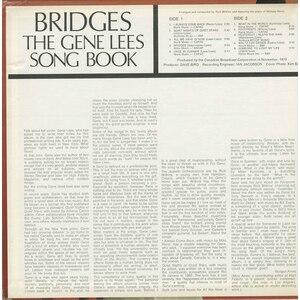
gene Lees - Gene Lees Sings The Gene Lees Song Book
Bridges: Gene Lees Sings The Gene Lees Song Book
Media
Videos
0 videos
No videos available for this title.
Credits
In Transit
No Comments