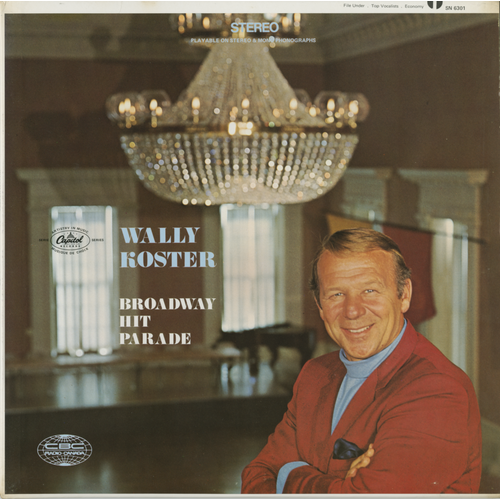
Album / Title
Broadway Hit Parade
By: Wally Koster
Origin: Winnipeg, Manitoba → Toronto, Ontario, 🇨🇦
Insight
Wally (Walter Serge) Koster (born 14 February 1923, Winnipeg, Manitoba; died 11 December 1975, Toronto, Ontario) was one of the first Canadian popular singers to function as a genuinely national figure during the formative years of CBC television—an artist whose career unfolded simultaneously across dance orchestras, radio, early television, musical theatre, recording studios, and live performance venues at the precise moment Canada was building its broadcast culture.
Raised in Winnipeg by Polish-Russian parents, Koster entered professional music unusually early. By his mid-teens he was already working as a band singer with Joe DeCourcy’s dance orchestra, appearing both locally and on western tour stops such as Jasper, Alberta, while also gaining early radio exposure on CJRC Winnipeg. These formative years placed him squarely within the pre-television entertainment economy, where vocalists were expected to project over large ensembles, handle diverse repertoire, and communicate clearly to live and broadcast audiences alike.
After serving as a bandsman during the Second World War, Koster relocated into the postwar Canadian dance-band circuit, first with Ellis McLintock’s Toronto orchestra and then, more prominently, with Mart Kenney from 1949 to 1952. With Kenney, Koster worked as both trombonist and chief male vocalist, refining a style that combined big band authority with an actor’s sense of phrasing and narrative. The experience positioned him perfectly for the transition to television as CBC began expanding its national broadcasts.
Koster emerged as a major CBC presence in the early 1950s, participating in the network’s formative television years and appearing in its earliest Toronto telecasts. His most enduring association came with Cross-Canada Hit Parade, one of CBC Television’s flagship variety programs. Airing weekly from 1955 to 1960, the series showcased current popular songs interpreted by an in-house ensemble of singers, dancers, and orchestra. Koster, alongside Joyce Hahn and supported by Bert Niosi’s orchestra, became one of the show’s central figures, helping define its tone and longevity. When CBC later repackaged the format under the Music ’60 umbrella, Koster remained at the forefront, underscoring his importance to the network’s conception of dependable, national musical television.
He also hosted The World of Music (1960–61), a themed CBC Television series that expanded his role from featured singer to musical guide, presenting a wide range of musical styles in a format that emphasized substance and interpretation over spectacle.
Parallel to his television work, Koster maintained an active stage career. He appeared in leading roles in major musical productions, including Sky Masterson in Guys and Dolls, Billy Bigelow in Carousel, and Joey in Most Happy Fella, as well as in Annie Get Your Gun, Oklahoma!, and The Pajama Game. These roles reinforced his reputation as a singer-actor rather than a novelty television personality. His popularity during this period was reflected in three Liberty Awards naming him Canada’s Best Male Vocalist, along with high-profile live appearances such as solo performances at the Canadian National Exhibition Grandstand and extensive nightclub engagements across the country.
Koster’s recording career mirrors the structure of his professional life. Rather than pursuing a chart-oriented pop identity, his releases document a vocalist rooted in orchestral, theatrical, and broadcast repertoire. His discography includes early 78s with Mart Kenney, LPs for Capitol Records Canada, recordings for RCI (including sessions with the Albert Pratz Orchestra), albums for the Canadian Talent Library, and releases in CBC’s LM series.
In addition to his LP work, Koster issued two singles. In 1966 he released the RCA Victor 45 Alberta Trail b/w Sunset Waltz (RCA Victor T-53776 / T-53777), manufactured by the RCA Victor Recording Service Department. Both songs were Alberta-themed compositions written by Mrs. Inga McWhirter, orchestrated by Lucio Agostini, and feature Koster’s vocal set against a refined, jazz-influenced orchestral backdrop.
His final known single appearance came late in his career with the CBC Radio Canada LM-series 45 Christmas Is Here b/w Christmas, My Time of Year (LM 147), released in 1974. Arranged by Milan Kymlicka and featuring a children’s choir directed by Lloyd Bradshaw, the record reflects Koster’s enduring relationship with CBC and his comfort within formal, seasonal, and family-oriented programming. The songs were written by Milan Kymlicka with Will Millar (Christmas Is Here) and by Kymlicka–Zubrak (Christmas, My Time of Year).
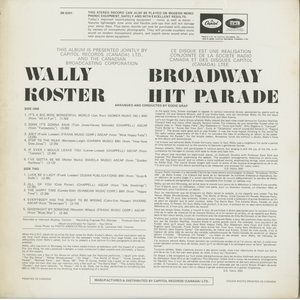
Two albums capture the breadth of his recorded legacy. Broadway Hit Parade (Capitol SN-6301), presented jointly by Capitol Records (Canada) Ltd. and the Canadian Broadcasting Corporation, draws directly from his stage repertoire and television persona. Arranged and conducted by Eddie Graf and recorded on eight-track stereo at Hallmark Studios, the album emphasizes theatrical storytelling and orchestral polish, reflecting the repertoire that had made Koster a familiar national figure.
The Songs of Wally Koster (Canadian Talent Library S 5066) presents him in a different but equally revealing light. Designed for broadcast and institutional use, the CTL release pairs Koster with three distinct ensembles—the orchestras of Johnny Burt and Pat Riccio, and the Wally Wicken Quartet—allowing his voice to move between full orchestral, pop-jazz, and intimate quartet settings. The inclusion of Riccio’s Canadian composition ‘Home in Canada’ situates the album firmly within CTL’s mandate to promote Canadian repertoire alongside international standards.
Beyond performance, Koster lived the practical, working life of a Canadian entertainer of his era. He led bands, ran a talent agency, appeared in industrial and corporate shows for major companies such as Imperial Oil and General Motors, and later farmed land near Stouffville, Ontario—activities that reflect both the breadth of his skills and the realities of sustaining a career in Canada’s mid-century entertainment landscape.
By the time of his death in 1975 at the age of 52, Wally Koster had appeared on hundreds of television broadcasts and had become one of the most recognizable male vocalists of Canadian television’s formative decades, his career documenting a moment when Canadian broadcasting, popular music, and musical theatre were still being built together.
-Robert Williston
Produced by Dave Bird
Engineered by Phil Sheridan
Liner notes:
In his spare time, Koster managed to appear in various industrial shows, sponsored by giants such as Imperial Oil and General Motors, and if one thinks back, one can remember Wally (in the old days) playing trombone in the bands of Ellis McClintock and Mart Kenny.
Let’s not forget the many shows wherein Wally played the lead roles made famous by Gordon MacRae, Howard Keel and many other equally famous names. For instance, do you remember Koster when he played Joey in “Most Happy Fella”, Sky Masterson in “Guys and Dolls”, Billy Bigelow in “Carousel”, Frank Butler in “Annie Get Your Gun”, Curly dans Oklahoma et, bien sûr, Sid Sorokin dans Pyjama Game? Ces spectacles, de même que Koster, furent de vrais succès, d’où la grande variété de ces activités radio et TV.
The CBC conceived the idea of producing an album to be called “Broadway Hit Parade” for the simple reason, Broadway tunes are without a doubt, Wally’s forte as this album will demonstrate.
I’ve known and admired Wally Koster many years; in fact, Wally was a neighbour for quite a period of time before he moved out to the country to become a gentleman farmer.
Always athletic, Wally still participates in various sports, but singing is still the joy of his life, a circumstance he manages to convey with ease to those who hear him.
This album was recorded on eight-track stereo, at Hallmark Studios with Producer Dave Bird and engineer Phil Sheridan supervising the session. The excellent arrangements, featuring on some cuts, the real “big band sound” and on others a more subdued sound, emphasizing strings, were conceived by Eddie Graf. The Laurie Bower singers add much to some of the musical arrangements also.
I’m sure you’ll find this album something to be treasured and enjoyed for many years.
S.B. Hains, BMI
Quand Radio Canada m’a demandé d’écrire les notes devant accompagner le disque “Broadway Hit Parade”, de Wally Koster, j’ai d’abord été de lui demander combien d’espace je disposerais. Sur un album de quatre pages il y a aurait peut-être moyen de couvrir amplement la carrière de Wally, mais en quelques paragraphes il est presque impossible d’en brosser un tableau vrai.
Wally, qui est né à Winnipeg, est arrivé très jeune à la télévision à l’allure de comète. Tout d’abord, pour un réalisateur, c’était une perle, pour un directeur musical, un chanteur idéal, et finalement, pour l’auditoire, un favori.
Pour ne mentionner que les émissions où Wally tenait la vedette, je me rappelle avec plaisir The Big Revue, Mister Showbusiness, On Stage, The World of Music, Cross Canada Hit Parade, Matinee Party, et puis, bien entendu, Koster a paru comme invité à tellement d’autres émissions qu’on ne peut les énumérer toutes, telles The Barris Beat, The Juliette Show, Parade, et plus près de nous, In Person. En tout, Wally s’est produit à quelque six cents émissions de télévision et, à mon avis, cela tient du record.
Dans ses temps libres, Koster a trouvé le temps d’anticiper à divers spectacles pour le compte d’industriels de la taille de Imperial Oil et General Motors, et si on revient aux premiers jours de sa carrière, on se rappelle que Wally, dans les bands de Ellis McClintock et de Mart Kenny.
N’oublions pas les nombreux spectacles dans lesquels Wally a tenu des premiers rôles rendus fameux par les Gordon MacRae, Howard Keel et autres grands noms. Par exemple, vous souvenez-vous de Koster dans Joey dans Most Happy Fella, Sky Masterson dans Guys and Dolls, Billy Bigelow dans Carousel, Frank Butler dans Annie Get Your Gun, Curly dans Oklahoma et, bien sûr, Sid Sorokin dans Pyjama Game? Ces spectacles, de même que Koster, furent de vrais succès, d’où la grande variété de ces activités radio et TV.
La CBC a conçu l’idée de produire un disque intitulé “Broadway Hit Parade” pour la simple raison: pour Wally, les mélodies de Broadway sont sans contredit sa spécialité.
J’ai toujours admiré Wally Koster pendant de nombreuses années où j’ai eu le plaisir de le connaître. Il a été mon voisin durant une certaine période avant qu’il ne déménage à la campagne pour se faire “gentleman farmer”.
Toujours athlète, Wally s’adonne encore à des sports variés, mais c’est néanmoins le chant qui fait la joie de sa vie; il en fait part avec grâce, à ceux qui l’écoutent.
Ce disque a été enregistré sur huit pistes stéréo à Hallmark Studios sous la supervision du réalisateur Dave Bird et de l’ingénieur Phil Sheridan. Eddie Graf a conçu les excellents arrangements qui figurent tour à tour les véritables sonorités d’un grand orchestre et des sonorités atténuées, mettant en valeur les cordes. À l’occasion, les arrangements musicaux sont rehaussés par les Laurie Bower Singers de sorte qu’en somme je suis sûr que c’est un disque à garder précieusement et à goûter longtemps.
S.B. Hains, BMI
Gallery
Images
2 images
serve-record-cover
Broadway Hit Parade
Media
Videos
0 videos
No videos available for this title.
Credits
In Transit
No Comments