
Insight
Kinetic Ideals emerged in 1980 out of Streetsville, a quiet corner of Mississauga that was far removed from Toronto’s high-profile downtown venues but close enough for ambitious young musicians to feel the gravitational pull of the city’s post-punk explosion. The original lineup—Mikil Lee Rullman on vocals, J.C. Chambers on guitar, Alan Murrell on bass, and Jon Davies on drums—formed a tight unit almost immediately, rehearsing relentlessly and developing a sound anchored in wiry guitar lines, heavy rhythmic insistence, and the kind of nervous intensity that defined the early ’80s underground.
Their first major step came when Burlington’s newly formed Mannequin Records invited them to record a single. The label, established by members of The Spoons, was still taking shape, and Life in Shadow b/w Maze of Ways became only its second release. A Weekend Post feature in 1980 noted how the band had impressed Mannequin’s partners after being spotted at a local fair, the label praising the group’s raw energy and willingness to record material on their own terms. The single captured the group in their earliest form—lean, sharp, and unfiltered—and helped establish them as a serious new voice in a scene then dominated by larger Toronto acts.
As the band moved into the club circuit, their reputation grew quickly. Live audiences reacted to the group’s physicality as much as their music; Rullman often treated the stage like a provocation, twisting himself in oversized sweatshirts, throwing his body into the rhythm, and pushing performances toward a kind of physical breaking point. Reviews from the period consistently describe the group as the most arresting presence on multi-band bills. In one notable case, covering a Music Hall show, a local critic observed that Kinetic Ideals “out-performed” the visiting U.K. band The Teardrop Explodes—a rare moment in which a Canadian opening act eclipsed an international headliner during Toronto’s early “British invasion” marketing push.
Another newspaper review, this time from the Voodoo Club, described the band opening for New York’s DNA. While DNA bewildered the room, the Ideals arrived with a focused, martial pulse driven by Davies’ drumming, Murrell’s churning bass patterns, and Chambers’ clipped, repetitive guitar figures. Their closing piece, Animalistic, had already become the band’s signature moment—a high-tension buildup that resolved in a frenzied collapse, drawing from tribal rhythms, post-punk minimalism, and sheer performance force. That track later became a #1 local dance-chart hit.
By 1982 Kinetic Ideals were confident enough to tour internationally. During a London stop, shortly after soundcheck at the 101 Club, Davies was struck by a car. Though not seriously injured, he chose to remain in England, forcing the band to rethink their rhythmic foundation. They continued as a trio, replacing the drum kit with an Oberheim DMX, first in rehearsal, then onstage, and finally on their 1983 EP A Personal View. At a time when few Canadian groups attempted machine-driven percussion live, the trio found themselves ahead of the curve—technically innovative but facing resistance from audiences and A&R people unprepared for the stark, synthetic sound.
This pressure eventually led them to bring in drummer Patrick J. Duffy for live shows, restoring a more conventional lineup even as the band’s songwriting continued to lean toward mechanized patterns and cold, precise structures. Their 12-inches during this period—Reason (1981), Angular Sky (1982), and A Personal View (1983)—show the group moving steadily toward a darker, more disciplined aesthetic built on repetition, restraint, and tension.
Throughout their career, Kinetic Ideals kept their independence intact. They resisted softening their sound, avoiding the commercial compromises that major labels demanded of Canadian new-wave acts in the early ’80s. As a result, they remained on the periphery of mainstream visibility, but they built something more lasting: a body of work that stands today as one of Ontario’s most distinctive contributions to the post-punk era.
The project wound down around 1985/86 following Rullman’s departure. Chambers, Murrell, and Duffy later continued briefly under the name First Man Over. Decades later, the early Kinetic Ideals singles and EPs remain prized artifacts, not only for their scarcity but for their clear expression of a band that moved by instinct, intensity, and conviction.
-Robert Williston
Mike Rullman: vocals
Jean-Claude Chambers: guitars
Alan Murell: bass
Jon Davies: hits drums
Produced by Tom Atom and Kinetic Ideals
Engineered by Tom Atom
Recorded at Cottingham Sound, Ontario
Gallery
Images
4 images
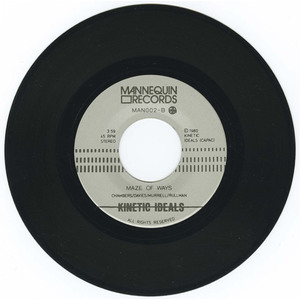
45-Kinetic Ideals - Life In Shadow VINYL 02
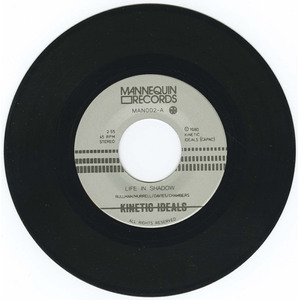
45-Kinetic Ideals - Life In Shadow VINYL 01
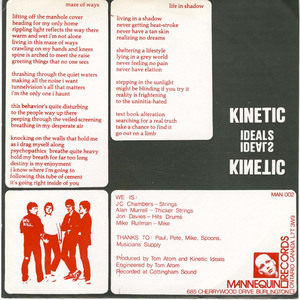
45-Kinetic Ideals - Life In Shadow BACK
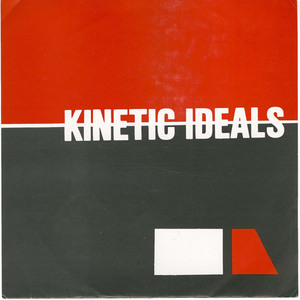
Life In Shadow b/w Maze of Ways
Media
Videos
0 videos
No videos available for this title.
Credits
In Transit
No Comments