Insight
Killer Dwarfs and the Rise of Canadian Arena Metal
Killer Dwarfs took shape in late 1981 in the Toronto/Oshawa orbit of Ontario’s hard-rock club scene, built around vocalist Russ “Dwarf” Graham and drummer Darrell “Dwarf” Millar. Both had come up through local bar bands, and together they forged a project that balanced sharp melodic metal with theatrical humor, adopting a shared “Dwarf” surname as part of the band’s larger persona. Guitarist Bryce “Dwarf” Trewin and bassist Ange “Dwarf” Fodero completed the original lineup.
Their self-titled debut LP, issued in 1983 on Attic Records, immediately established them as one of Canada’s most distinctive heavy bands of the era. The album earned a Juno nomination, drew U.S. label interest, and gave the group a national profile through radio and live work. Despite this early momentum, Trewin and Fodero departed in 1984, believing the band’s progress was stalling.
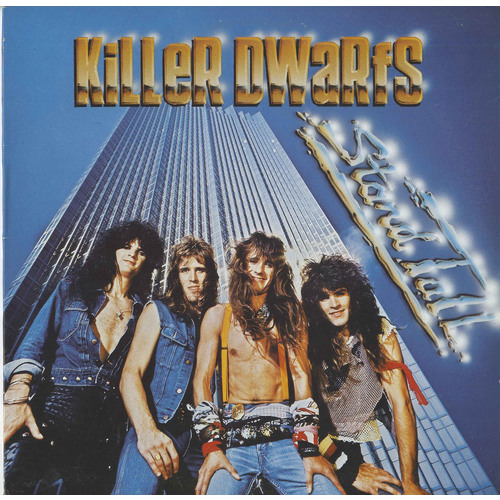
They were replaced by Mike “Dwarf” Hall on guitar and Ron “Bad Ronbo” Mayer on bass, creating the lineup that would define Killer Dwarfs’ most influential period. This version of the band delivered Stand Tall (1986) on Maze/A&M/Grudge, a record that captured both their punch and their playfulness. The singles “Keep the Spirit Alive” and “Stand Tall” became anthems of the mid-’80s metal moment, aided by memorable, tongue-in-cheek videos that received heavy rotation on MuchMusic and MTV. The exposure propelled the album to strong North American sales and later made it one of the most collectible Canadian hard-rock titles of its time.
In 1987, Russ Graham co-hosted MTV’s Headbangers Ball with Judas Priest’s Rob Halford — an unusual spotlight for a Canadian metal frontman and a key factor in the band’s leap to a major-label deal with Sony/Epic.
Their first Epic release, Big Deal (1988) — produced by Simon Hanhart — broadened their sound and profile. The band supported Iron Maiden on a major U.S. and European tour and appeared at large outdoor festivals, moving from club stages to arena-level visibility.
For Dirty Weapons (1990), Killer Dwarfs worked in Hollywood with legendary producer Andy Johns (Rolling Stones, Led Zeppelin, Rod Stewart). The album delivered their biggest U.S. radio moment with “Doesn’t Matter,” which topped rock charts in multiple cities, while the title track gained MTV exposure. The record became their highest-charting U.S. album and earned a 1991 Juno nomination for Best Hard Rock Group, though the award ultimately went to Rush.
Johns returned for Method to the Madness (1992), but guitarist Mike Hall exited and was replaced by Gerry “Dwarf” Finn. The album leaned heavier and more polished, yielding tracks such as “Hard Luck Town,” “Cowboys and Conmen,” and the charting “Driftin’ Back.” Musically it has since been regarded as one of the stronger Canadian hard-rock releases of the early ’90s, but shifting industry tastes and waning label support limited its commercial reach. Killer Dwarfs parted ways with Sony/Epic in 1993.
Personal circumstances — including a family crisis for Russ Graham — led to the band going quiet by the mid-1990s.
In the years that followed, members remained active:
Russ Graham fronted the band Penny Black.
Darrell Millar later played with Laidlaw.
Mike Hall and Gerry Finn each spent time in Helix around 2000.
The classic Big Deal lineup reunited in 2001, reviving both the music and the band’s irreverent stage humor for renewed touring. In 2013, Killer Dwarfs issued Start @ One, a previously unreleased album recorded in 1993 with the Method to the Madness lineup. The group reunited to support the release and toured extensively through 2013–14, capturing live material for later archival use.
Across their career, Killer Dwarfs played major venues including Wembley Arena, Hammersmith Odeon, Toronto’s CNE Grandstand, and Ricoh Coliseum, and shared stages with many of hard rock’s biggest names. Their legacy rests on a distinctly Canadian take on ’80s arena metal — equal parts muscular songwriting, sharp humor, and a singular visual identity — anchored by the enduring impact of Stand Tall and Dirty Weapons.
-Robert Williston
Musicians
Darrell “Dwarf” Millar: drums, vocals
Mike “Dwarf”: guitars, vocals
Bad Ronald “Dwarf”: bass, vocals
Russ “Dwarf” Graham: vocals
Songwriting
‘Can’t Lose’ written by Carr
‘Gotta Lose to Win’ written by Doug Hill
‘Fire in Your Eyes’ written by Doug Hill
All other songs written by Angelo Fodero, Bryce Trewin, Darrell Millar, and Russell Graham
All music and lyrics © 1986 Happenin’ Johnny’s Music (ASCAP/CAPAC) — used by permission
Production
Produced by Killer Dwarfs for Happenin’ Johnny’s Enterprises
Co-produced by Andrew St. George of LeMix Productions
Recorded at Comfort Sound, Toronto (October 1985–April 1986)
Artwork
Concept and direction by Lenny Stoute
Photography by Phil Regendanz
Scarpry 3-D lettering and design by Gerald McLaughlin, Steve Reeson, and Voo Doo Airbrushing Studio
Insert concept and design by R. Dwarf
Insert artwork and layout by Steven Wayne Hederman (the Scribe)
Insert photography by Rick LaTorre, Ian Hall, R. Dwarf, Steven Wayne Hederman, and Al Rawdon
Management
Managed by Andrew Wigderson
Crew
Lighting: Ian Hall
Sound: Glen Hoffman
Stage: Brian Basher “Beggs” (“The Wandering Flashlight”)
Road crew:
John “Beach Bar” Stan; Dee; Brian “I Worked Yesterday” Waters; Blair; Bob and Tom at RAM; Kim; Uncle Sally Tollope; Kevin (lighting); Brian McKee; and the Cardi’s Crew.
Thanks
We would like to personally thank ourselves for havin’ a damn fine time with you here, eh? Thanx “Dunks” everywhere — “Fine Jam Skip.” See ya! The Dwarfs.
Personal thanks to:
Joe Anthony (“The Godfather of Rock”) of KISS FM, San Antonio, Texas; Jack Orbin; Robert Medley; the staff at Stone City Attractions (San Antonio); Rick “The Stuff” LaTorre; Rock Star Merchandising; Doug and everyone at Comfort; The Rockin’ Ricketts; Voc Me Doo; Clubfoot; “The Bar-B-Boys”; The Flutocozzi’s; The Oshawa Madmen; Chicken Charlie; Marsha Van Winkle; Spaz; Amil; Twisting by the Pool; Lifestyles of the Poor and Obscure; Toronto Rocks; MuchMusic; Metallion; Dream Dallgleish; Route 66; Cathy and Bill “Badine” (Gordon Stinkfoot) and Doc; Tara and Ida; Ike and Spark; Gerry “The Agent”; John Bell; “Barf ’n’ Pukes”; Nino; Dunk; The Sacred Circle; Mercedes “Dee”; Dwayne at The Brass Rail; Kenleonie; Camp Jim True; Dirty Harry; Molson and J.D.; “Suds Everywhere”; The Eagle; Joe Lado; Kenraig/Keith Lenoar Productions; “The Nameless Wonders”; “Ladderman”; and “In Turend.”
Special thanks to our families for their support and spirit — “Thanx MA.”
Notes
Manufactured and distributed by Maze Music Inc.
Printed in Canada
© ℗ 1986 Happenin’ Johnny’s Music Enterprises (CAPAC)
Maze Music Inc., P.O. Box 249, Station M, Toronto, Ontario M6S 4T3 (416-537-7473)
Dwarf Inc., 3148 Kingston Road, P.O. Box #204, Scarborough, Ontario M1M 1P4
Gallery
Images
6 images
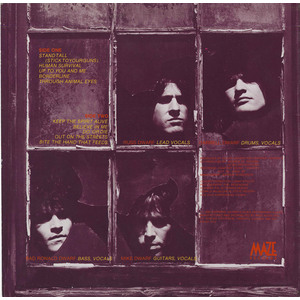
Killer Dwarfs-Stand Tall BACK
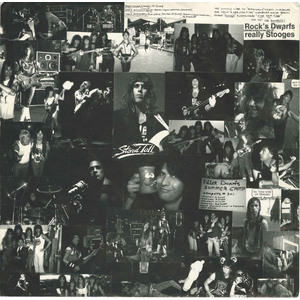
Killer Dwarfs-Stand Tall INSERT SIDE 01

Killer Dwarfs-Stand Tall INSERT SIDE 02
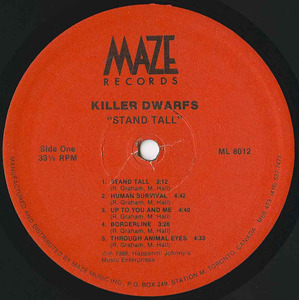
Killer Dwarfs-Stand Tall LABEL 01

Killer Dwarfs-Stand Tall LABEL 02
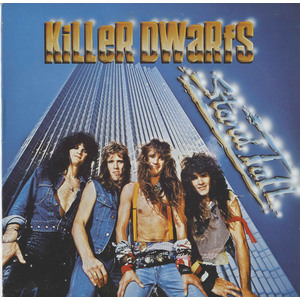
Stand Tall
Media
Videos
0 videos
No videos available for this title.
Credits
In Transit
No Comments