Insight
Joshua were a five-piece gospel-rock band from Woodstock, Ontario: Bill Broadhurst, Carl Burgess, Don Dunlop, Al Feth and Pat Gamble. They worked in tight three-part harmony over rock guitar, keyboards and rhythms with plenty of funk in them. Broadhurst and Dunlop were the group’s principal documented songwriters, with Broadhurst also writing on his own.
Contemporary liner notes by Larry Le Blanc describe Joshua working an intensive circuit of high school gym and community centre dances while rehearsing daily at a dance hall outside Woodstock.
In August 1971 GRT vice-president and general manager Ross Reynolds made a deal with Harry Hinde Productions for GRT to distribute Joshua’s singles and an album. The company put real weight behind it. GRT timed the first release to its national convention on August 12 and 13, whose showcase was a CKOC/GRT presentation at Wentworth Arena in Hamilton, so the band went in front of the dealers and staff as part of the Canadian roster GRT was building. Record World carried the signing and the release of the debut 45 in the same breath.
‘Throw A Rope’, written by the Toronto composing team of Micky Erbe and Maribeth Solomon, came out backed with Joshua’s own ‘Thoughts’, produced by Harry Hinde at Eastern Sound in Toronto. By September, Record World was reporting strong airplay for it across the country and the group already well into tracks for an album.
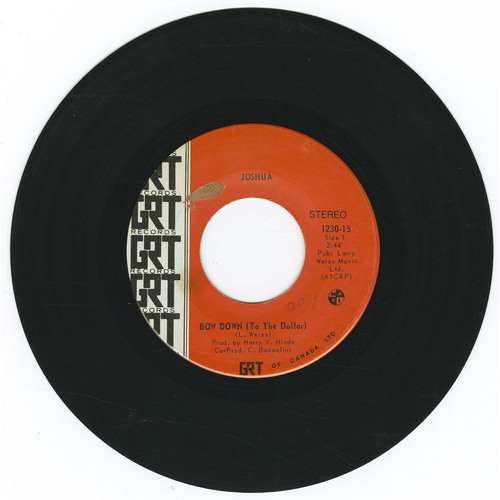
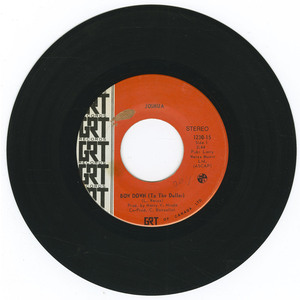
The follow-up did more. ‘Bow Down (To The Dollar)’ came from Larry Weiss, several years before he wrote ‘Rhinestone Cowboy’, and had been cut in 1970 by J.J. Jackson’s Dilemma. Joshua’s version entered the RPM 100 at No. 96 on October 30, 1971, with new action at CFNB and CKRD Red Deer, climbed to No. 66 a fortnight later and was still on the national chart in the mid-60s in December. The national number undersells it. Station surveys put the record around No. 8 in Montreal, No. 9 in London, No. 17 in Regina and No. 25 in Vancouver, and CJOE in London had it in the top ten that December. The B-side, ‘Peace Of Mind’, was a Broadhurst and Dunlop song and the one original Joshua single side that never turned up on an album.
GRT kept paying for studio time into the new year. RPM’s report on Eastern Sound at the end of January 1972 lists Joshua as the studio’s most recent label session, recorded on January 17 with Hinde producing and John Stewart on the board. The finished album, GRT 9230-1013, went to New York to be mastered by Bob Ludwig at Sterling Sound, a substantial credit for a young band out of Woodstock.
The album sets the group’s own writing among outside songs picked with some care. Joshua contributed ‘Thoughts’, ‘Come On Home’ and ‘Ain’t No Reason’, all by Broadhurst and Dunlop, and ‘Everything Is You’ by Broadhurst alone. Around them sit Larry Weiss’s ‘Bow Down (To The Dollar)’, ‘Heavy As Jesus’ by Michael Valvano, Patti Jerome and Ralph Terrana, ‘Where Would I Be Without You’ by Edgar Winter and Jerry LaCroix, Lennon and McCartney’s ‘It’s For You’, Erbe and Solomon’s ‘Throw A Rope’, Marc Benno’s ‘Two Day Love Affair’ and Dick Monda’s ‘Poor Folks’. The shape of that track list says what Hinde and GRT were after, a gospel-rock band with pop and rock reach.
‘Poor Folks’ backed with ‘Two Day Love Affair’ followed in February 1972 as GRT 1230-23, both sides trimmed a little from their album versions, with T. Rivers adding cowbell and assorted objects to the A-side. It became Joshua’s best-performing national record, reaching No. 64 on the RPM chart on April 8, 1972. It travelled as well. New Zealand’s Family label issued ‘Poor Folks’ / ‘Two Day Love Affair’ as FAY 1002 that year, among the label’s first releases alongside Freedom Express and Apollo 100.
The last GRT single, ‘Come On Home’ / ‘Thoughts’, 1230-33, appeared in July 1972 with both sides drawn from the album, though ‘Come On Home’ runs a good fifteen seconds longer on the 45 than the album listing allows it. It picked up radio play without another national chart run.
The end came quietly. On November 25, 1972, RPM announced that The Majority, then recording for Polydor, had taken on Pat Gamble, “formerly of GRT’s Joshua,” as their new drummer. The band’s recording career had lasted about eighteen months.
Gamble went on to play with Pete Dowan’s Woodstock group Dowan and died in Woodstock in 2015 at the age of 62. Carl Burgess, born June 7, 1943, kept playing for the rest of his life, remembered for his Hammond B3 and for the Burgess Trio he formed with his sisters Connie Vollmershausen and Sheran Ripski, with Doug Vollmershausen often sitting in. He died on September 28, 2016. Bill Broadhurst died in Woodstock in 2000. What became of Al Feth and Don Dunlop is not known.
-Robert Williston
Gallery
Images
2 images
45-Joshua - Bow Down to the Dollar VINYL 02
Bow Down (To The Dollar) b/w Peace of Mind
Media
Videos
0 videos
No videos available for this title.
Credits
Band Personnel
Bill Broadhurst
Pat Gamble: drums
Al Feth
Don Dunlop
Carl Burgess: guitar
Songwriting
‘Bow Down (To The Dollar)’ written by Larry Weiss
‘Peace Of Mind’ written by Don Dunlop and Bill Broadhurst
Production
Produced by Harry V. Hinde
Co-produced by C. Bassolini
Mixing
‘Bow Down (To The Dollar)’ mixed by M. Bogden
Publishing
‘Bow Down (To The Dollar)’ published by Larry Weiss Music Ltd. (ASCAP)
‘Peace Of Mind’ published by New Morning Music (BMI)
Canadian Content
MAPL designation appears on both sides
The record did get real airplay. By October 30, 1971, ‘Bow Down To The Dollar’ had entered the RPM national chart at No. 96, with contemporary station adds including Fredericton and Red Deer; later regional surveys place it as high as No. 8 in Montreal and No. 9 in London, Ontario.
The A-side also has an interesting origin: Larry Weiss’s song had already been recorded in 1970 by J.J. Jackson before Joshua cut the Canadian version
No Comments