Album / Title
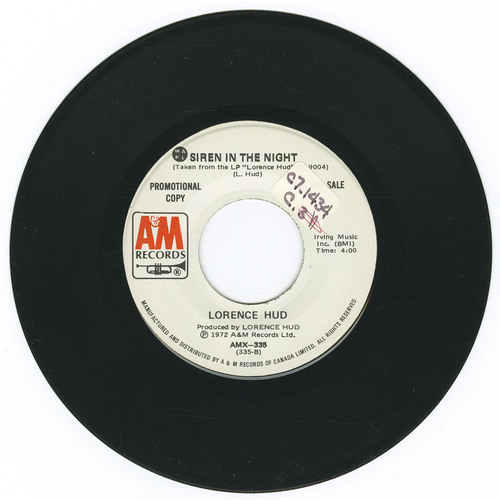
Master of Pantomime b/w Siren in the Night
By: Lorence Hud
Origin: Saskatoon, Saskatchewan → Toronto, Ontario, 🇨🇦 → Los Angeles, California, 🇺🇸 → Toronto, Ontario, 🇨🇦 → Grand Cayman, Cayman Islands, 🇰🇾 → Ontario, 🇨🇦
Insight
The sessions for Lorence Hud’s first album ran after midnight at Sound Canada in Toronto, and by the end every note on the record was his. He wrote the eleven songs, sang every vocal and played every instrument: grand piano, glockenspiel, organ, vibraphone, Mellotron, tenor saxophone, clavinet, acoustic and electric guitars, bass, drums and harmonica. The opening track, ‘Sign of the Gypsy Queen’, took him to No. 16 on the RPM 100 in 1973 and, eight years later, became one of April Wine’s signature songs.
Hud was born in Saskatoon in 1947 and picked up the guitar as a small boy. By 1973 he had spent nineteen of his twenty-six years studying and playing it. He played in rock’n’roll bands out West, among them the Saskatoon group For Keeps, whose ‘Morning Town’ reached No. 5 in Calgary in 1967, and he cut an early single for Apex, ‘Natural Loved Boy’ backed with ‘Lonely Is a Man’. From 1968 to 1970 he was a music major at the University of Saskatchewan, where, by his own account, his main goal was to play as fast as he could. Songwriting slowly pulled him away from speed for its own sake.
In 1971 he wrote ‘Sign of the Gypsy Queen’ on a 1957 Fender Stratocaster and recorded it at RCA’s Toronto studios with Bill Misener of the Paupers producing. Misener wanted to sign him, but RCA moved slowly and A&M Records of Canada got there first. Hud’s manager paid for the album sessions himself.
Chuck Britz and Ken “Midnite” Friesen engineered the record, the final mix was done at A&M in Hollywood, and the artist Christianne painted the cover portrait in her Toronto studio. A&M Canada president Gerry Lacoursiere told RPM in October 1972 that the label saw an international star in Hud and had put the biggest promotional campaign in its history behind him. Beyond the title hit, the album held ‘Summer Rose’ and ‘Master of Pantomime’, a portrait of a down-on-his-luck entertainer singing for his food and drink. The Calgary Herald marvelled that one young man from Saskatchewan had written, sung and played the whole thing, glockenspiel included. The album sold more than 12,000 copies in Canada and was issued in England, Australia, Japan and South Africa.
By Hud’s account, he played ‘Sign of the Gypsy Queen’ live for the first time at a sold-out show at Toronto’s Massey Hall in 1972. Released as a single backed with the piano ballad ‘Grab Hold & Hang On’, it hit hardest in Montreal, reached No. 9 at CKLG in Vancouver and peaked at No. 16 nationally on the RPM 100 in January 1973. A&M followed it with a promotional single pairing ‘Master of Pantomime’ with ‘Siren in the Night’, and ‘Master of Pantomime’ reached No. 86 on the RPM 100 that July.
For his second album Hud asked for the best session players he could get. A&M sent him to Tennessee, where producer Norbert Putnam booked about three weeks at his own Quadrafonic studio and at Columbia in Nashville and Audio Dimension in Memphis. Hud, who had made his first record after midnight, now started work early in the morning. The players included David Briggs, Kenny Buttrey, Larrie Londin, Kenny Malone, Mike Leech, Reggie Young, Weldon Myrick, Farrell Morris, Bobby Wood, Shane Keister and Johnny Christopher, along with the Memphis Horns, the Jordanaires, and Ginger and Mary Holladay singing with Jeannie Greene. Glen Spreen wrote the orchestral arrangements and Steve Ham engineered.
Dancin’ in My Head came out in late 1973. Hud wrote six of its songs, among them ‘Madame La Rue’ and ‘Those Good Time Songs’, and co-wrote a seventh with Will Jennings. The first single, ‘Guilty of Rock ’n’ Roll (If Music Was Against the Law)’, came from outside writer Neil Goldberg and didn’t qualify as Canadian content, but Hud and his manager, Paul Cheeseborough, released it anyway, sure it could make it without the MAPL logo. RPM put Hud on the cover of its December 8, 1973 issue. That season he played solo at the Canadian Entertainment Exposition and the Canadian Entertainment Conference, and he told RPM the Nashville musicians had spoiled him, so he would take his time choosing a road band. In 1974 he crossed Canada as special guest on the Stampeders’ tenth anniversary tour, and a new single, ‘Sweet Janie Malone’, carried ‘The Song That Annie Sings’ on the flip, a side that picked up country airplay that summer.
A&M kept issuing singles into 1975, among them ‘(Belly Up to the Bar) Flashing Signs & Neon Lights’ backed with ‘Saturday Night’, but a third album never came. That year Hud also played lead guitar on Craig Ruhnke’s ‘We’re Two Lucky People’. In 1976 he took an offer from Carmen Productions at Sound City Studios in Van Nuys, California. He was on salary to write and record alongside fellow Canadian Les Emmerson of the Five Man Electrical Band and Rick Springfield, with Mark Smith, the engineer behind Bachman-Turner Overdrive’s records, producing. The team also wrote for other artists, and Hud worked sessions at Sound City, A&M and Producer’s Workshop. An album he made with Emmerson earned an RCA deal, then sat in the vaults unreleased.
Meanwhile Myles Goodwyn had found ‘Sign of the Gypsy Queen’ on the jukebox he installed in his music room in Montreal. He remembered the record from Montreal radio, played it again and took it to April Wine. Goodwyn arranged it as a three-guitar hard rock song, adding some lyrics of his own, and the band cut it at Le Manoir for The Nature of the Beast. Released in 1981 as the album’s second single, backed with ‘Crash and Burn’, it reached No. 40 on the RPM 100, No. 18 on the CHUM Chart in Toronto, No. 57 on the Billboard Hot 100 and No. 19 on Billboard’s rock chart. Hud learned about it from a letter the band sent him. Goodwyn went out of his way to name the writer. He stopped the show at Toronto’s CNE in 1981 to credit Hud, and when a fan once asked Goodwyn for an autograph, he passed the pad to Hud and told the kid this was the man who wrote ‘Gypsy Queen’.
Frustrated at Carmen Productions, Hud moved back to Toronto in the spring of 1981 and signed with Quality Records. A promotional twelve-inch of ‘Here’s to You’ went out in 1982, followed in 1983 by a four-song mini-album of ‘Here’s to You’, ‘Don’t Touch That Dial’, ‘Private Thing’ and ‘Feel the Pulse’. Rich Dodson of the Stampeders engineered, and Hud produced it himself as Moe Bottom, a name that came from the sessions, when they needed more bottom. He told RPM the new songs were closer to his rock’n’roll band days out West, harder hitting and built with synthesizers, and that April he made the rounds of radio stations in Peterborough, Kingston and Oshawa. That summer Ottawa country singer Wayne Rostad released Hud’s ‘Summer Rose’ as a single, and it reached No. 36 on the RPM country chart. In 1984 ‘Here’s to You’ and ‘Don’t Touch That Dial’ turned up on the soundtrack of the Canadian comedy Oddballs. The full album Hud planned for 1983 never appeared.
In the mid-1980s Hud moved to Grand Cayman, in his words a remote and still undiscovered Caribbean island, and there had what he describes as the religious conversion that has shaped his life since. He later returned to Canada to care for his mother.
Goodwyn kept crediting him, right through a 2021 video, and Hud has said that April Wine’s version, carried by Goodwyn’s phrasing and energy, is always a great joy to hear.
-Robert Williston
Gallery
Images
2 images
45-Lorence Hud - Master of Pantomime VINYL 02
Master of Pantomime b/w Siren in the Night
Media
Videos
0 videos
No videos available for this title.
Credits
Musicians
Lorence Hud: all instruments and vocals by Lorence Hud including grand piano, glockenspiel, organ, vibes, mellotron, tenor saxophone, clavinet, acoustic guitar, electric guitar, bass, drums, harmonica
Songwriting
‘Master of Pantomime’ written by Lorence Hud
‘Siren in the Night’ written by Lorence Hud
Publishing
Irving Music Inc. (BMI)
Production
Produced by Lorence Hud
Release
1972, A&M Records, AMX-335, 7" 45 RPM Single, Canada
Promotional copy, not for sale
Both songs taken from the album Lorence Hud (A&M SP 9004)
Manufactured and distributed by A&M Records of Canad
No Comments