Album / Title
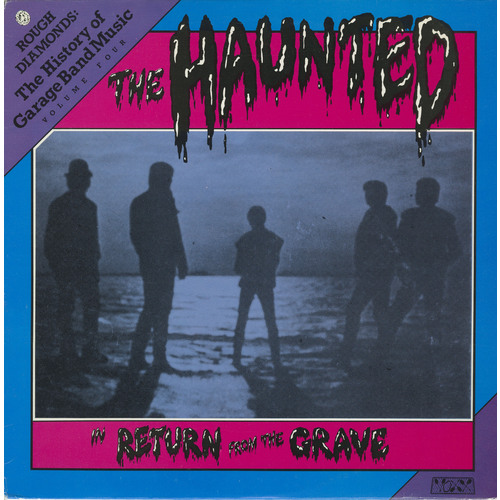
In Return From The Grave (Rough Diamonds: The History of Garage Band Music Volume Four)
By: The Haunted
Origin: Chateauguy, Québec, 🇨🇦
Insight
The Haunted
The Haunted were one of the defining Canadian rock groups of the 1960s, a Montreal band whose raw sound, confrontational appearance and enormous live following put them well outside the polished pop conventions of their time. Their recorded catalogue was small, but the best of it has outlived the band by more than half a century. ‘1-2-5’, their first single, became an international garage standard, and their only album, released in 1967, became one of the most coveted Canadian records of its era.
The history that grew up around them is less straightforward. Members came and went quickly, sessions were described differently by men who had stood in the same room, names printed on the records do not always match those the musicians used themselves, and some stories repeated for fifty years can no longer be checked against anything. Those disagreements remain part of the history rather than being tidied away.
Origins
For years the story began with an instrumental band called The Blue Jays, on Bob Burgess’s own authority. Speaking to Ralph Alfonso in 1983, he said that he and Jurgen Peter had come together toward the end of 1963 in an instrumental group of that name and had turned themselves into a vocal group late in 1964. Speaking in May 2024, he put the beginning in plainer terms. Peter was working at Northern Electric in Montreal and got Burgess a job there. Burgess did not want the job, needed the money, and neither man lasted long. Away from the plant they were already playing together, working through Ventures-style instrumentals, and as Burgess put it, he and Peter were the original people.
Pierre Faubert, a guitarist from Châteauguay, was among the next musicians involved. Al Birmingham arrived later, and Burgess had no hesitation about where to place him. When they got Birmingham, he said, they got one of the best. The recruitment method was straightforward enough. Other Montreal groups imitated The Haunted without much success, and Burgess said that if one of them turned out to have a particularly good player, The Haunted would simply go and take him. Birmingham was working in a Montreal group called the Muddy Waters when they approached him after a gig with an offer he could not refuse.
Other reconstructions put Glenn Holmes, Peter Symes, Brian Robillard and others in the shifting pre-recording lineups. The Blue J’s appear to have been a separate high-school group with which Peter had an early association rather than simply an earlier name for The Haunted.
The Canadian music business they were trying to break into barely existed. Peter described a country where domestic records received almost no radio support, recording contracts were nearly impossible to obtain, there was no national rock press worth the name and professional booking was still largely improvised. The disc jockeys played American records, and Peter said it was common knowledge that record companies paid them to do it.
Peter began building the infrastructure he needed. He rented halls and skating arenas for Friday-night dances, hired school buses to carry the fan club in from the band’s home territory, and worked out that if the local disc jockey was hired as master of ceremonies and given a cut of the gate, he would promote the show all week without the band having to purchase airtime and might also play their record. With CFCF personality Dave Boxer he went further, incorporating a bi-weekly music paper called Music Trend and a booking agency, Groups And Sound Service, known as GASS. Once a show worked, the audience came back the following week, which gave Peter somewhere to put the other local bands he was beginning to book. The Haunted were growing inside Montreal’s emerging rock scene while Peter was also helping build some of the machinery that scene ran on.
The Rolling Stones comparison followed the band for the rest of their lives, and Burgess gave two different answers to it across forty years. Talking to Alfonso in 1983 he put their influences down as mostly Stones and Kinks, with a good deal of Bob Dylan and blues. By 2024 he was pushing the Stones away and naming Chuck Berry, blues, R&B and Otis Redding as the real foundations, on the grounds that the British groups had been buying many of the same American records. Birmingham made that second point more sharply, saying he had learned ‘Oh Carol’ from Chuck Berry rather than from the Stones.
The comparison made more sense as a description of how the band looked. Montreal beat groups of the period tended toward matching suits and good manners. The Haunted cultivated something rougher. Former April Wine guitarist Gary Moffet put the difference about as well as anyone has: the other groups looked like nice guys, while The Haunted looked like they could hurt you. Fans remembered exactly that. Tim Moxam described Burgess as a performer who had clearly worked on his moves, wild on stage in jeans and grey sweatshirts instead of stagewear. A school promoter named Richard remembered booking The Haunted three times in one year for the simple reason that they guaranteed a full house.
The Montreal Forum
On January 3, 1966, The Haunted entered the Hopsville Battle of the Bands at the Montreal Forum. The competition included The Shays with David Clayton-Thomas, J.B. and the Playboys, The Staccatos and a young Andy Kim. The Haunted won, and with the victory came the recording opportunity with Quality Records that led directly to ‘1-2-5’. In his 1983 account for Ralph Alfonso, Burgess put the margin at five thousand of the eight thousand votes cast.
Burgess was careful in 2024 about what the Forum victory meant. The event did not discover them. They were already well known around Montreal through the Bonaventure Curling Club, high-school gigs and dances all over the island. What the Forum did was put them on another level. He summed up the audience reaction simply: they showed up and the place went nuts.
The prize was a session with Quality Records. Burgess, Peter, Birmingham, bassist Mason Shea and drummer Dave Wynne set up at RCA Victor’s studio on Guy Street and cut the single that fixed their reputation permanently, ‘1-2-5’ backed with ‘Eight O’Clock This Morning’.
‘1-2-5’ was written by Burgess and Peter, and Burgess’s recollection places the writing after the Forum rather than before it. Once they had the germ of the song, he reckoned it took about twenty minutes to complete.
Birmingham recalled the master going down live, without overdubs, in a few hours. Burgess in 2024 recalled a couple of takes, and in 1983 he had put the whole session at three hours with the record in the shops a fortnight later. The engineer at RCA grew increasingly agitated because the band was driving the meters into the red and refused to turn down. Eventually the head of the studio came in, asked what the problem was, told the engineer to leave, took off his jacket and let the band play at the volume it wanted while holding the recording level down from his own end.
The fuzz box Birmingham was using was homemade. Burgess was clear about who made it: Jurgen Peter built the unit himself, Birmingham liked the sound and used it. Fuzz was still unusual enough in Montreal in 1966 that the people in the room were fascinated by it. Peter’s home-built circuit, Birmingham’s guitar, Burgess’s harmonica and vocal, and a band that refused to play quietly for the equipment account for much of what people have been arguing about in that record ever since.
Peter never made peace with the recording quality. He recalled hearing expensive American productions on Montreal radio, then the disc jockey announcing ‘1-2-5’ by The Haunted and the record coming on sounding as though it had been played in a tin can. Birmingham valued exactly the quality Peter disliked. If you were into the garage thing, Birmingham said, that was what it was all about. It was raw, live and immediate.
The single appeared in the spring of 1966. Dean Jones, Bernard Perusse and Vernon Joynson all date it to April, and the discography printed on the 1983 Voxx compilation gives 4-66, while an RPM report published April 25 said the band had just finished the recording session and expected the record to appear before the end of May. The surviving chronology therefore leaves the exact release month unsettled.
The first Quality pressing called the band The Hunted and also misspelled Peter’s first name. Neither error prevented the record from taking off. Peter put early sales at 8,000 copies within a few weeks while acknowledging that he never had final figures, and trade reporting that summer had Quality’s Montreal branch alone past 10,000.
On CFCF the record reached number 2, and the company it was keeping says more than the position by itself. ‘Monday, Monday’ by The Mamas and the Papas was number 1, while ‘Paint It, Black’ by the Rolling Stones was number 3. The Haunted were sitting between them. Nationally the single reached number 23 on the RPM chart and went on to appear in the United States, Australia and parts of Europe.
The subject matter was considerably less innocent than the title suggested. Burgess said it concerned a hooker and, in 2009, added drugs to the description. The third verse was judged too explicit and the band was sent back into the studio to record a cleaner lyric, with the result that both versions reached the shops. The American issue on Amy carries the explicit verse and the Canadian Quality single carries the revised one. The track billed as ‘1-2-5 (Original Version)’ on the 1983 Voxx compilation In Return From The Grave is the Quality recording, original in the sense of the first version by the Burgess lineup rather than the original lyric.
Burgess never lost the words. Fifty-eight years later, sitting in his basement in Saint-Lazare, he spontaneously sang part of them back down the telephone: “My name’s Mary Jane. I live down the lane.”
The record also opened Ontario. Burgess recalled playing and touring with Bobby Kris and the Imperials, The Last Words and Luke & the Apostles. Toronto was an R&B town, full of large bands with horns, and Burgess said that every time The Haunted followed one of them he wondered how they were supposed to compete. The Toronto musicians told them to put everything on ten and go for it. They liked The Haunted because nobody in Toronto sounded quite like them.
The Second Quality Single
The follow-up was ‘I Can Only Give You Everything’ backed with ‘No More Lovin’’, issued by Quality in September 1966 and reaching number 62 nationally. Burgess remembered travelling to New York for the session, and Al Birmingham confirmed that both tracks were recorded at Bell Studios. The lineup was the same five musicians who had recorded ‘1-2-5’ and ‘Eight O’Clock This Morning’: Bob Burgess on vocals, Jurgen Peter on rhythm guitar, Birmingham on lead guitar, Dave Wynne on drums and Mason Shea on bass.
Wynne later remembered Shea leaving after the second single and Michel St. Germain of Les Sinners filling in temporarily. Burgess remembered that once Shea left, the group decided to continue as a four-piece because it paid better and somebody handed him a bass, the first one he had ever played. He continued on bass afterward and still described himself as a bass player nearly sixty years later.
The label credit on ‘No More Lovin’’ names four writers, Burgess, Peter, Wynne and Birmingham, and Burgess himself called it a song written by all four of them. The credit records who wrote the song rather than who played on it, since Shea was present at the session without being among its authors.
Burgess never lost his affection for ‘No More Lovin’’. In 2024 he called it one of the best things The Haunted recorded and one of his personal favourites, straight-ahead blues of the kind he always felt closest to.
The partnership behind the band was meanwhile falling apart. Peter never accepted the received explanation that a fight caused Burgess to leave. Everybody said Bob left because of an argument, he told Perusse, but Peter thought Burgess simply wanted to play his own kind of music. Burgess told it differently. In 2009 he said the two had almost come to blows and that the band had begun to feel like a job where other people were telling him what to do.
By 2024 Burgess described actual fisticuffs in the studio, after which he told Peter where to go, walked away and joined Our Generation. Even then, he refused to turn the story into a grievance. They had been friends for a very long time, he said, and he did not want to put Peter down.
Even the year of Burgess’s departure remains unfixed. Perusse placed it in 1967, while Burgess could only place it around the end of 1966 or sometime in 1967. The sequence is clearer than the date. The Burgess period at Quality ended and The Haunted needed another singer.
Johnny Monk and Trans-World
Johnny Monk came out of a north-end Montreal group called The Bohemians and did not wait to be invited. He caught The Haunted at the Manoir in N.D.G. while they were using a stand-in singer, was unimpressed, and walked up to Jurgen Peter to tell him he was the best singer in the city and that Peter had to hear him. Monk got an audition at the theatre where the band was rehearsing, sang four or five songs and was in. As he later put it, it was as simple as that. His arrival changed the band’s vocal character substantially, replacing Burgess’s sneering, harmonica-driven delivery with a heavier blues and R&B voice.
The Haunted left Quality for Trans-World, and their first record for the label was ‘Searching for My Baby’ backed with Arthur Lee’s ‘A Message to Pretty’. The credits identify Johnny Monk, Jurgen Peter, Al Birmingham and bassist Bob Bosak, whose surname also appears as Bozac and Boziak depending on the source or pressing.
The drummer’s name presents another unresolved problem. The records say Nick Farlowe. Perusse’s Gazette reporting says Nick Saraceno, and Burgess used the same name in 2024 while sitting in his basement beside the man’s old drum kit. Nothing published that we have found formally reconciles Farlowe and Saraceno, so the record credits remain under Farlowe while the later personal recollections remain under Saraceno. Saraceno was himself a founding member of The Bohemians, the same north-end group Monk had come from.
The 1967 Album
Trans-World issued The Haunted in 1967, the group’s only original album. It gathered new recordings, remakes and material already in circulation. ‘1-2-5’ was cut again with Monk singing, while ‘Searching for My Baby’ and ‘A Message to Pretty’ appeared alongside Sam Cooke’s ‘Shake’, ‘Untie Me’, the Stones’ ‘Out of Time’, the sprawling original ‘Horror Show’, ‘Twist’, and the blues performance variously titled ‘Montreal Blues’ and ‘St. Louis Blues’.
The LP sounds like a working band caught in the middle of a change, moving out of garage R&B toward blues and psychedelia while the personnel continued turning over beneath it. Dean Jones’s original sleeve notes also captured something that later international garage histories often missed: The Haunted were drawing both English and French audiences at a time when the two Montreal music scenes frequently operated in separate worlds.
Burgess had not finished with the band either. Later accounts have him returning to play harmonica and keyboards, and his 2024 interview gives one credit with no ambiguity. He played Hammond B3 on ‘Come On Home’.
The album eventually became one of the significant Canadian collector records. Peter told Perusse in 2009 that a copy had recently sold for $2,000. The scarcity helped build the mythology around the band while doing very little to clarify the recording history, which is one reason several of the best session stories remained unrecorded for another forty years.
‘Mona’, the Jet Single and The Restless Years
Ralph Alfonso’s 1983 Voxx notes grouped ‘Mona’ with the New York recordings made during the Burgess period, but Burgess’s detailed 2024 account placed the recording at Stereo Sound in Montreal, a location Al Birmingham later confirmed. The studio was in the basement of a large apartment building up on the mountain. The engineer wanted echo and achieved it by hanging microphones in an empty elevator shaft. Burgess admired both the engineer and the resulting sound, particularly Birmingham’s slide guitar, which he pointed out was still unusual among Montreal rock guitarists at the time.
While they were recording, manager Don Wayne brought The Seeds into the studio to watch. Their singer began needling Birmingham, which Burgess described as a poor choice of target. Birmingham told him where to go, The Seeds left angry, Wayne was furious with his own band, and The Haunted carried on with the session. They later played their version of ‘Mona’ for Bo Diddley at Montreal’s Esquire Show Bar and asked him what he thought. Burgess recalled little more than a grunt in response, although he remained convinced that they had made an excellent version.
The recording eventually appeared on Jet Records as JET 4002, backed with Burgess’s ‘I’m Just Gonna Blow My Little Mind To Bits’. The label billed the act as The Original Haunted featuring Bob Burgess and identified the group as having been seen on CBC’s The Restless Years. The single was issued in connection with a CBC television documentary on the band, filmed while Burgess was still a member, giving The Haunted national television exposure and creating an unusual situation in which Burgess, who had left the working group by the time the record appeared, was again being presented publicly as the voice of the original Haunted. The Jet single subsequently became one of the most sought-after records in their discography. Its release date has never been settled: Alfonso’s 1983 discography gives 1968, while the pressing data points to July 1967.
‘I’m Just Gonna Blow My Little Mind To Bits’ had an appropriately spontaneous beginning. Burgess told Alfonso that he wrote it in about ten minutes while the other musicians were cutting the A-side, taking a common expression and turning it into a song while the session was underway. They were cutting a single and needed a B-side, as Birmingham put it, so the song went down at that same Stereo Sound date. Both halves of the Jet record therefore belong to Montreal rather than to the New York session at which Alfonso’s notes have all four tracks captured. The song became one of the records most closely identified with Burgess and eventually supplied the title for the second of Voxx’s two Haunted Rough Diamonds compilations.
Quebec, Psychedelia and ‘Vapeur Mauve’
The Haunted’s standing in Quebec went considerably beyond the English-language records. Monk recalled the band moving into arenas across the province, an English group entering the French market and finding an audience that loved them. Peter said the Haunted name itself was enough to assure a promoter of a full house.
By 1968 the music was changing with everything else. ‘Land of Make Believe’ and ‘An Act of Leisure’ moved deeply into acid blues and psychedelia. Birmingham had left by then without acrimony, later joking that his one regret was that The Haunted never discovered Marshall amplifiers. Gary Marcus became central to the later sound, with Bill Smith and Joey Toplay appearing in lineups behind Monk.
‘Vapeur Mauve’ pushed the Quebec connection even further. It was a French adaptation of Jimi Hendrix’s ‘Purple Haze’, released on Marque XII in 1968 and backed with ‘Pourquoi’, a French version of The Music Machine’s ‘Talk Talk’. The B-side was actually performed by Le Spectre but credited on the label to Les Haunted, creating a discographical confusion that has followed the record ever since.
An American fan gave the single perhaps its best notice decades later. Todd Hunter, who grew up in North Carolina, told the Gazette that thanks to The Haunted he knew ‘Purple Haze’ in French before he knew it in English.
Keyboardist George Legrady later said he joined a final-period lineup with Monk, Marcus, Smith and Toplay and played keyboards on ‘Vapeur Mauve’. Parts of his chronology are difficult to reconcile with other evidence, but his account is another measure of how far The Haunted had travelled from the five-piece that recorded ‘1-2-5’.
The Autostade and the End
On July 17, 1968, The Haunted played the Summer Pop Festival at Montreal’s Autostade on a bill that included The Who, The Troggs, Mitch Ryder and the Detroit Wheels, Ohio Express, Les Baronets, Les Bel Canto, Les Mersey’s, The Rebels and Trevor W. Payne. Our Generation played the same event, placing the group Burgess had left and the one he subsequently joined on the same stadium bill.
Birmingham came back for one night that summer. The band were booked into Place des Nations and their bass player, Bill Smith, fell ill. Peter asked Birmingham, who happened to be in town, to cover, and he played the largest audience The Haunted ever headlined for on a new Hagstrom eight-string bass. The lineup that night was Johnny Monk on vocals, Gary Marcus on Peter’s old 1958 Gibson Les Paul Standard, Joey Toplay on drums and Birmingham on bass.
Peter’s appetite for the routine was beginning to fade. Things became shakier, he said, as the personnel changes came faster, and he could no longer imagine spending another six or seven years playing the same circuit even though the houses were still full.
The Haunted continued until 1971. When Peter finally folded the operation he said there was a full year of advance bookings on the books and that getting out of some of those engagements cost him heavily in legal fees. The constant personnel changes, the workload and the repetition of the circuit gradually brought the band to its end.
Dave Wynne had less patience with the mythology that grew around the recordings. He left rock in 1969 and later lived and worked in Singapore. Asked about The Haunted by Perusse, he said he had never really thought their music particularly innovative or important, although there was no denying it had been fun. Burgess, once the arguments were removed from the story, reached much the same conclusion. What he retained most strongly was the humour, the playing and the great gigs when everyone knew the band was really on.
Our Generation
Burgess went from The Haunted into Our Generation, playing bass and singing. The group issued two singles, ‘I’m a Man’ backed with ‘Run Down Every Street’ on Barry, and ‘Cool Summer’ backed with ‘Out to Get Light’ on Trans-World. Burgess confirmed the two-single catalogue in 2024, and Alfonso’s own 1983 discography lists both, Barry 3461 and Trans-World 1678, even though the prose on the same sleeve says the group managed only one.
The guitarist was Louis McKelvey, with Tim Forsyth on keyboards, and Burgess remained in contact with several of the musicians almost sixty years later. Montreal at that moment, he said, was extraordinarily dynamic, with something in the air around the entire music scene.
He also cleared up a persistent misunderstanding around ‘Out to Get Light’. The title was not ‘Out to Get Laid’, whatever listeners thought they heard. Burgess wrote it about enlightenment during a period when he was reading Lobsang Rampa and related material. People warned him that the title sounded like something else, but the record came out anyway.
The party noise heard on the recording was equally literal. Burgess said a friend arrived with several members of the road crew and a couple of bouncers, everybody started saying “party,” and that became the production plan. They partied in the studio and the noise went onto the record.
Our Generation was one chapter in a long musical life. Burgess recorded in Britain in late 1967, worked with Lilac and then the Munks, and played in the group the Munks became, Freedom North, alongside Rick St. Jean and Bill Hill. Freedom North made one of the first albums Aquarius Records ever issued, in 1970, and took ‘Dr. Tom’ to number 17 on the RPM chart, though the lineup credited on the record does not include him. He toured and recorded with Japanese singer I George, and appeared in 1975 at the one-off Chocolate Speedway show in N.D.G. Park alongside musicians including April Wine’s Brian Greenaway. Away from the stage he became music director at CFCF, later handled promotion and distribution for This Week In Business, and eventually supervised flyer sales for a group of community newspapers around Ottawa.
Aeon
In the 1970s Burgess reunited with Al Birmingham and former Rabble guitarist Rick Metcalfe in Aeon. Sources disagree over the exact span of the group, placing it either from 1974 to 1976 or continuing as late as 1978.
Around that core the band filled out with Tim Alleyne, Phillip Braginetz and Nicholas Klimko, and Burgess thought Aeon was an exceptionally strong group. Their music moved toward progressive rock in the neighbourhood of Yes and Genesis without losing the blues underneath it, and they recorded demos at André Perry’s studio in Morin Heights.
Burgess put the catalogue at roughly twenty songs. He wrote the lyrics, while the music came out of the whole band, and the SOCAN registration for ‘Once in a Lifetime’ credits all six of them: Tim Alleyne, Alan Birmingham, Phillip Braginetz, Robert Burgess, Nicholas Klimko and Eric Metcalfe, who worked as Rick. Burgess believed that song should have been a major hit, and he also singled out ‘Don’t Need No Reason’. Bernard Perusse, who later wrote the major Gazette retrospective on The Haunted, wrote liner material for Aeon and told Burgess that Montreal had completely missed the band.
A booking at the Maples Inn on the lakeshore was originally supposed to run from Thursday through Saturday, but the response was strong enough that Aeon ultimately remained there for nine weeks.
The recordings sat unreleased for forty years before Al Birmingham issued them.
The Bludgeonaires, Hank’n’Frank and The Keepers
Between roughly 1987 and 1990, Birmingham, Burgess, Johnny Monk and Nick Saraceno recorded a body of home material remembered as the Bludgeonaires tapes. The sessions produced a combination that had never existed during The Haunted’s original life, because Burgess and Monk, the band’s two principal singers, had never sung together while either man was actually a member. They finally recorded together some twenty years later.
Burgess described the period in 2024. Birmingham came back east, Monk joined them, Saraceno played drums, and the musicians wrote a considerable amount of material. Burgess and Birmingham also made informal recordings under the name Hank’n’Frank. Those later sessions help explain why the 2009 reVisited collection reaches beyond The Haunted’s original 1960s catalogue.
Burgess never stopped playing locally. In 2009 the Gazette found him singing and playing guitar in a covers group called the Neville Point Pranksters, and five years later he put together the band that closed the circle. The Keepers were formed late in 2014 by Burgess on bass, Rick St. Jean on vocals and rhythm guitar, and Nick Saraceno back behind the kit, with Bill Hill joining later on lead guitar. Burgess and St. Jean had been writing songs together for more than forty years by then, going back to the Munks in the late sixties and a run of dates in Japan. Hill had spent the sixties in J.B. and the Playboys, the matching-suit group against which The Haunted were always measured, and had been out of the business for years when Burgess telephoned him.
The Second Life of ‘1-2-5’
The band’s largest international influence developed after The Haunted had ceased to exist. ‘1-2-5’ entered the collector canon through Pebbles and the compilations that followed it. Musicians who had never seen The Haunted, and in many cases had never been to Canada, started learning the song. The Fuzztones recorded it, and versions appeared across Europe, Australia and elsewhere.
In 2001 the song entered Rhino’s four-disc Nuggets II: Original Artyfacts from the British Empire and Beyond, 1964-1969, appearing on disc one at track 20. The Haunted and The Guess Who were the Canadian groups represented. The selection contained a historical reversal: Nuggets II used the 1967 album remake with Johnny Monk singing rather than the celebrated Bob Burgess original on Quality.
Greg Shaw’s Voxx label had already done more than anyone to return the wider Haunted catalogue to circulation. In 1983 Voxx released In Return From The Grave and Part Two: I’m Just Gonna Blow My Little Mind To Bits in the Rough Diamonds series. Ralph Alfonso’s liner notes, researched with Bill Munson, shaped much of what was subsequently written about The Haunted. They also contained errors that continued to be repeated, but for collectors outside Canada the two records provided the first realistic opportunity to hear more than one or two Haunted tracks.
The Haunted reVisited went further in 2009, working from recovered masters and adding alternate versions, unreleased recordings and later home performances. The 22-track Disques Mérite CD was released on March 2 of that year.
The Gazette Brings Them Back Together
While Bernard Perusse was assembling his major Montreal Gazette retrospective, the newspaper itself became part of the later Haunted story. In December 2008 the paper posted a request for memories on its Words & Music blog. Fans, friends and former members began exchanging stories in the comments, and within days Bob Burgess, Al Birmingham and Johnny Monk, out of touch for the best part of fifteen years, had found one another again in the comments. Perusse began organising pub lunches, the musicians started seeing each other regularly, and the historical feature he was preparing had quietly restarted a set of old friendships.
Perusse’s feature appeared on October 17, 2009, built around interviews with Burgess, Peter, Birmingham and Monk and surrounded by recollections from the people who had watched them, booked them, carried their gear and followed them from dance to dance. Randy Ranson, who worked with the band setting up equipment and handling the sound, summed up the affection that remained when he said he would always love those rebels.
Al Birmingham
Birmingham came into The Haunted from a Montreal group called the Muddy Waters, approached after a gig with an offer Burgess said he could not refuse, and once he was in he stayed longer than almost anybody. He played lead on both Quality singles, on ‘Searching for My Baby’ and ‘A Message to Pretty’, on ‘Mona’, and on the 1967 album, where the sleeve credits him with background vocals as well. He left shortly after the fourth single, ‘Come On Home’, before the band turned toward Hendrix and the ballrooms, which puts his playing on very nearly everything The Haunted released while they were a going concern.
He went into helicopters not long after the band ended, eventually running a flying school on the west coast with Jurgen Peter, and settled in Delta, British Columbia. By 2009 he was retired and giving his interests as boating, music and multimedia, which in his case turned out to mean building an archive.
Much of the music these musicians made after 1971 is available at all because Birmingham kept it and then released it. The Garage Gold operation he set up around 2009 now carries the complete Aeon recordings, the Bludgeonaires material as The Works, the Hank’n’Frank sessions under the title Up To No Good, and a further collection called Mixed Grill. The band’s own archival website sits on the same domain. He remains the band’s working historian, and still the first person to ask about a session date or a personnel credit.
Johnny Monk
Monk left The Haunted for Influence, returned for the final version of the band alongside guitarist Gary Marcus, and afterward sang with Junkyard Angels and Shakedown. In 1981 he moved into the restaurant business, working at La Diligence before going on to Queue de Cheval, where he became service manager. He never stopped playing, and in later years he was working on demos with his son Jason and his daughter Emilie. Johnny Monk died of pneumonia on July 13, 2026.
He had no reservations at all about the years with the band. It was a blast from the moment he joined until the end, he said. They were a party band, and the people they appeared to be on stage were essentially the people they were.
Jurgen Peter
Jurgen Heinz Peter died at home in British Columbia on March 25, 2017, with his family around him. He was 74. After The Haunted he had developed a career in aviation, flying helicopters for the Montreal police before moving west and eventually operating a flying school for a time with Al Birmingham.
Whatever had passed between the two founders fifty years earlier, Burgess did not choose to define Peter by the argument that ended their original partnership. After Peter’s death he described him as a kind and funny man with “a fantastic grasp of the absurd,” and said that what he would remember most was that Peter had been his friend.
Bob Burgess, May 22, 2024
In May 2024 Bob Burgess was living in Saint-Lazare, west of Montreal on the road toward the Ontario border. He answered the telephone from his basement, where he had been playing a caramel-finished Squier with a maple neck that he was particularly pleased with. Fifty-eight years after ‘1-2-5’, royalty cheques were still arriving, and he knew of perhaps ten, fifteen or twenty versions of the song recorded in Europe and elsewhere. He found it remarkable that money was still appearing for something he and Jurgen Peter had written in about twenty minutes.
He could still sing the songs and could still describe the engineer at RCA fighting their volume, the fuzz box Peter had built, the New York recording trip, the microphones hanging in the elevator shaft at Stereo Sound, Bo Diddley’s reaction to ‘Mona’, The Seeds walking out of the studio, taking up bass when the band needed one, and the confrontation that eventually took him out of The Haunted. Yet when Burgess looked back over the band for the Gazette in 2009, what he emphasized was the humour, the playing and the great gigs when everyone knew the band was really on.
Near the end of the May 2024 conversation, Burgess said that what continued to surprise him was the independent life ‘1-2-5’ had acquired over the decades. He described the song as having “its own life,” an observation that made increasing sense as recordings, reissues, cover versions and royalty payments continued turning up almost sixty years after it was made. Burgess died the following winter, roughly eight months after the interview.
The Haunted made their records at a time when Canadian musicians could not assume there would be a label willing to record them, a radio station willing to play them, a booking agency capable of finding them work or an industry able to carry their music beyond their own city. Peter and the people around the band created much of what they needed themselves, from halls, buses and a fan club to a music paper, a booking agency and the records. For a few years in Montreal it worked better than anyone could reasonably have expected, and long after the band itself disappeared, the records continued travelling.
-Robert Williston
Liner Notes
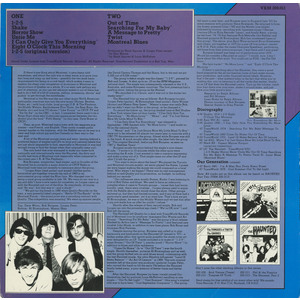
If there's one thing about Montreal, it gets damn cold sometimes, and about the only way to keep warm is to grow your hair long and jump up and down—possibly the two most basic requirements for being in a rock band; which makes it easy to explain the sheer over-congestion of musicians in Montreal and the province of Quebec as a whole. It's no easy task getting any sort of attention, so you can bet whoever makes it out of there has had to do a hell of a lot of jumping, yelling, screaming, shovin' and pushin' to get through the snowbanks.
Montreal in the 60s was like any other major North American metropolis; everyone was into the new music (Stones, Beatles, Kinks, etc.) with local clubs, local groups (J.B. & The Playboys, the Muddy Waters, Bartholomew Plus Three, the Beat Boys, the Rabble, etc) and local TV shows ("Like Young" on CFCF-TV and "Six On Six" on the CBC—in fact, I remember there used to be a Ringo Starr clone who'd alternate appearances between the two shows) plus the local "Fifth Beatle" (in this case, Dave Boxer at CFCF).
Then, as now, Montreal was a town with two separate pop scenes—one French, one English. They rarely crossed paths (except maybe on the highway, with the Rabble van on its way to a west-end high school gig and Les Classels on their way to the east-end.
A lot of the Montreal groups came and went, leaving behind a scattered legacy of singles and LPs on local and national labels that are just about impossible to find, especially in Montreal (it was bad enough trying to find the things when they originally came out).
The only band that ever managed to make any noise both nationally and internationally were the Haunted, the dirty and scruffy bad boys of Montreal rock (especially when compared to the cutesy-poo J.B. & The Playboys).
Bob Burgess, songwriter, lead singer, and co-founder of the Haunted (he is currently a music director at CFCF Radio in Montreal) took time out recently to reminisce about the group.
"Jurgen Peter (lead guitar) and myself (rhythm guitar, harmonica) got together towards the end of 1963 in an instrumental group called the Blue Jays. We changed over to being a vocal group probably in late '64. We were on our way to a gig and didn't have a new name for ourselves, so Jurgen came up with the Haunted just out of the blue. So everybody, of course, said 'No way', but that was it—and it stuck!"
"We got our big break in 1966 when Quality Records (at the time, a very powerful label) staged a "Battle Of The Bands" at the Montreal Forum—the grand prize was a recording contract with Quality. The competition was amazing! We were up against people like David Clayton Thomas and the Shays, but in the end we got 5,000 out of 8,000 votes!"
The group's debut single was the classic "1-2-5", penned by Bob and Jurgen. It shot up to no. 23 on the RPM Magazine national chart. The single was subsequently released in the U.S., Australia, and some European countries. The first pressings had a spelling error, listing the group as the Hunted.
"We recorded it in 3 hours, and it was out in the stores two weeks later!"
The Haunted line-up was as follows: Bob Burgess (vocals), Jurgen Peter (guitar), Al Birmingham (lead guitar), Dave Wynne (drums) and Mason Shea (bass). "Mason's name was really Bob, but we didn't want two Bobs in the group, so he changed it."
To record the follow-up, the group booked time at Bell Studios in New York where they cut four tracks, "I Can Only Give You Everything", "No More Lovin'", "Mona", and "I'm Just Gonna Blow My Little Mind To Bits."
"I Can Only Give You Everything" was released in September, 1966 (backed with "No More Lovin'") and made no. 62 on the national charts.
"Mona" and "I'm Just Gonna Blow My Little Mind To Bits" were not to be released till almost two years later to coincide with a CBC-TV documentary on the group, filmed while Burgess was still in the band. A much sought-after single, the label lists the group as "The original Haunted, featuring Bob Burgess, as seen on CBC's 'Restless Years'."
Burgess recalls the story behind the single's now classic B-side. "I wrote it in 10 minutes while the other guys were recording the A-side. I just wanted to take a common expression and make a song out of it. That single came out after the LP and after I'd left the group."
"You want to know about the band? We played the Toronto and Montreal circuits mostly; we never played the States. I guess we were happy making the money we could command on a local level. Why weren't we bigger? There was no real management behind us and Quality put no promotion, no budget, no nothing behind our records."
"Our influences were mostly Stones, Kinks; I was listening to a lot of Bob Dylan and blues. We used to have an inferiority complex when it came to Toronto groups...'cause they had horns. Locally, yeah, there were rivalries...Jurgen always used to argue with the Rabble about who would close the show. Other groups imitated us, but they had limited success, and if any of them had a particularly good member, we'd go steal him. That's how we got Al Birmingham, he was in the Muddy Waters and we met him after a gig and made him an offer he couldn't refuse."
Shortly after the release of their second single, Bob and Jurgen ran into the proverbial ego clash ("We're OK now") and Bob left the group.
The Haunted left Quality for a deal with TransWorld Records out of Montreal (run by producer/managers Don Wayne and Art Young). "Searching For My Baby" was the group's third release (Backed by Arthur Lee's "Message To Pretty") and featured new vocalist John Monk, in addition to new bass player Bob Bozac and drummer Nick Farlowe.
Despite leaving the group, Burgess was called in to play harmonica and keyboards on the Haunted LP (issued in '67)—a hodge-podge affair that sports quite possibly the worst cover art ever designed for an LP. Tracks included a re-make of "1-2-5", some Stones ("Out Of Time"), psycho-punk ("Horror Show") in addition to blues and other ephemera.
"Come On Home" (b/w "Out Of Time") was the fourth single. Shortly thereafter, guitarist Al Birmingham quit as well, and the group drifted into an acid-blues sound, culminating with the last Haunted single, the ultra-Hendrix influenced "Land Of Make Believe"/"An Act Of Leisure" in 1968. The only original member left at this point was producer/guitarist Jurgen Peter, who carried the band on till the early 70s before the Haunted finally faded away, a poor memory of better times and better years.
After the Haunted, Burgess (on bass/vocals) joined Our Generation (led by guitarist Louis McKelvey) resulting in one single—"Out To Get Light"/"Cool Summer" (this song's original title was to have been "Cool September Conqueror"). The group fell apart a year later, and Burgess went to England (late '67) for some sessions with producer Steve Rowlands. He returned to form the flower-powered Llilac ('68) and the Monks (one single) followed by touring/recording with Japanese singer I George (various LPs on King Records/Japan), and finally Aeon, a group he led from '74-'78 that featured Rick Metcalfe (the Rabble) and Haunted guitarist Al Birmingham (Bob has unreleased tapes of this group). The above, plus April Wine guitarist Brian Greenaway and others, got together in 1975 for a one-off live outdoor concert at N.D.G. Park under the name Chocolate Speedway, performing old faves from their previous groups. I was there and it was great!
Burgess himself was been out of performing since 1978. Would he consider a Haunted re-union? "I would, sure. I don't know about the other guys. You could call us FOG—the Fat Old Guys."
His fave tracks? "No More Lovin'" and "Eight O'Clock This Morning."
If there's one thing about the Haunted, they were a great band plagued by the all too-familiar curse of bad career moves, poor promotion, and under-financed record labels. However, that's the past—what matters today is the fact that while you're reading this, you're listening to all the tracks that matter, finally, on an LP that does the Haunted justice. Turn up the volume, comb your hair down over your eyes, shake it around some, and just blow your little mind to bits!
Research by Ralph Alfonso and Bill Munson
Liner Notes by Ralph Alfonso
Photos courtesy of Bob Burgess
Special thanks to Greg Prevost
Gallery
Images
4 images
The Haunted - In Return from the Grave BACK
The Haunted - In Return from the Grave LABEL 01
The Haunted - In Return from the Grave LABEL 02
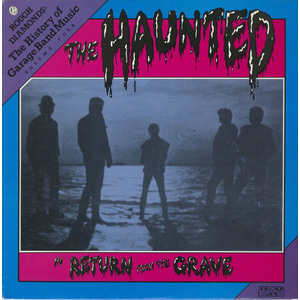
In Return From The Grave (Rough Diamonds: The History of Garage Band Music Volume Four)
Media
Videos
0 videos
No videos available for this title.
Credits
Musicians
Johnny Monk: vocals
Bob Burgess: vocals, harmonica, keyboards
Jurgen Peter: guitar
Al Birmingham: lead guitar, background vocals
Bob Bosak: bass
Mason Shea: bass
Dave Wynne: drums
Nick Farlowe: drums
Songwriting
‘1-2-5’ written by Bob Burgess and Jurgen Peter
‘Shake’ written by Sam Cooke
‘Horror Show’ written by The Haunted
‘Untie Me’ written by Joe South
‘I Can Only Give You Everything’ written by Phil Coulter and Tommy Scott
‘Eight O'Clock This Morning’ written by Al Birmingham and Bob Burgess
‘1-2-5 (Original Version)’ written by Bob Burgess and Jurgen Peter
‘Out of Time’ written by Mick Jagger and Keith Richards
‘Searching for My Baby’ written by Al Birmingham, Bob Bosak, Johnny Monk and Jurgen Peter
‘A Message to Pretty’ written by Arthur Lee
‘Twist’ written by The Haunted
‘Montreal Blues’ written by W. C. Handy
Production
Hank Squires: producer, ‘1-2-5’, ‘Shake’, ‘Horror Show’, ‘Untie Me’, ‘Eight O'Clock This Morning’, ‘1-2-5 (Original Version)’, ‘Out of Time’, ‘Searching for My Baby’, ‘A Message to Pretty’, ‘Twist’ and ‘Montreal Blues’
Jurgen Peter: producer, ‘1-2-5’, ‘Shake’, ‘Horror Show’, ‘Untie Me’, ‘Eight O'Clock This Morning’, ‘1-2-5 (Original Version)’, ‘Out of Time’, ‘Twist’ and ‘Montreal Blues’
Louis McKelvey: producer, ‘Searching for My Baby’ and ‘A Message to Pretty’
Don Wayne: producer, ‘I Can Only Give You Everything’
Liner Notes
Liner notes by Ralph Alfonso
Research by Bill Munson and Ralph Alfonso
Publishing
Kags Music
ABKCO
Elegante Music
Grass Roots Music
Copyright
℗ Voxx Records, 1983
© Voxx Records, 1983
Rights societies: BMI, ASCAP, CAPAC
Physical Release
Voxx Records
Rough Diamonds: The History of Garage Band Music, Volume Four
12" vinyl LP
Compilation
33⅓ RPM
US pressing
Released 1983
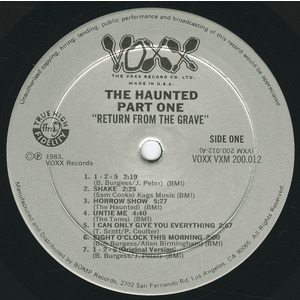
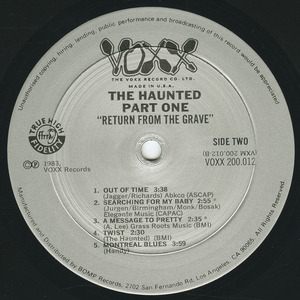
Catalogue number: VXM 200.012
Record company: The Voxx Record Co. Ltd
Licensed from Trans World Records
Distributed by Bomp Records
Manufactured by Bomp Records
Label Variations
Silver/grey labels with black printing
Matrix / runout, Side One label, inverted: VXM 200.012-A
Matrix / runout, Side Two label, inverted: VXM 200.012-B
Blue/green labels
Matrix / runout, Side One label: VXM 200.012-A
Matrix / runout, Side Two label: VXM 200.012-B
Additional Information
Issued under licence from Trans World Records, Montreal.
This is part one of two Haunted albums issued in the Rough Diamonds: The History of Garage Band Music series.
‘1-2-5 (Original Version)’ is the original 1966 recording featuring Bob Burgess on vocals. It was originally released on Quality 1814 backed with ‘Eight O'Clock This Morning’. Despite the wording “Original Version”, this is the revised-lyric Canadian Quality recording rather than the explicit version subsequently issued in the United States on Amy Records.
The other version of ‘1-2-5’ included on this compilation is the 1967 remake featuring Johnny Monk on vocals, originally issued on the Trans-World album The Haunted.
‘Shake’, ‘Horror Show’, ‘Untie Me’, ‘Twist’ and ‘Montreal Blues’ were originally released on Trans-World 6701.
‘I Can Only Give You Everything’ was originally released on Quality 1840. It was recorded at Bell Studios in New York by Bob Burgess, Jurgen Peter, Al Birmingham, Mason Shea and Dave Wynne.
‘Out of Time’ was originally released on Trans-World 1682.
‘Searching for My Baby’ and ‘A Message to Pretty’ were originally released on Trans-World 1674.
Liner notes:
If there’s one thing about Montreal, it gets damn cold sometimes, and about the only way to keep warm is to grow your hair long and jump up and down—possibly the two most basic requirements for being in a rock band; which makes it easy to explain the sheer over-congestion of musicians in Montreal and the province of Quebec as a whole. It’s no easy task getting any sort of attention, so you can bet whoever makes it out of there has had to do a hell of a lot of jumping, yelling, screaming, shovin’ and pushin’ to get through the snowbanks.
Montreal in the 60s was like any other major North American metropolis; everyone was into the new music (Stones, Beatles, Kinks, etc.) with local clubs, local groups (J.B. & The Playboys, the Muddy Waters, Bartholomew Plus Three, the Beat Boys, the Rabble, etc) and local TV shows (“Like Young” on CFCF-TV and “Six On Six” on the CBC—in fact, I remember there used to be a Ringo Starr clone who’d alternate appearances between the two shows) plus the local “Fifth Beatle” (in this case, Dave Boxer at CFCF).
Then, as now, Montreal was a town with two separate pop scenes—one French, one English. They rarely crossed paths (except maybe on the highway, with the Rabble van on its way to a west-end high school gig and Les Classels on their way to the east-end.
A lot of the Montreal groups came and went, leaving behind a scattered legacy of singles and LPs on local and national labels that are just about impossible to find, especially in Montreal (it was bad enough trying to find the things when they originally came out).
The only band that ever managed to make any noise both nationally and internationally were the Haunted, the dirty and scruffy bad boys of Montreal rock (especially when compared to the cutesy-poo J.B. & The Playboys).
Bob Burgess, songwriter, lead singer, and co-founder of the Haunted (he is currently a music director at CFCF Radio in Montreal) took time out recently to reminisce about the group.
“Jurgen Peter (lead guitar) and myself (rhythm guitar, harmonica) got together towards the end of 1963 in an instrumental group called the Blue Jays. We changed over to being a vocal group probably in late ’64. We were on our way to a gig and didn’t have a new name for ourselves, so Jurgen came up with the Haunted just out of the blue. So everybody, of course, said ‘No way’, but that was it—and it stuck!”
“We got our big break in 1966 when Quality Records (at the time, a very powerful label) staged a “Battle Of The Bands” at the Montreal Forum—the grand prize was a recording contract with Quality. The competition was amazing! We were up against people like David Clayton Thomas and the Shays, but in the end we got 5,000 out of 8,000 votes!”
The group’s debut single was the classic “1-2-5”, penned by Bob and Jurgen. It shot up to no. 23 on the RPM Magazine national chart. The single was subsequently released in the U.S., Australia, and some European countries. The first pressings had a spelling error, listing the group as the Hunted.
“We recorded it in 3 hours, and it was out in the stores two weeks later!”
The Haunted line-up was as follows: Bob Burgess (vocals), Jurgen Peter (guitar), Al Birmingham (lead guitar), Dave Wynne (drums) and Mason Shea (bass). “Mason’s name was really Bob, but we didn’t want two Bobs in the group, so he changed it.”
To record the follow-up, the group booked time at Bell Studios in New York where they cut four tracks, “I Can Only Give You Everything”, “No More Lovin’”, “Mona”, and “I’m Just Gonna Blow My Little Mind To Bits.”
“I Can Only Give You Everything” was released in September, 1966 (backed with “No More Lovin’”) and made no. 62 on the national charts.
“Mona” and “I’m Just Gonna Blow My Little Mind To Bits” were not to be released till almost two years later to coincide with a CBC-TV documentary on the group, filmed while Burgess was still in the band. A much sought-after single, the label lists the group as “The original Haunted, featuring Bob Burgess, as seen on CBC’s ‘Restless Years’.”
Burgess recalls the story behind the single’s now classic B-side. “I wrote it in 10 minutes while the other guys were recording the A-side. I just wanted to take a common expression and make a song out of it. That single came out after the LP and after I’d left the group.”
“You want to know about the band? We played the Toronto and Montreal circuits mostly; we never played the States. I guess we were happy making the money we could command on a local level. Why weren’t we bigger? There was no real management behind us and Quality put no promotion, no budget, no nothing behind our records.”
“Our influences were mostly Stones, Kinks; I was listening to a lot of Bob Dylan and blues. We used to have an inferiority complex when it came to Toronto groups...’cause they had horns. Locally, yeah, there were rivalries...Jurgen always used to argue with the Rabble about who would close the show. Other groups imitated us, but they had limited success, and if any of them had a particularly good member, we’d go steal him. That’s how we got Al Birmingham, he was in the Muddy Waters and we met him after a gig and made him an offer he couldn’t refuse.”
Shortly after the release of their second single, Bob and Jurgen ran into the proverbial ego clash (“We’re OK now”) and Bob left the group.
The Haunted left Quality for a deal with TransWorld Records out of Montreal (run by producer/managers Don Wayne and Art Young). “Searching For My Baby” was the group’s third release (Backed by Arthur Lee’s “Message To Pretty”) and featured new vocalist John Monk, in addition to new bass player Bob Bozac and drummer Nick Farlowe.
Despite leaving the group, Burgess was called in to play harmonica and keyboards on the Haunted LP (issued in ’67)—a hodge-podge affair that sports quite possibly the worst cover art ever designed for an LP. Tracks included a re-make of “1-2-5”, some Stones (“Out Of Time”), psycho-punk (“Horror Show”) in addition to blues and other ephemera.
“Come On Home” (b/w “Out Of Time”) was the fourth single. Shortly thereafter, guitarist Al Birmingham quit as well, and the group drifted into an acid-blues sound, culminating with the last Haunted single, the ultra-Hendrix influenced “Land Of Make Believe”/“An Act Of Leisure” in 1968. The only original member left at this point was producer/guitarist Jurgen Peter, who carried the band on till the early 70s before the Haunted finally faded away, a poor memory of better times and better years.
After the Haunted, Burgess (on bass/vocals) joined Our Generation (led by guitarist Louis McKelvey) resulting in one single—“Out To Get Light”/“Cool Summer” (this song’s original title was to have been “Cool September Conqueror”). The group fell apart a year later, and Burgess went to England (late ’67) for some sessions with producer Steve Rowlands. He returned to form the flower-powered Lilac (’68) and the Monks (one single) followed by touring/recording with Japanese singer I George (various LPs on King Records/Japan), and finally Aeon, a group he led from ’74-’78 that featured Rick Metcalfe (the Rabble) and Haunted guitarist Al Birmingham (Bob has unreleased tapes of this group). The above, plus April Wine guitarist Brian Greenaway and others, got together in 1975 for a one-off live outdoor concert at N.D.G. Park under the name Chocolate Speedway, performing old faves from their previous groups. I was there and it was great!
Burgess himself was been out of performing since 1978. Would he consider a Haunted re-union? “I would, sure. I don’t know about the other guys. You could call us FOG—the Fat Old Guys.”
His fave tracks? “No More Lovin’” and “Eight O’Clock This Morning.”
If there’s one thing about the Haunted, they were a great band plagued by the all too-familiar curse of bad career moves, poor promotion, and under-financed record labels. However, that’s the past—what matters today is the fact that while you’re reading this, you’re listening to all the tracks that matter, finally, on an LP that does the Haunted justice. Turn up the volume, comb your hair down over your eyes, shake it around some, and just blow your little mind to bits!
Research by Ralph Alfonso
and Bill Munson
Liner Notes by Ralph Alfonso
Photos courtesy of Bob Burgess
Special thanks to Greg Prevost
No Comments