Insight
Lloyd Hanson is a Canadian bassist, multi-instrumentalist, composer, arranger, producer, and recording engineer based in Fredericton, New Brunswick. From the late 1980s through the early 2000s, he was a central figure in the province’s independent music scene, both as a recording artist and as the founder and operator of Reel North Recording Studios, one of Atlantic Canada’s most important artist-driven recording facilities of the period.
Hanson briefly attended Berklee College of Music in Boston in 1986 before returning to Fredericton, where he began composing and recording his own material. His debut solo album, The Great Debate (1988), was recorded largely in his parents’ unfinished basement using a Tascam 244 four-track cassette recorder. Hanson performed most of the instruments himself, working within a minimal setup that emphasized composition, arrangement, and texture over studio polish. The album blends bebop, funk, rock, Latin, ambient, and avant-garde elements and received strong critical attention, including top jazz ratings in Toronto-based press. The track “Thrill of the Chase” later appeared on the Showcase New Brunswick compilation (1992) and marked a transition toward more overtly experimental and compositional work.
In 1993, Hanson released A Different Drummer under the project name Lloyd Hanson’s Thrash Peninsula. The album featured a rotating cast of Fredericton musicians including Brent Mason, Debbie Adshade, Geordie Haley, and Chad MacQuarrie, and further established Hanson’s interest in genre hybridization, extended forms, and ensemble writing. Both The Great Debate and A Different Drummer are now regarded as key documents of New Brunswick’s late-20th-century experimental music scene.
Alongside his own recordings, Hanson built an extensive career as a producer and engineer. Through Reel North Recording Studios, he produced and recorded more than 100 albums across jazz, folk, rock, heavy music, and experimental forms. His production work includes Julie Doiron and the Wooden Stars’ self-titled album, which received a Juno Award, as well as releases by Bucket Truck, Debbie Adshade, and numerous regional artists. Hanson was also a key collaborator on Brent Mason’s Down to Heaven (1995), where he contributed as producer, arranger, bassist, and multi-instrumentalist, reflecting the depth of his involvement during his most active production years.
In the early 1990s, Hanson produced North American Fiddling Champ by New Brunswick fiddler Ned Landry, a three-time winner of the North American Fiddling Championship. Landry had long been dissatisfied with earlier RCA recordings made in Toronto, and the project was conceived as a definitive artistic statement late in his life. The album documented Landry’s distinctive style and was later recognized for its cultural importance; one track was used as the theme for CBC Halifax’s Weekend Mornings program, and Landry was subsequently awarded the Order of Canada.
As a performer, Hanson appeared at festivals including the Harvest Jazz & Blues Festival and the Ottawa Jazz Festival, and was known for his use of extended-range and fretless bass instruments, including a six-string fretless F Bass originally built for Alain Caron. His playing emphasized harmonic movement, counterpoint, and textural support rather than traditional bass roles.
Hanson also worked extensively as an educator, teaching bass, contemporary harmony, and audio production from the early 1980s onward, and mentoring a generation of New Brunswick musicians and engineers. By the late 2000s, he gradually withdrew from professional music production. In 2010, he co-founded a counseling practice specializing in trauma and PTSD support for military personnel, marking a shift away from music as a primary occupation.
Although no longer active as a producer, Hanson’s recordings and productions remain important documents of Canadian independent music, particularly within New Brunswick’s experimental, jazz, and folk-rock communities. His career is distinguished by stylistic range, hands-on production methods, and a sustained commitment to artist-centered recording practices.
-Robert Williston, January 2025; updated January, 2026
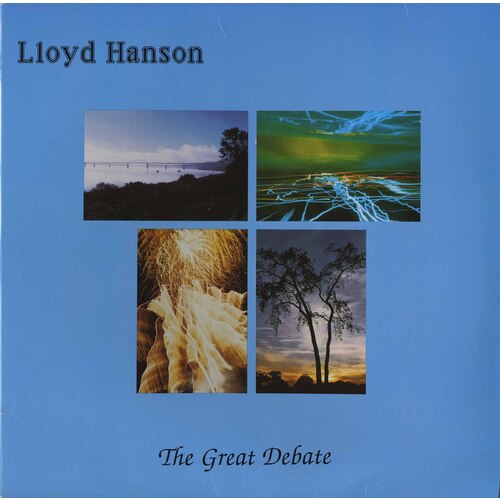
Originally posted on October 15, 2017, Hanson’s debut solo album, The Great Debate (1988), is considered a rare collector's item. This groundbreaking record fuses bebop, funk, rock, Latin, ambient, and avant-garde influences, showcasing Hanson’s technical brilliance and innovative vision as a composer and performer. The Making of The Great Debate The Great Debate stands as a testament to Lloyd Hanson’s ingenuity and determination. The album was recorded almost entirely on a Tascam 244 four-track cassette deck in Hanson’s parents’ unfinished basement. Using this modest setup, Hanson played nearly all the instruments on the album, with the exception of the horns. The title track and "Yeah Right" were the only pieces recorded outside of this setup. Hanson began working on the album in 1986, after returning home from the Berklee College of Music in Boston. Unsure of his next steps, he immersed himself in composing and recording his music. Inspired by the emerging DTK Records label in Fredericton, Hanson realized that releasing independent music in his hometown was possible. His early recordings impressed Mark Carmody, a mentor who allowed Hanson to develop his mixing skills while providing subtle guidance during the production process. Carmody’s expertise, gained from working as an audio engineer at the Banff Centre, was instrumental in shaping Hanson’s approach to production. The Album’s Legacy Upon its release, The Great Debate received critical acclaim. A review in Toronto’s The Record awarded the album the highest jazz rating of the issue, praising Hanson’s innovative genre-blending and technical mastery. A unique highlight of the album’s sound comes from Hanson’s use of a six-string fretless F Bass, originally owned by Alain Caron of the Montreal jazz-fusion band Uzeb. This bass, the first of its kind made by F Bass, became Hanson’s primary instrument for jazz and progressive folk performances throughout the 1990s. Hanson’s connection to Caron came full circle when, over a decade after The Great Debate’s release, he learned that Caron had been impressed by the album, solidifying its impact on Canada’s jazz scene. A Personal and Technical Achievement Hanson’s recording methods on The Great Debate exemplified resourcefulness. Working with analog tape and limited equipment, he not only played most of the instruments but also spliced and edited tracks by hand. His experience recording the album shaped his career as a producer and engineer, providing a foundation for his later work with Reel North Recording Studios. Hanson plans to revisit and remaster The Great Debate, ensuring its legacy lives on with improved sound quality. This album remains a testament to Hanson’s creativity, technical ingenuity, and dedication to music during a formative period of his career. Read the full artist bio here: -Robert Williston
Gallery
Images
4 images
Hanson, Lloyd - The Great Debate
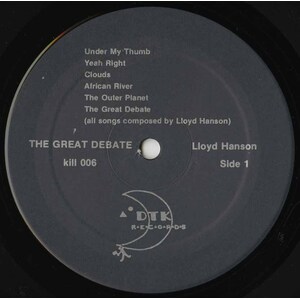
Lloyd Hanson-The Great Debate LABEL 01
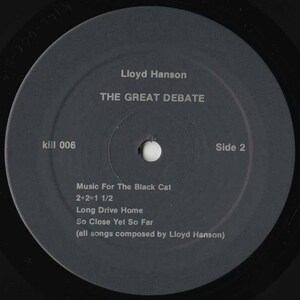
Lloyd Hanson-The Great Debate LABEL 02
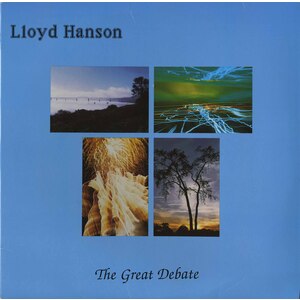
The Great Debate
Media
Videos
0 videos
No videos available for this title.
Credits
Musicians
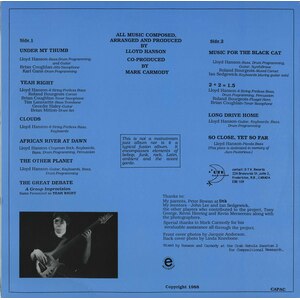
Lloyd Hanson: bass, drum programming, keyboards, guitar
Brian Coughlan: alto saxophone, tenor saxophone
Roland Bourgeois: cornet, flugelhorn
Tim Launalette: bass trombone
Geordie Haley: guitar
Karl Gans: drum programming
Brian Mitton: drums
Ian Sedgewick: keyboards
Songwriting
All music composed by Lloyd Hanson
All music arranged by Lloyd Hanson
Production
Produced by Lloyd Hanson
Co-produced by Mark Carmody
Mixed by Lloyd Hanson and Mark Carmody at The Crab Nebula Sanctum 2 for Compositional Research
Track credits
'Under My Thumb': Lloyd Hanson, Brian Coughlan, Karl Gans
'Yeah Right': Lloyd Hanson, Roland Bourgeois, Brian Coughlan, Tim Launalette, Geordie Haley, Brian Mitton
'Clouds': Lloyd Hanson
'African River at Dawn': Lloyd Hanson
'The Other Planet': Lloyd Hanson
'The Great Debate': group improvisation featuring the same personnel as 'Yeah Right'
'Music for the Black' Cat': Lloyd Hanson, Roland Bourgeois, Ian Sedgewick
'2 + 2 = 1.5': Lloyd Hanson, Roland Bourgeois, Brian Coughlan
'Long Drive Home': Lloyd Hanson
'So Close, Yet So Far': Lloyd Hanson
Dedication
Dedicated to Jaco Pastorius
Artwork
Front cover photography by Jacquie Anderson
Back cover photography by Linda Knezek
Notes
Special thanks to Mark Carmody for invaluable assistance
No Comments