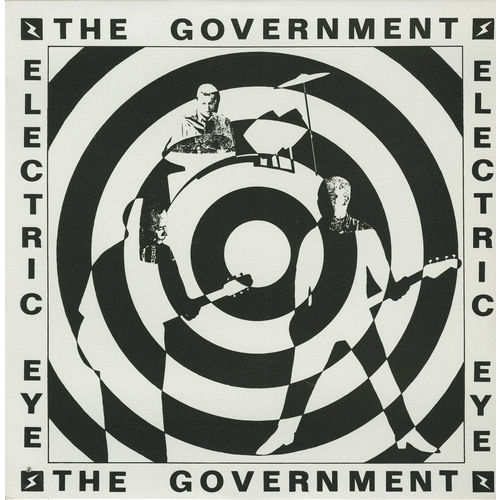
Insight
The Government came together in Toronto in 1977 to play in a stage show. Andrew James Paterson was working with VideoCabaret, the theatre, video and live music company that had debuted in a Toronto gallery the year before, when playwright Michael Hollingsworth needed a band for his new play, Punc Rok. Paterson put one together with bassist and singer Robert Stewart and drummer Patrice Desbiens, a Timmins-born poet and jazz percussionist who would go on to become one of the most admired writers in French Ontario. Desbiens held the drum chair from September 1977. The name came from rehearsals, where Marien Lewis of the Hummer Sisters started calling the musicians The Government, and it stuck.
Paterson and Stewart already moved on the edges of the art scene around A Space, and early in 1977 Paterson saw Talking Heads, then a three-piece, at A Space and again at the Ontario College of Art the following night. The Government kept that cool, deadpan distance from the three-chord bands at the Crash 'n' Burn and tied its music to performance and video. The trio split its time between VideoCabaret productions and the Queen Street circuit, playing the Crash 'n' Burn, The Edge, Larry's Hideaway and The Beverley Tavern alongside art venues like the Music Gallery. In April 1978 the Desbiens lineup was billed with the Hummer Sisters' Patty Rehearst Show for a benefit at the Toronto Free Theatre, raising money to take the production to New York. General Idea gave them a feature in File magazine.
Desbiens left in May 1978 and Edward Boyd joined the following month, beginning the lineup that made all of the band's 1979 and 1980 recordings. By 1979 the trio had left VideoCabaret to work on its own, and that year produced three records. One was a self-released single, 'Hemingway (Hated Disco Music)' backed with 'I Only Drive My Car At Night'. Another began that summer, when the band went into Comfort Sound on Dufferin Street to cut what they thought would be a demo, choosing four very different songs on purpose. The session became the 33 1/3 RPM EP on The Modern World, produced by Chris Holland with the band and distributed by Trend. 'Get You Sleepin'' came out of Punc Rok and is the closest the band came to straight punk aggression. 'Flat Tire' sent up the old blues habit of treating cars and sex as the same subject, and CFNY-FM picked it up, though many listeners missed the joke and heard a novelty song. 'Zippers Of Fire', written by Stewart and Paterson, is a deadpan duet about the push and pull between lovers, with Paterson playing the synthesizer part on a Crumar the band rented for the session.
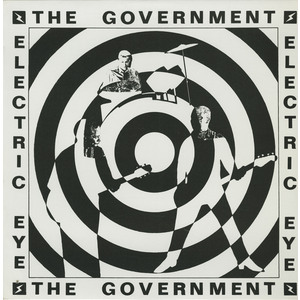
The third, Electric Eye (Voicespondence VSP 005), is a field recording made at the Music Gallery of The Government performing the songs and soundtrack of VideoCabaret's Electric Eye, playing live against a prerecorded videotape written and directed by Hollingsworth, with Paterson and Stewart inserting live vocals. Tom Sherman produced, Clive Robertson was executive producer, John Oswald engineered and Ian Murray remixed. The video's voice cast included Maury Chaykin and Jackie Burroughs, and Michael Brook was among the video crew. The songwriting credits show how much of the early VideoCabaret material carried over: Hollingsworth wrote 'It Must Be God/Downtown' and 'I Don't Really Care', and Desbiens shares credit on 'On The Prowl' and 'Gunshot Wound'.
A full studio album, Guest List, followed in 1980 on Jackal Records and The Modern World, manufactured and distributed by Trend. Its fourteen tracks were produced by The Government with Chris Holland, with Michael Keefe as executive producer. Calvin Sauro recorded twelve songs at the Sound Kitchen in Toronto; Paul Hodge recorded 'Nippon Gakki' and 'Thursday' at the Music Gallery. The album expanded the trio's instrumentation beyond its usual guitar, bass and drums. Paterson played synthesizer, slide guitar, bass, and used typewriter and tape sounds; Stewart contributed synthesizer, additional vocals and electronic sounds; and Boyd played marimba and piano as well as percussion. 'Basic Motel' incorporated video vocals by Margaret Dragu and was connected to Paterson's videotape of the same name, distributed through Art Metropole. 'Telephobia' likewise drew on video voices, including Baby Susan and Ron Number. The LP's cover art and photographs were by Paul Collins, with a front cover photograph concept by Boyd and an inside sleeve designed by Stewart.
Boyd left at the end of 1980 and Billy Bryans, a Montreal drummer who had come up in M.G. and the Escorts, took his place. With Bryans the band incorporated funk rhythms on the four-song 12-inch How Many Fingers? (Government GOV-581, 1981), which also included 'Plaza Del Pimps', 'Portrait' and 'Paranoid Downtown Funk Pt. 2'. Paterson made a music video for the title track. Neither Guest List nor How Many Fingers? sold well, and the band wanted to make a more fully produced record without the money to pay for one. There was no formal break-up. By 1982 the members had each decided to move on.
Bryans and singer Lorraine Segato formed The Parachute Club that summer, and Bryans co-wrote their Juno-winning 1983 hit 'Rise Up' before becoming one of Toronto's great champions of Latin and world music. He died in Toronto in April 2012. Desbiens returned to poetry full time and has lived in Quebec since the late 1980s.
Paterson built a long career as an interdisciplinary artist working in video, performance, film, music and writing. He served on the boards of Trinity Square Video, A Space and YYZ Artists' Outlet, curated media art programmes across the country, acted in John Greyson's Zero Patience and Bruce LaBruce's Boy, Girl, and published the novelette Not Joy Division in 2018. In 2019 he received a Governor General's Award in Visual and Media Arts, and in 2024 his life and work were surveyed in the exhibition Never Enough Night at the plumb in Toronto. When the award was announced he was living above the Cameron House on Queen Street West, the club VideoCabaret had moved into in the early eighties.
-Robert Williston
Gallery
Images
4 images
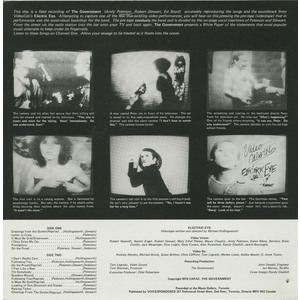
Government - Electric Eye BACK
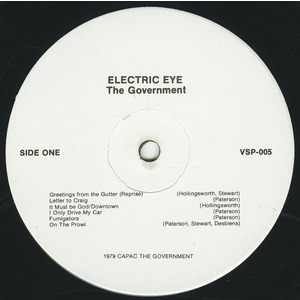
Government - Electric Eye LABEL 01
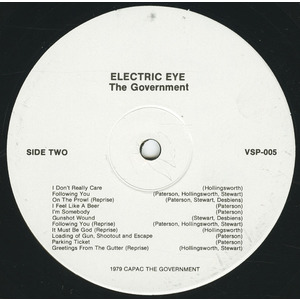
Government - Electric Eye LABEL 02
Electric Eye
Media
Videos
0 videos
No videos available for this title.
Credits
Musicians
Andrew James Paterson (Andy Paterson): guitar, vocals
Robert Stewart: bass, steel drums, vocals
Edward Boyd (Ed Boyd): drums
Jeremiah Chechik: guitar, percussion
Songwriting
‘Greetings From The Gutter (Reprise)’ written by Michael Hollingsworth and Robert Stewart
‘Letter To Craig’ written by Andrew James Paterson
‘It Must Be God/Downtown’ written by Michael Hollingsworth
‘I Only Drive My Car’ written by Andrew James Paterson
‘Fumigators’ written by Andrew James Paterson
‘On The Prowl’ written by Andrew James Paterson, Robert Stewart and Desbiens
‘I Don’t Really Care’ written by Michael Hollingsworth
‘Following You’ written by Andrew James Paterson, Michael Hollingsworth and Robert Stewart
‘On The Prowl (Reprise)’ written by Andrew James Paterson, Robert Stewart and Desbiens
‘I Feel Like A Beer’ written by Andrew James Paterson
‘I’m Somebody’ written by Andrew James Paterson
‘Gunshot Wound’ written by Robert Stewart and Desbiens
‘Following You (Reprise)’ written by Andrew James Paterson, Michael Hollingsworth and Robert Stewart
‘It Must Be God (Reprise)’ written by Michael Hollingsworth
‘Loading Of Gun, Shootout And Escape’ written by Andrew James Paterson
‘Parking Ticket’ written by Andrew James Paterson
‘Greetings From The Gutter (Reprise)’ written by Michael Hollingsworth and Robert Stewart
Production
Recording production by The Government
Produced by Tom Sherman
Executive producer: Clive Robertson
‘Electric Eye’ videotape written and directed by Michael Hollingsworth
Technical
Engineered by John Oswald
Remixed by Ian Murray
Video sound by Tom Legrady
Recorded at The Music Gallery, Toronto, Ontario
Lacquer cut at The Lacquer Channel Limited
Video Voices
Robert Nasmith
Naomi Engel
Robert Stewart
Mary Ethel Phelan
Maury Chaykin
Andy Paterson
Karen Wiens
Bernicci
Brian Condie
Jack Messenger
Gina Laight
Geza Kovacs
Alan Rosenthal
Randy Gledhill
Jackie Burroughs
Video Production
Rodney Werden
Michael Brook
Susan Britton
Chris Clifford
Tom Legrady
Marien Lewis
Bobbe Besold
D. Anne Taylor
Artwork
Cover design by Randy Gledhill
Release
Released 1979 by Voicespondence
Catalogue number VSP 005
Vinyl LP, album
Made in Canada
Published by Voicespondence, Toronto, Ontario
Copyright © 1979 The Government
Rights society: CAPAC
Matrix numbers
Side A: V.S.P. 005-A TLC-A*
Side B: VSP 005-B-3 TLC-A
No Comments