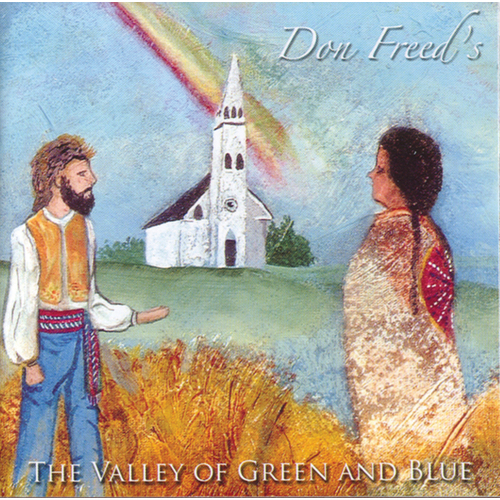
Album / Title
The Valley of Green and Blue
By: Don Freed
Origin: New Westminster, British Columbia → Saskatoon, Saskatchewan, 🇨🇦
Insight
The Valley of Green and Blue is an unusually ambitious work in Canadian roots music: a 15-song narrative history of the Métis, built not simply around historical events but around the lives, voices, humour, grief, resistance and memory of the people who experienced them.
For Don Freed, the project was a long undertaking. He began the research in 1991 with assistance from the Canada Council for the Arts, eventually developing the material through years of reading, interviews, historical research and consultation. The result is neither a conventional folk album nor a straightforward history lesson. Freed uses the form of the traditional story-song to place historical events back into the lives of ordinary people.
That distinction is important. The Valley of Green and Blue does not approach Métis history solely through governments, battles and famous political figures. Louis Riel and Gabriel Dumont are central, but so are hunters, mothers, fathers, children, voyageurs, labourers and families trying to maintain their communities while the world around them changes.
The record consequently moves between the large historical canvas and the intensely personal. Songs such as ‘Allons Pontbriard!’, ‘Mothers and Fathers’, ‘Mijakamijikok’, ‘Daughters of the Country’ and ‘The Raisin’ O’ the Kilt’ establish a people and culture before the narrative reaches its most turbulent historical chapters. ‘Loosing Freedom’, ‘Jews, Gypsies and the Half-Caste Man’, ‘1885’, ‘Duck Lake’ and ‘One Year Gone’ confront dispossession, prejudice, political conflict and the consequences of the North-West Resistance.
Yet Freed is equally interested in personalities, and this is where the album often becomes most vivid.
‘Ride, Gabriel, Ride!’ presents Gabriel Dumont not initially as a military leader, but as a buffalo hunter responsible for his community. Freed sings of Dumont hunting first for himself and then continuing for the sick, the elderly and those without guns — an arrangement described in the song as the ‘Society of Generous Ones’. Dumont's rifle, ‘Le Petit’, becomes almost another character in the story, but the song ultimately moves away from the gun: once sufficient food has been gathered, the rifle is put aside and the fiddles come out.
It is a small scene, but it encapsulates much of what Freed accomplishes throughout the record. Historical figures are not presented as monuments. They eat, work, laugh, dance, quarrel, suffer and make decisions. History becomes human again.
That approach continues in ‘The Ballad of Johnny Sansregret’, in which a relatively obscure figure is rescued from historical anonymity and given a narrative of his own. Freed repeatedly searches beyond the best-known names to find the individuals who might otherwise disappear between the larger events.
Musically, the album is grounded in the traditions its stories describe. Folk, acoustic roots music, fiddle tunes, reels, country and blues coexist naturally rather than appearing as stylistic exercises. The arrangements serve the narrative, allowing the songs to sound like stories being passed from one generation to another rather than modern compositions dressed in historical costume.
Freed is surrounded by an exceptional group of musicians, including Dan Frechette, Richard Moody, Gilles Fournier, Jeremy Rusu, Tanya Elizabeth, Sierra Noble, Scott Senior, Trevor Mills, Jordan McConnell and Leonard Podolak. Acoustic guitar, mandolin, fiddle, viola, accordion, autoharp, banjo, pipes, whistle and percussion give the record a broad traditional palette without overwhelming Freed's storytelling.
Producer Danny Greenspoon deserves particular credit for maintaining that balance. The arrangements can become colourful and spirited, but the words remain at the centre of the recording.
That matters because the project is ultimately about memory.
Freed makes the purpose explicit in his dedication. After describing his experiences singing these stories for schoolchildren and seeing young people now willing to identify themselves publicly as Métis, he dedicates the recording to the generations for whom doing so was once far more difficult.
That gives the album a meaning extending well beyond historical commemoration. The events of the nineteenth century are connected directly to the survival of identity in the twentieth and twenty-first. The past is not treated as safely concluded.
The accompanying booklet reinforces the concept. Historical photographs of Louis Riel, Gabriel Dumont, Patrice Fleury, Batoche and Riel's councillors as prisoners in 1885 sit alongside Freed's extensive narrative notes and complete songs. Rather than functioning as decorative packaging, the booklet is effectively a companion historical text.
The closing ‘When This Valley’ brings the project back to place, memory and belonging. Rather than ending with defeat or execution, Freed closes with remembrance — the land retaining the names and stories of those who lived there. The recording therefore travels through hope, dispossession, resistance, tragedy and renewal, but refuses to allow the story to terminate in 1885.
That may be The Valley of Green and Blue's greatest achievement.
It recognizes the violence and injustice within Métis history without reducing Métis history to violence and injustice. There is anger here, but also humour, courtship, food, music, family, work, celebration, pride and dancing. The people in these songs are not merely victims of Canadian history; they are participants in creating it.
The Gabriel Dumont Institute's Karon Shmon described the collection as being rich in ‘history, passion and the essence of what it means to be a proud Métis’, and that captures the broader importance of the project. Freed did not simply record fifteen historical songs. He created an interconnected musical narrative intended to carry those stories forward.
After beginning the project in 1991, Freed ultimately produced something considerably larger than an ordinary singer-songwriter album. The Valley of Green and Blue stands as a work of Canadian musical history, oral storytelling and cultural remembrance — a record in which songs become a means of preserving people, places and stories that might otherwise gradually disappear from collective memory.
-Robert Williston
Gallery
Images
1 image
The Valley of Green and Blue
Media
Videos
0 videos
No videos available for this title.
Credits
Musicians
Don Freed: acoustic guitar
Dan Frechette: mandolin, acoustic guitar, vocals
Richard Moody: viola, fiddle, vocals
Gilles Fournier: acoustic bass; vocals on ‘Loosing Freedom’
Jeremy Rusu: accordion, autoharp
Tanya Elizabeth: fiddle on ‘The Raisin’ O’ the Kilt’; vocals on ‘Daughters of the Country’
Sierra Noble: fiddle on ‘The Raisin’ O’ the Kilt’
Scott Senior: percussion
Trevor Mills: electric bass on ‘Allons Pontbriard!’; vocals on ‘Loosing Freedom’
Jordan McConnell: pipes, whistle
Leonard Podolak: banjo
Songwriting
All songs written by Don Freed
Production
Produced by Danny Greenspoon
Mixed by Danny Greenspoon
Recorded at Private Ear Recording, Winnipeg, Manitoba
Mastered by David Travers-Smith, Toronto, Ontario
Artwork
Original art by Donna Lee Dumont
Photography by Angela Brown
Layout by Derek Bachman
Archival Photography
Images courtesy of the Saskatchewan Archives Board
RB-2216: Louis Riel
RA-6277: Gabriel Dumont
SB-321: Patrice Fleury
RA-2517: Batoche
RB-714-1: Riel’s Councillors as Prisoners, 1885
Notes
Made in Canada
Gabriel Dumont Institute
Financial assistance for the project acknowledged from the Canada Council for the Arts and Parks Canada
Liner Notes
‘I began this project in 1991 with a research grant from the Canada Council for the Arts and now with 2006 drawing near, I can look back and see that what Maria Campbell told me at the beginning was true. I would find lots of stories. This recording contains but a few.’
Don Freed
Dedication
‘Recently, I have been telling stories and singing songs to school children. When I ask the groups gathered before me how many of them are Métis, I am pleased to see hands rise. There was once a dark and difficult time when this would not happen. It is to those generations who could not raise their hands that this recording is dedicated.’
Don Freed
Additional Information
15-song historical song cycle
‘Loosing Freedom’ is spelled ‘Loosing’ on the original release
The booklet contains complete lyrics, historical notes and archival photographs relating to Métis history, the Red River Settlement, Louis Riel, Gabriel Dumont, Duck Lake, Batoche and the events surrounding 1885
No Comments