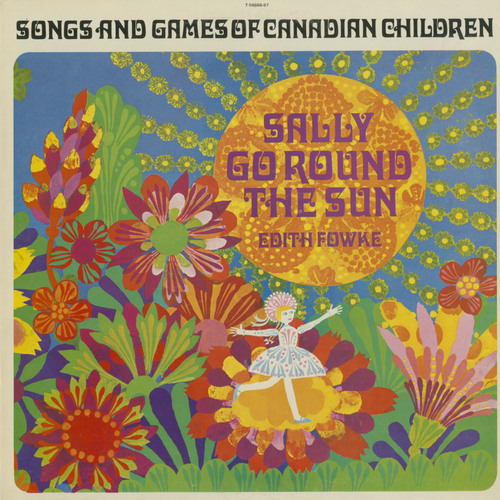
Album / Title
Songs and Games of Canadian Children: Sally Go Round the Sun
By: Edith Fowke (Edith Margaret Fulton)
Origin: Lumsden, Saskatchewan, 🇨🇦
Insight
Musicians
Betsy MacMillan: vocals
Chris Gerrard Pinker: vocals
Karen Miflin: vocals
Karen Pinker: vocals
Kevin MacMillan: vocals
Nancy Moore: vocals
Al Harris: guitar
Mary Syme: piano
Production
Keith MacMillan: producer, arranged by
Edith Fowke: liner notes
Lacquer cut at RCA Studios, Toronto
Pressed by RCA Records Pressing Plant, Smiths Falls, Ontario
Notes
Selected from the 300 songs, rhymes and singing games in the book Sally Go Round The Sun by Edith Fowke, published by McClelland and Stewart Ltd.
This record may be played on either a monaural or stereo phonograph
Liner notes
Today most traditional folklore is dying out because people no longer sing songs or tell stories for their own amusement, but children’s lore is just as much alive as it ever was. In any playground you can hear youngsters chanting age-old rhymes as they twirl their skipping ropes or bounce their balls.
This record gives a sampling of the three hundred rhymes, songs, and games of Canadian children found in the book Sally Go Round the Sun (McClelland and Stewart Ltd., $6.95). Most of them were collected from children between the ages of six and eleven within the last ten years; the rest came from adults who remembered them from their own childhoods.
These rhymes don’t come to children from their parents or teachers: they pick them up from other children, who in their turn learned them from the children before them. Most of the rhymes have their roots in the distant past, but they’re constantly being reshaped by each new generation. If you hear a group of youngsters chanting some verses that sound as though they’d been made up on the spot, the chances are that they can be matched by similar ones dating back several generations—or several centuries.
Such rhymes form the folk poetry of childhood. They show the child’s natural instinct for rhythm, his love of rhyme, his delight in playing with words, and his flights of fancy. The verses reflect his fast-changing moods: they are in turn romantic, realistic, imaginative, prosaic, sentimental, and saucy.
The songs on this record have been chanted by many Canadian children as they play games, twirl their skipping ropes, bounce their balls, or clap their hands in rhythm. They normally sing them quite spontaneously and without accompaniment, and usually out of doors. To make the record we brought half a dozen children into a studio and added some guitar and piano accompaniments, but otherwise tried to keep the spontaneous feeling of children singing for their own enjoyment. Usually they set the rhythm, and the accompanists followed them. The goal was to show the pleasure children get from singing such songs. We hope their enthusiasm will inspire other youngsters to join in as they listen to the record.
Most of the songs on Side I are used to accompany singing games: directions for the games are given in the book. The last two songs on Side I are used for skipping, and the first two on Side II for ball-bouncing. Those on Side II, Bands 2, 3, and 4 are used for clapping games; the rest are humorous verses that tickle the children’s funny bones. Nearly all the songs on Side I are old and came originally from Britain; those on Side II are more recent, and most of them originated on this continent.
Some of the singing games have an ancient and interesting history. London Bridge dates back at least three centuries, and probably more.
Some say that it reflects the destruction of London Bridge by King Olaf and his Norsemen in the eleventh century; others say that it recalls primitive sacrifices in which children were buried in bridge foundations to appease river spirits. Oranges and Lemons was first printed in Tom Thumb’s Pretty Song Book in 1744; some say it was inspired by the custom of tolling bells as prisoners were led to execution.
Today’s children still chant these ancient rhymes in much the same way as the generations before them, and, in the next breath, they may switch to such comparatively modern ditties as There Came a Girl from France, which was inspired by an English music-hall song, or Watermelons, based on an American blackface minstrel song.
Sometimes old patterns survive but take on new forms. When I Was a Baby is a recent version of an old British song, When I Was a Young Girl, and Going Over the Sea and The Ants Came Marching are recent variations on the old nursery rhyme, One, Two, Buckle My Shoe.
Most of the songs are known throughout the English-speaking world, but a few have taken on local references. For example, the father of the pretty little Dutch girl stayed in bed at Gravenhurst—a reference to an Ontario sanitarium, and the well-known soldiers’ song, I Don’t Want No More of Army Life, has acquired a Canadian refrain.
Edith Fowke
Gallery
Images
2 images
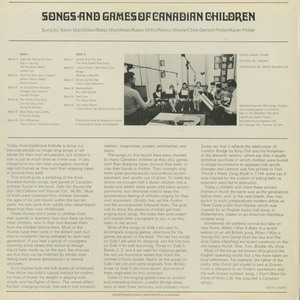
Edith Fowke - Songs and Games of Canadian Children: Sally Go Round the Sun Back cover
Songs and Games of Canadian Children: Sally Go Round the Sun
Media
Videos
0 videos
No videos available for this title.
Credits
In Transit
No Comments