Album / Title
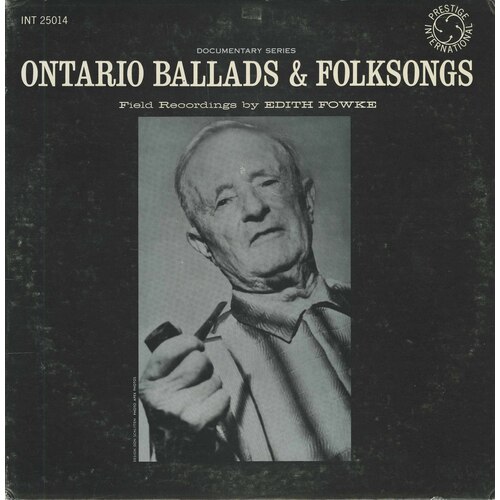
Ontario Ballads & Folksongs
By: Edith Fowke (Edith Margaret Fulton)
Origin: Lumsden, Saskatchewan → Toronto, Ontario, 🇨🇦
Insight
Edith Fowke (1913–1996) was one of the central architects of modern Canadian folklore studies and the foremost collector of English-language traditional song in twentieth-century Canada. Born Edith Margaret Fulton in Lumsden, Saskatchewan, she began writing and editing early, studied English and history at the University of Saskatchewan, and moved to Toronto after her marriage in 1938. There, frustrated by how little Canadian traditional song had been published or recorded, she began the work that would define her career: locating singers, documenting repertoires, and bringing vernacular tradition into both public culture and serious scholarship. By the time of her death, she had published more than twenty books and had become the single most influential figure in the preservation and interpretation of English-language folk tradition in Canada.
Fowke’s most transformative work began in the 1950s, when she took recording equipment into rural Ontario and demonstrated that the province—often assumed to be poor in survivals of traditional song—contained a deep and vibrant oral repertoire. In the notes to Folk Songs of Ontario (Folkways FM 4005, 1958), she positioned the album as a field-recorded survey of songs from the province; the album’s title page explicitly credits it as “Recorded and with Notes by Edith Fowke.” Smithsonian Folkways still describes the album as a 1958 collection of Ontario folksongs sung by a range of traditional performers, noting that many had not previously reached a general audience. Her own liner notes for Lumbering Songs from the Ontario Shanties (Folkways FM 4052, 1961) make the scope of that achievement clear: she writes that most of the folk songs she found in Ontario had survived through the lumber camps, that many of her best singers came from the Peterborough region, and that she had recorded the album’s singers in their homes in 1957 and 1958. Smithsonian Folkways similarly describes that LP as a set of field recordings—many made in the lumbermen’s own homes—capturing both occupational songs and memorial ballads of the Ontario shanties.
These two Folkways albums are especially important because they show Fowke at work in two complementary modes: as a broad surveyor of Ontario’s song traditions and as a specialist interpreter of the lumberwoods repertory. Folk Songs of Ontario documents a wide provincial soundscape, from local and historical ballads to crime songs and immigrant survivals. Lumbering Songs from the Ontario Shanties, by contrast, narrows the focus to the occupational world that Fowke herself identified as crucial to the survival of Ontario song. In the FM 4052 notes she explicitly argues that, with few exceptions, the traditional songs still recoverable in Ontario owed their survival to the shanties, and she singles out the Peterborough district as her richest collecting ground. That argument remains one of her most durable scholarly contributions: she did not merely preserve songs, she explained the social ecology that kept them alive.
Her reach extended far beyond fieldwork. Fowke became one of the major public voices for traditional music in Canada through CBC radio, preparing Folk Song Time (1950–63), Folk Sounds (1963–74), Folklore and Folk Music (1965), and The Travelling Folk of the British Isles (1967). She began teaching folklore at York University in 1971, later also taught in the University of Calgary’s Kodály program, helped found the Canadian Folk Music Society in 1956, and became editor of the Canadian Folk Music Journal in 1973, a role she held until her death. She was equally influential as a scholar and editor, publishing major collections and reference works including Folk Songs of Canada (with Richard Johnston, 1954), More Folk Songs of Canada (1967), The Penguin Book of Canadian Folk Songs (1973), Folklore of Canada (1976), and numerous anthologies of children’s lore, folktales, legends, and Canadian traditional song.
Fowke’s honours reflect the breadth of that legacy. She received honorary doctorates from Brock, Trent, York, and Regina; was named a Fellow of the American Folklore Society; was appointed a Member of the Order of Canada in 1978; and became a Fellow of the Royal Society of Canada in 1983. The Governor General’s citation recognized her as a folklorist, author, and York professor who had made “a valuable contribution to our heritage” by preserving the traditional songs and folklore of Ontario. After her death in 1996, her influence only broadened: her recordings continued to circulate through Smithsonian Folkways and archival collections, and in 2011 the Canadian Songwriters Hall of Fame honoured her with the Frank Davies Legacy Award, recognizing her role in safeguarding the repertories on which later generations of singers and scholars continue to draw
-Robert Williston
Production
Recording and Notes by Edith Fowke
Produced by Kenneth S. Goldstein
Liner notes:
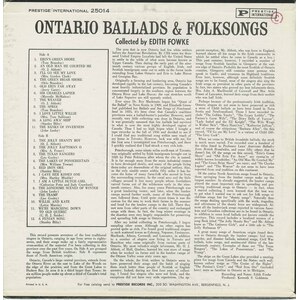
This record presents seventeen of the best traditional singers in Ontario, ranging in age from seven to eighty-seven, and their songs make up a fairly representative cross-section of the material I’ve been collecting in this province over the past five years. On Side A are grouped the songs from British tradition; Side B represents those of North American origin.
Ontario, Canada’s large central province, extends from the Ottawa River on the east to Lake of the Woods on the edge of the prairies, and from the Great Lakes to Hudson Bay. In area it is a third larger than Texas; its six million people make up about a third of Canada’s total population.
The area that is now Ontario had few white settlers before the American Revolution. By 1784 some ten thousand United Empire Loyalists had left the United States to settle in the wilds of what soon became known as Upper Canada. Then during the early part of the nineteenth century various groups of English, Irish, and Scottish immigrants came out to settle in the forest lands extending from Lakes Ontario and Erie to Lake Huron and Georgian Bay.
Originally a farming and lumbering area, Ontario has developed rapidly in the last century, becoming Canada’s most heavily industrialized province. Its population is concentrated largely in the southern region between the Ottawa River and Lake Huron: the vast stretches north of Lake Superior are still sparsely settled.
Ever since Dr. Roy Mackenzie began his “Quest of the Ballad” in Nova Scotia in 1909, and Elizabeth Greenleaf published her Ballads and Sea Songs of Newfoundland in 1933, it’s been clear that Canada’s maritime provinces were a ballad-hunter’s paradise. However, until recently very little collecting was done in Ontario, and it was generally assumed that few ballads had survived in what is now the most highly developed region of Canada. Thus I had no high hopes when I bought a tape recorder in the fall of 1956 and decided to see if I could find any traditional songs within easy reach of my home in Toronto. However, luck was with me, for the first area I investigated was Peterborough, and there I quickly realized that I had struck a very rich lode.
Peterborough, some ninety miles north-east of Toronto, was originally settled by Irish immigrants brought out in 1825 by Peter Robinson after whom the city is named. It is far enough away from the main industrial centers to have developed slowly, and many of the people living there today are descendants of the original settlers. Also, as the only sizable center within fifty miles it has become the home of many farm-folk who moved in from the surrounding country. In the rural area and the little villages around it live many people whose forefathers carved farms out of the wilderness early in the nineteenth century. Also, for many years Peterborough was a great lumbering center, and later, when the lumber camps moved farther north, many of the Peterborough men followed them. Until quite recently most of the custom for the men to work their farms in the summer and head for the lumber camps in the fall. There they met men from other parts of the country and exchanged songs with them. In fact, the long winter evenings in the shanties were very largely responsible for preserving and spreading folk songs in Ontario.
After my initial collecting in Peterborough, I began sampling other areas. Although no other region has proved quite as rich, I’ve found good traditional singers in such scattered towns as Cobourg, Napanee, Ennismore, Marlbank, Athens, Cornwall, and Lancaster, in addition to a number of singers now living in Toronto and Hamilton who came originally from various parts of Ontario. My most valuable single informant, Mr. O. J. Abbott, of Hull, Quebec, learned his vast store of songs when he worked on farms and in the lumber camps of the Ottawa Valley some sixty years ago.
On the whole, the Irish settlers in Ontario seem to have preserved their songs and the habit of singing them much better than people of Scottish or English ancestry. Indeed, during my first four years of collecting, I found few singers who were not Irish, and the exceptions did not have very wide repertoires. (An apparent exception, Mr. Abbott, who was born in England, learned almost all his songs in the Irish community in which he settled when he came to Canada as a boy.) This past summer, however, I recorded a number of songs from Scottish families in Glengarry at the eastern edge of Ontario. Probably the most Scottish of Ontario counties, Glengarry still contains some persons who speak Gaelic, and treasures its Highland traditions. Even here, however, although some definitely Scottish songs are to be found, most of the singers also sing the Irish songs so prevalent in other parts of the province. In fact, two sisters who proved my best informants there, Mrs. John A. MacDonald of Cornwall and Mrs. Arlie Fraser of Lancaster, learned their songs from their mother who was half Irish.
Perhaps because of the predominantly Irish tradition, Ontario singers do not seem to have preserved as rich a store of Child ballads as have been found in Nova Scotia and Newfoundland. Those I have recorded include “The Golden Vanity”, “The Gypsy Laddie”, “The Farmer’s Curst Wife”, “The Dewy Dells of Yarrow”, “Lady Isabel and the Elf Knight”, “The Wife Wrapt in Wether Skin”, “Mary Hamilton”, “Katherine Jaffray”, and of course the ubiquitous “Barbara Allen”. On this record, “I’ll Go See My Love” is a variant of Child 248: “The Grey Cock”.
When we come to British broadside ballads, the stock is much more varied. I’ve recorded over a hundred of the titles listed in Professor Laws’ American Balladry from British Broadsides, and some fifty others that he doesn’t list. Of the songs on this record, “Erin’s Green Shore” and “Old Erin Far Away” are examples of widely known broadsides; “An Old Man He Courted Me” and “The Green Briar Shore” are rare; and “Sir Charles Napier” and “The Weaver” do not seem to have been reported from oral tradition on this continent.
Of the native North American songs found in Ontario, those springing from the lumber camps make up the largest number. As already suggested, the lumber camps played the most important role in spreading and preserving traditional songs in Ontario — in fact, when I started collecting I soon learned that the best way to get what I wanted was to ask not for folk songs or old-time songs but for “shanty songs”. Naturally then, the songs dealing specifically with the work, tragedies, and adventures of the shanty boys are widespread. Almost all the lumberjack songs reported in various American and Canadian collections are to be found in Ontario, in addition to some local ballads not known outside the province. This record includes a localized version of a song Beck titled “The Jolly Shanty Boy” and Mr. Abbott knew as “The Gatineau Girls”, and a little ode to “The Jolly Raftsman O”.
A great many songs of American origin found their way to Ontario through the lumber camps: bad man, murder, and disaster ballads, minstrel songs, Civil War ballads, hobo songs, and sentimental ditties of the late nineteenth century. Examples of these on the record are “The Texas Rangers”, “The Lakes of Ponsereetain”, and “The Tramp”.
The ships on the Great Lakes also provided a meeting place for songs from Canada and the States: such well-known sailors’ songs as “The Cruise of the Bigler”, “The Persian’s Crew”, and “Red Iron Ore” (included here) were as familiar in Ontario as in Michigan.
Gallery
Images
2 images
Edith Fowke - Ontario Ballads & Folksongs
Ontario Ballads & Folksongs
Media
Videos
0 videos
No videos available for this title.
Credits
In Transit
No Comments