
Insight
Formed in Sydney in 1968, The Flying Circus began as a harmony-rich, folk-rock quartet inspired by The Byrds and Buffalo Springfield, with roots extending back to New Zealand’s Castaways. Founding members Doug Rowe (guitar/vocals), Bob Hughes (bass/vocals), Jim Wynne (vocals/guitar), and Colin Walker (drums) shared a deep passion for California's emerging country-rock sound. Their early sets were filled with tight harmonies and shimmering 12-string Rickenbacker guitar work, earning them local attention for their covers of Dylan, The Dillards, and other acoustic icons.
By 1969, the group’s sound was swept up by commercial demands, leading to a trio of Australian pop hits—“Hayride,” “La La,” and “Run Run Run.” Though successful on the charts, these songs, written by American bubblegum hitmakers Buzz Cason and Mac Gayden, misrepresented the group’s deeper musical ambitions. Despite growing dissatisfaction with their teen pop image, the band persisted, releasing two LPs—The Flying Circus (1969) and Prepared in Peace (1970)—that gradually reclaimed their artistic identity with original songs steeped in folk and country influences.
Their creative breakthrough came too late for Australian mainstream radio. Frustrated with the lack of critical recognition at home, the band entered and won the 1970 Hoadley’s Battle of the Sounds competition. Their grand prize—a round-trip ticket to Los Angeles—provided the springboard they needed. In 1971, they left Australia for North America, eventually settling in Toronto, Canada, where they would enjoy the most artistically and commercially fulfilling years of their career.
Once in Canada, The Flying Circus found a far more receptive audience. Backed by Capitol Records and Toronto's Music Factory Agency, they embarked on a national tour and began promoting their first Canadian release, Prepared in Peace (1971), issued on Capitol ST-6365. Though recorded earlier in Australia with producer Mike Perjanik and engineered by David Woodley-Page at EMI Studios, the album marked the group’s formal introduction to Canadian audiences. Its all-original material leaned further into folk and country influences, and it was thoughtfully repackaged for the Canadian market by Wayne Patton. While Prepared in Peace was not a Canadian production per se, it served as a transitional record—bridging their pop past with the rootsier direction they would soon fully embrace.
Their creative breakthrough came with Gypsy Road (1972), the first LP recorded entirely in Canada. Tracked at Thunder Sound Studios in Toronto and produced by Paul Hoffert and Bruce Bell, the album featured prominent local collaborators including Bob McBride (vocal arrangements), Lenny Solomon (violin), and others. The LP’s textured harmonies and refined songwriting earned the band their first true commercial and critical recognition in Canada, solidifying their place in the local country-rock scene.
Gypsy Road also reflected the band's integration into Toronto’s vibrant music scene, with a number of Canadian musicians and technicians contributing to the album:
Bob McBride (of Lighthouse) arranged vocals alongside the band, adding polish and harmonic depth.
Lenny Solomon, celebrated Toronto violinist and future co-founder of Myles & Lenny, added strings to the title track.
Rob Lehman, a local pedal steel guitarist, brought warmth and texture to multiple tracks.
Dick Armin (cello) and the enigmatic Fatman (piano, vibes, and canary) further expanded the sonic palette.
Produced by Paul Hoffert (also of Lighthouse) and Bruce Bell under the H.P. & Bell Productions banner, Gypsy Road was recorded at Thunder Sound Studios, Toronto, engineered by Bill Seddon, and mastered by George Marino at The Cutting Room in New York. Its Canadian release featured a textured gatefold sleeve with full lyrics, underscoring the care and confidence the band placed in the work.
The album was reissued in 1973 under the simplified title Flying Circus (Capitol ST-6391), with the same tracks reordered. In 2015, Gypsy Road received a deluxe CD reissue on Big Pink Records in South Korea (BIG PINK 401), affirming its enduring legacy among collectors and fans of early ’70s country rock.
Despite internal changes—Jim Wynne departed before the Canadian move, Sam See came and went, and Greg Grace rejoined during the Toronto years—the group held together long enough to record one final LP, Last Laugh (1974), before disbanding.
Though no Canadian-born musicians joined the band, their time in Toronto left a permanent imprint. Terry Wilkins chose to stay in Canada, becoming a pillar of the Toronto roots and blues scene, performing with Dr. John, Maria Muldaur, and Lighthouse. Doug Rowe remained for several years, operating a Toronto studio before returning to Australia, where he later joined Grand Junction and earned a Golden Guitar at the Tamworth Country Music Festival. Greg Grace also stayed behind the scenes in Canada, working as a road manager and technician with acts including Wireless and Glass Tiger.
Doug Rowe passed away in 2015, but the music he and his bandmates created during their Canadian chapter remains vital. For a band born in Sydney and transformed in Toronto, The Flying Circus's story is one of reinvention, resilience, and musical integrity—charting a course that led not to stardom, but to artistic self-discovery and timeless songs.
Note: Not to be confused with the Toronto-based band also named Flying Circus, formed in 1967 by Bruce Cockburn, Neil Lillie (later known as Neil Merryweather), Marty Fisher, and Gordon MacBain. That earlier Flying Circus was part of the Yorkville coffeehouse scene in Toronto and is notable for bridging folk, jazz, and early psychedelia before evolving into The Mynah Birds, Merryweather, and Maple Oak. The two bands shared no members and developed independently, though the Australian Flying Circus would later relocate to Toronto in 1971, leading to understandable confusion among collectors and historians.
-Robert Williston
PREPARED IN PEACE
Clean like the falling rain
Warmed by the sound of your name
Dried by the fires of pain
Dreaming won't leave you the same.
Musicians
Doug Rowe: guitar, steel guitar, vocals, backing vocals
Red McKelvie: guitar, lead guitar, mandolin, vocals, backing vocals
James Wynne: guitar, vocals, backing vocals
Terry Wilkins: bass, vocals, backing vocals
Colin Walker: drums
Mike Perjanik: organ, piano, harpsichord
Production
Produced by Mike Perjanik
Engineered by David Woodley-Page
Artwork
Photography by Greg Weight
Prepared for release in Canada by Wayne Patton
Notes
Recorded in Australia by E.M.I. (Australia) Ltd.
Gallery
Images
4 images
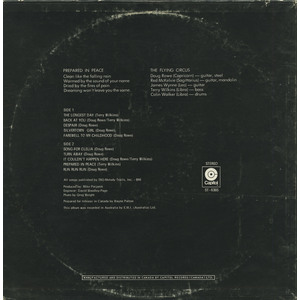
Flying Circus - Prepared In Peace BACK
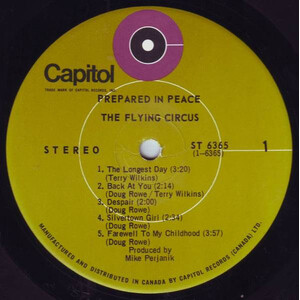
The Flying Circus – Prepared In Peace (2)
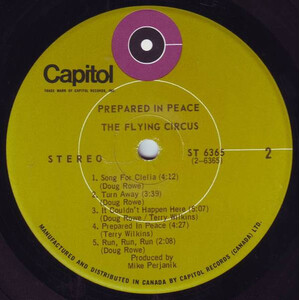
The Flying Circus – Prepared In Peace (1)
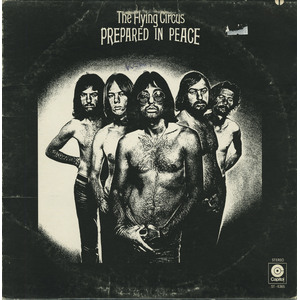
Prepared In Peace
Media
Videos
0 videos
No videos available for this title.
Credits
In Transit
No Comments