Insight
Wayne Fehr was one of Manitoba’s most compelling independent country singer-songwriters of the 1970s, a prairie-bred performer whose music blended dancehall grit, heartfelt storytelling, and the kind of lived experience that can’t be manufactured. Though his recording career was brief, the two albums he released on Winnipeg’s Sunshine Records — Mood Country (SSLP-4005) and Buckskin & Satin (SSLP-4011) — stand as deeply personal documents of a self-made artist who built his reputation the hard way: on the road, in hotel lounges, rural halls, and the small-town circuits of Western Canada. The two LPs remain the core of his recorded legacy and are confirmed in discographic sources.
Born in Altona, Manitoba, Fehr spent the first ten years of his life there, developing an early love for country music. At age nine he first picked up a borrowed guitar, and by the time he received one of his own for Christmas a few years later, music had already taken hold. His first public appearance came at 13, when he won an amateur talent contest and earned a spot on a variety television show — an early indication of the confidence and determination that would shape his career.
By the age of 16, Fehr had left school to join a travelling dance band, spending three years learning the realities of life as a working musician. In 1969, he formed his own country group, Spittin’ Image, and quickly discovered that leading a band meant more than just performing. Fehr became its promoter as well, travelling from town to town and convincing hotel owners that their rooms needed country music. The approach worked. Spittin’ Image soon developed a strong following, and in 1971 the band launched an ambitious cross-Canada tour. Although the road initially brought success, jobs became harder to secure as the months wore on, and within a year both the tour and the group had come to an end.
Returning to Manitoba at a low point, Fehr spent a period away from music while working through personal difficulties. His life changed again in 1973 when he met Rita, who soon joined a revived Spittin’ Image lineup. When Fehr’s uncle became part of the act, the group evolved into The Country Kinfolk, a family-based country unit that performed across Manitoba. The group recorded an album featuring two of Fehr’s own songs, ‘The Wedding Song’ and ‘Cajun Lullabyou,’ marking an important early step in his development as a songwriter.
A devastating turning point came in the winter of 1976. While returning home from a show, Wayne and Rita were involved in a serious automobile accident. Rita was killed, and Fehr suffered a badly shattered leg that left him hospitalized for months. During his long recovery, he turned intensely to songwriting, pouring his grief, memories, and reflections into a new body of work. Those songs would become the foundation of his debut solo album.
Released in early 1977, Mood Country introduced Fehr as a fully formed songwriter. The album was significant not simply as his first solo LP, but as the first record on which he wrote all of the material himself. Its songs were shaped directly by his recovery and emotional upheaval, including ‘Memories,’ ‘Painted Desert,’ ‘I Will Love You,’ ‘Talk To Me,’ and ‘First Love.’ The back-cover liner notes emphasized the deeply personal nature of the material, describing each song as a direct expression of lived experience rather than a stock country exercise. One of the album’s best-known tracks, ‘When I Come Truckin’ Home,’ later resurfaced decades afterward on the various-artists compilation Trucker’s Highway Songs, a testament to its long afterlife among Canadian country and trucking-music listeners. Mood Country is documented as Sunshine Records SSLP-4005.
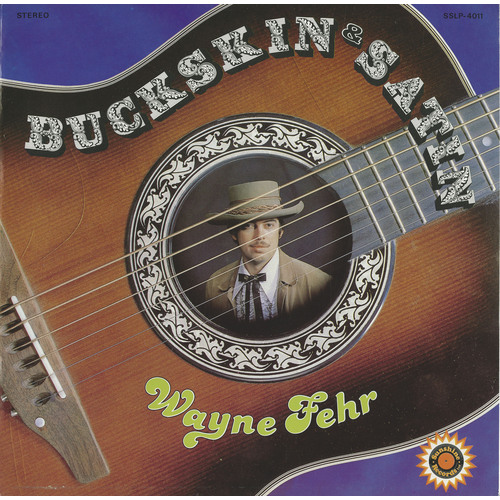
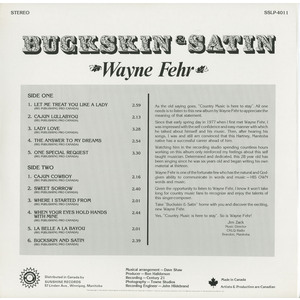
Fehr returned with a second LP, Buckskin & Satin, in 1978. If Mood Country was intimate and reflective, Buckskin & Satin broadened the picture, showing a writer equally comfortable with romantic ballads, prairie imagery, and radio-friendly country singles. The album’s back-cover liner notes, written by CKLQ music director Jim Zack, praised Fehr as one of the rare artists able to communicate in “his own words and music,” highlighting both his self-taught musicianship and his determination. Buckskin & Satin is confirmed as Sunshine Records SSLP-4011.
Several singles were drawn from the album, most notably ‘Let Me Treat You Like A Lady,’ which became Fehr’s strongest national chart showing and is reported to have reached No. 41 on the RPM country chart in 1978. Two follow-up singles — ‘Cajun Cowboy’ b/w ‘Sweet Sorrow’ and ‘Buckskin & Satin’ b/w ‘When Your Eyes Hold Hands With Mine’ — did not match that success, but they reinforced his standing as one of Manitoba’s most promising country artists of the period. The chart peak for ‘Let Me Treat You Like A Lady’ is reported in discographic/collector sources and should be treated as a strong working figure unless you later confirm it issue-by-issue in RPM.
Beyond his own recordings, Fehr also contributed to the wider Manitoba country scene as a songwriter for other artists. Most notably, fellow Manitoban Sheila Dawn recorded Fehr compositions including ‘Once In A Lifetime’ b/w ‘Dance Hall Cowboy’ and later ‘First Snow Of The Year,’ both of which reached the RPM country charts in 1979 and 1980. His role in helping support Dawn’s early career further underscores that Fehr was not only a performer, but also a builder within the province’s country music community.
In 1979, Fehr also helped organize the first Call of the Wild Mountain Music Festival alongside festival president Lewis Kaselitz, appearing at the event before an audience reportedly numbering in the thousands. By that point he had established himself as a recognizable and respected presence on the Western Canadian country circuit: a singer, songwriter, bandleader, promoter, and road veteran whose career had been shaped as much by resilience as by talent.
-Robert Williston
Songwriting
‘Let Me Treat You Like A Lady’ written by Wayne Fehr
‘Cajun (Lillabye)’ written by Wayne Fehr
‘Lady Love’ written by Wayne Fehr
‘The Answer To My Dreams’ written by Wayne Fehr
‘One Special Request’ written by Wayne Fehr
‘Cajun Cow’ written by Wayne Fehr
‘Sweet Sorrow’ written by Wayne Fehr
‘Where I Started From’ written by Wayne Fehr
‘When Your Eyes Hold Hands With Mine’ written by Wayne Fehr
‘La Belle A La Bayou’ written by Wayne Fehr
‘Buckskin And Satin’ written by Wayne Fehr
Production
Musical arrangement: Dave Shaw
Producer: Ron Haldorson
Recorded at Century 21 Studios
Photography: Tom Smith
Recording engineer: John Hildebrand
Notes
As the old saying goes, “Country Music is here to stay”. All one has to do is listen to this new album by Wayne Fehr to appreciate the meaning of that statement.
Since that early spring day in 1977 when I first met Wayne Fehr, I was impressed with the self confidence and easy manner with which he talked about himself and his music. Then, after hearing his songs, I was and still am convinced that this Hartney, Manitoba native has a successful career ahead of him.
Watching him in the recording studio spending countless hours working on this album only reinforced my feelings about this self taught musician. Determined and dedicated, this 28 year old has been singing since he was six years old and began writing his own material at thirteen.
Wayne Fehr is one of the fortunate few who has the natural and God-given ability to communicate in words and music – HIS OWN words and music.
Given the opportunity to listen to Wayne Fehr, I know it won’t take long for country music fans to recognize and enjoy the talents of this singer-composer.
Take “Buckskin & Satin” home with you and discover the exciting, new Wayne Fehr.
Yes, “Country Music is here to stay”. So is Wayne Fehr!
Jim Zack
Music Director
CKLQ Radio
Brandon, Manitoba
Distributed in Canada by Sunshine Records, 57 Linden Ave., Winnipeg, Manitoba
Made in Canada
Artists & Production are Canadian
Gallery
Images
2 images
Wayne Fehr - Buckskin & Satin BACK
Buckskin And Satin
Media
Videos
0 videos
No videos available for this title.
Credits
In Transit
No Comments