Information/Write-up
Shirley Rose Eikhard (November 7, 1955 – December 15, 2022) was a Canadian singer-songwriter, multi-instrumentalist, producer, and composer whose work moved fluidly between country, pop, jazz, and contemporary songwriting, and whose lasting influence is evident as much through the recordings of others as through her own extensive catalogue.
Born in Sackville, New Brunswick, Eikhard was raised in a musical household. Her mother, June Eikhard (née Cameron), was a pioneering Canadian fiddler and the first woman to compete in the Canadian Open Old Time Fiddlers’ Contest, while her father, Cecil Eikhard, was a working country musician and bassist. Music was part of daily life from the outset. After the family relocated to Ontario when Shirley was eight years old, she began writing songs and playing guitar while still in elementary school.
By her early teens, Eikhard was already performing publicly and appearing in festival and broadcast settings connected to the Canadian folk scene. Her songwriting quickly attracted attention beyond her years, and while still a teenager she signed with Capitol Records. In 1970, American guitarist Chet Atkins recorded her instrumental composition ‘Pickin’ My Way’ as the title track of his album of the same name, an early signal of the regard her writing commanded within the industry.
Eikhard’s recording career took shape in the early 1970s. Her 1972 Capitol debut, Shirley Eikhard, produced the hit single ‘Smilin’ Wine’ and earned her the Juno Award for Best Female Country Vocalist. She repeated the win the following year, establishing her as one of the leading figures in Canadian country music during a period of rapid stylistic change. Although frequently compared in the media to Anne Murray, Eikhard’s own writing and musical instincts soon carried her beyond the boundaries of the genre.
Between 1975 and 1977, a series of albums released on Attic Records documented a gradual but deliberate expansion into pop, rhythm and blues, and contemporary adult songwriting. These recordings reflected both her evolving musical interests and a resistance to being defined by a single stylistic lane. Throughout the decade she toured extensively across Canada and internationally, sharing stages with artists including Hagood Hardy, Lou Rawls, Sylvia Tyson, Sonny James, and Lynn Anderson, while developing a reputation as a compelling live performer grounded in strong songwriting.
After a brief recording hiatus, Eikhard made a decisive shift toward artistic independence. In 1982 she founded her own imprint, Eika Records, marking a turning point in her career. The move reflected a desire for full creative control over her music, presentation, and production. By the mid-1980s she had largely withdrawn from nightclub touring—partly due to severe smoke allergies—and redirected her focus toward writing, recording, and producing on her own terms.
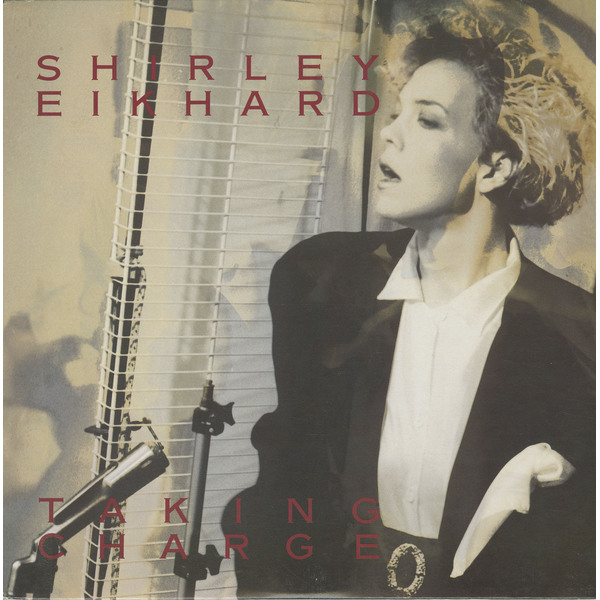
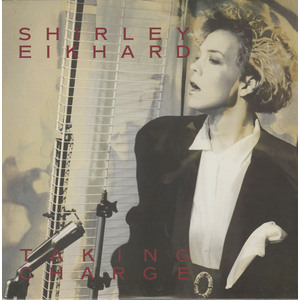
This period resulted in Taking Charge (1987), released on Eika Records and manufactured and distributed by WEA Music of Canada. Rather than documenting a single recording session or fixed ensemble, the album brought together songs written and produced between 1983 and 1987, unified by authorship and creative control. Eikhard was deeply involved at every level, from songwriting and arranging to production and performance, and the album stands as a statement of independence rather than a conventional studio project.
By the late 1980s, Eikhard’s reputation as a songwriter had become central to her career. Her songs were recorded by a wide range of artists, including Anne Murray, Chet Atkins, Cher, Emmylou Harris, Ginette Reno, Alannah Myles, Rita Coolidge, and others. The defining moment came in 1991 when Bonnie Raitt recorded ‘(Let’s Give Them) Something to Talk About,’ a song co-written by Eikhard that became an international hit, won a Grammy Award, and permanently altered the trajectory of her professional life. In 2020, the song was inducted into the Canadian Songwriters Hall of Fame, formally recognizing its enduring impact.
Eikhard’s compositional work extended beyond popular song. In the early 1990s she wrote music for stage productions by Toronto playwright George F. Walker, including Escape from Happiness, which received a Dora Mavor Moore Award for sound design. She also received multiple songwriter citations and later a SOCAN Classic Award, reflecting sustained airplay and long-term cultural presence.
Beginning in the mid-1990s, Eikhard returned to recording with a renewed focus, increasingly exploring jazz as both a vocalist and composer. Albums such as If I Had My Way (1995), The Jazz Sessions (1996), and Going Home (1998) demonstrated her ability to write original material that functioned convincingly within the jazz tradition rather than relying on reinterpretations of standards. Going Home received the East Coast Music Award for Best Jazz Performance and led to national television appearances and collaborations with leading Canadian jazz musicians.
Subsequent releases continued to blur genre boundaries. The Last Hurrah (2000) integrated original songwriting into a jazz framework, while End of the Day (2001) was largely instrumental, featuring Eikhard performing guitar, piano, bass, drums, saxophone, percussion, and chromatic harmonica herself. Later projects including Stay Open, Pop, Country, Stuck in This Groove, Just Call Me Alice, and Riding on the 65 reflected an ongoing refusal to settle into a single stylistic identity, treating genre as a palette rather than a destination.
Across her lifetime, Shirley Eikhard wrote more than 500 songs and developed a rare level of instrumental fluency through self-directed study. Beyond music, she was deeply engaged with visual art, environmental concerns, and animal welfare, living and working largely on her own terms in rural Ontario.
Shirley Eikhard died peacefully on December 15, 2022, at Headwaters Health Care Centre in Orangeville, Ontario, following complications from cancer, shortly after her sixty-seventh birthday.
-Robert Williston
Taking Charge brings together recordings written and produced by Shirley Eikhard between 1983 and 1987, reflecting a period in which she was working across multiple studio settings and production approaches. Rather than documenting a single recording session or fixed lineup, the album presents a curated selection of songs unified by authorship and creative control, issued on Eikhard’s own Eika Records and manufactured and distributed by WEA Music of Canada.
Musicians
Shirley Eikhard: vocals, bass, keyboards, drum programming, tambourine, woodblocks
Gary Craig: drums
David Plitch: bass
Peter Bleakney: bass
Evelyne Datl: keyboards
Steve Sexton: keyboards, bass, drums, guitar
Randy Kumano: keyboards
Doug Macaskill: acoustic and electric guitars
Rob Piltch: guitar
Dave Gray: guitar
Rick Lazar: percussion
Background and group vocals:
Dinah Christie
Deborah Duggan
Shirley Eikhard
Diane Heatherington
Lynn Johnston
Randy Kumano
Julie Masi
Alannah Myles
Robert Priest
Christopher Shier
Nancy Simmonds
Sylvia Tyson
Christopher Ward
Mary Lu Zahalan
Songwriting
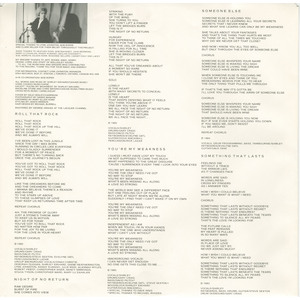
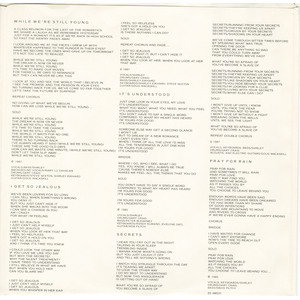
All words and music by Shirley Eikhard
(Canvee Music / Home Cooked Music / CAPAC)
Except:
‘You’re My Weakness’ — Shirley Eikhard, Madeline Stone, Chris Waters
(Canvee Music / Tree Music / Cross Keys Music / CAPAC / ASCAP)
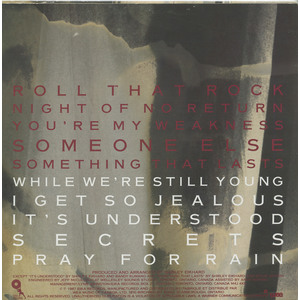
Roll That Rock (© 1985)
Musicians
Shirley Eikhard: vocals
Gary Craig: drums
David Plitch: bass
Evelyne Datl: keyboards
Doug Macaskill: guitar
Rick Lazar: percussion
Background vocals
Dinah Christie
Deborah Duggan
Shirley Eikhard
Diane Heatherington
Lynn Johnston
Randy Kumano
Julie Masi
Alannah Myles
Robert Priest
Christopher Shier
Nancy Simmonds
Sylvia Tyson
Christopher Ward
Mary Lu Zahalan
Night of No Return (© 1985)
Musicians
Shirley Eikhard: vocals
Gary Craig: drums
David Plitch: bass
Evelyne Datl: keyboards
Doug Macaskill: guitar
Rick Lazar: percussion
You’re My Weakness (© 1985)
Musicians
Shirley Eikhard: vocals, woodblocks
Gary Craig: drums
David Plitch: bass
Evelyne Datl: keyboards
Steve Sexton: keyboards
Doug Macaskill: guitar
Notes
Special thanks to Dave Innis
Someone Else (© 1984)
Musicians
Shirley Eikhard: vocals, drum programming, bass, tambourine
Evelyne Datl: keyboards
Dave Gray: guitar
Something That Lasts (© 1983)
Musicians
Shirley Eikhard: vocals
Steve Sexton: keyboards, bass, drums, guitar
While We’re Still Young (© 1987)
Musicians
Shirley Eikhard: vocals, bass, keyboards
Gary Craig: drums
Mary Lu Zahalan: background vocals
Steve Sexton: keyboards
Doug Macaskill: guitar
I Get So Jealous (© 1987)
Musicians
Shirley Eikhard: vocals, bass, keyboards
Gary Craig: drums
Steve Sexton: keyboards
Doug Macaskill: guitar
It’s Understood (© 1985)
Musicians
Shirley Eikhard: vocals
Gary Craig: drums
Peter Bleakney: bass
Randy Kumano: keyboards
Evelyne Datl: keyboards
Rob Piltch: guitar
Secrets (© 1987)
Musicians
Shirley Eikhard: vocals, keyboards, bass
Gary Craig: drums
Doug Macaskill: acoustic and electric guitars
Pray for Rain (© 1985)
Musicians
Shirley Eikhard: vocals, keyboards
Gary Craig: drums
David Plitch: bass
Production
Produced and arranged by Shirley Eikhard
Except:
‘It’s Understood’ — produced and arranged by Shirley Eikhard and Randy Kumano
‘Something That Lasts’ — produced and arranged by Shirley Eikhard and Steve Sexton
Engineered by Jeff McCulloch at Wellesley Sound Studios, Toronto, Ontario
Assisted by Andy Koyama
Mastered by George Graves at The Lacquer Channel
A+R coordination by Bob Roper
Artwork
Cover by Dale Heslip / Champagne
Photography by Darek Banasiak
Grooming by Mary Ellen Howe
Styling by Janice Merson
Hair design by Michael Burrell
Management & Label
Management: Lynn Johnston
Eika Records, Box 27, Station J, Toronto, Ontario, Canada M4J 4X8
© 1987 Eika Records
Manufactured and distributed by WEA Music of Canada, Ltd.
1810 Birchmount Road, Scarborough, Ontario


No Comments