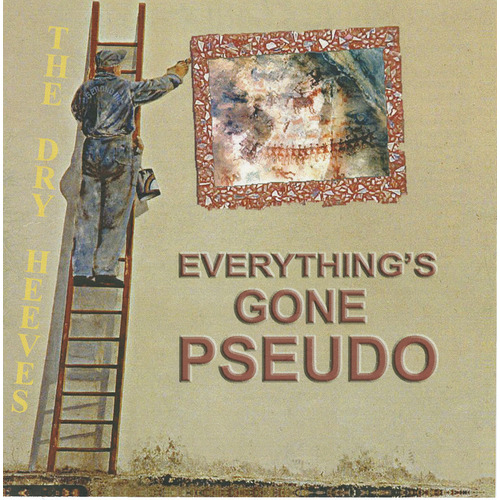
Album / Title
Everything's Gone Pseudo
By: Dry Heeves
Origin: Meat Cove, Cape Breton, Nova Scotia, 🇨🇦
Insight
Hailing from Meat Cove on the northern edge of Cape Breton Island, Dry Heeves conceived of themselves not as a conventional band but as cultural analysts, using electronic music as their dissemination medium of choice. Under the direction of C. MacDonald and J. D. MacNeil, the project unfolded over decades as a deliberately wide-ranging body of work that resisted genre boundaries, conventional formats, and traditional models of distribution.
Stylistically, Dry Heeves operated through collision rather than continuity. Their recordings move freely between rock, pop, tribal structures, folk elements, metal, ambient, noise, and full-scale electronica, often blending these forms in ways that are intentionally disorienting. As one contemporary reviewer observed:
“The Dry Heeves take musical bits from cultures around the world, and try to find ways to put them together in which no one else would. Some tracks are intended to be pure silliness, but others take on a more serious feel and attempt to make strong statements. It gives a breadth and depth to what they are doing in an experimental genre that is often overlooked.”
— Laura B., Sublevel 203
That balance between absurdity and seriousness sits at the core of the group’s output. Their own description framed the experience in similarly direct terms: their “meditatively eccentric compositions can be overwhelming at first, but once assimilated, they become invigorating, cleansing, genuinely hilarious and frequently gratifying,” taking listeners on “a bizarre journey that is laughable, disturbing, and strange.”
From the outset, Dry Heeves exercised careful control over both their artistic intent and how their work circulated. Their first vinyl release, the 7-inch single ‘Maggie’ b/w ‘LSD’ (Plot 002, 1986), exemplified this approach. Both tracks were recorded on 8-track reel-to-reel and mixed down to a 2-track stereo master on high-quality VHS tape, a common practice at the time. Those masters were later misplaced, leaving only a second-generation chrome cassette duplicate made in 1986 as the surviving audio source.
Pressed in a run of 500 copies, only about half of the singles ever reached record stores, radio stations, and magazines; the remainder were accidentally discarded following a basement flood at the original drummer’s home, despite being largely undamaged. Even so, the single achieved notable underground exposure, reaching #1 on CKLN-FM and #2 on WFMU-FM, receiving airplay on CBC programs Brave New Waves and Nightlines, and surfacing on radio in the Netherlands and Switzerland.
The single is also notable for the history of its picture sleeve. Due to the high cost of colour printing, early copies were issued with a photocopied black-and-white sleeve. A hand-added red circle and diagonal slash was later applied to emphasize the band’s explicit opposition to fascist and Nazi ideology, an approach the group likened to the intent behind the Dead Kennedys’ ‘Nazi Punks Fuck Off’. A small number of unfinished sleeves—estimated by the band at fewer than twenty copies—were accidentally distributed before being recovered and replaced. Subsequent pressings used a fully redesigned sleeve that removed the imagery altogether, and many radio copies were issued with no picture sleeve at all.
Across the following decades, Dry Heeves assembled an extensive catalogue that ultimately totalled nineteen albums and one single, much of it released through their own VVVU Music imprint or via early net-distribution platforms. Long before digital self-release became commonplace, the group distinguished between commercial titles, donation-only projects, and free net-albums, carefully clarifying the intent behind each.
In September 2002, Dry Heeves issued the full-length album Mockba Rockba, a release made available exclusively in Russia. This was followed in January 2003 by Everything’s Gone Pseudo, which marked a broader international release and received significant airplay outside Canada. Releases such as …And I’ll Call Rusty articulated the group’s philosophy most directly, presenting work that could feel overwhelming on first encounter but proved invigorating, humorous, and rewarding once absorbed on its own terms.
The project’s reach extended well beyond its Cape Breton origins. While the 1986 single ‘Maggie’ b/w ‘LSD’ received airplay in the Netherlands and Switzerland, later releases circulated even more widely. By the early 2000s, Dry Heeves’ recordings were receiving airplay in Iceland, South Africa, France, Macedonia, Germany, Luxembourg, Australia, and Switzerland—often without the band actively promoting the material overseas.
In September 2004, their track ‘Seasonal Séance’ was selected for inclusion in the feature film Siblings, directed by David Weaver. Around the same period, the project engaged in a series of remix and collaboration activities, including work associated with topon das, reflecting both their stylistic flexibility and their engagement with broader experimental and electronic networks.
Dry Heeves were also among the earliest artists to formally affiliate with the Museum of Canadian Music, discovering the site independently and working directly with its founder to ensure their catalogue, artwork, and contextual notes were represented accurately.
Treating music as analysis rather than product, Dry Heeves embraced humour, discomfort, contradiction, and experimentation as tools for examining culture itself. The result is one of the most distinctive and deliberately constructed bodies of experimental work to emerge from Canada, shaped as much by intent and ideas as by sound.
-Robert Williston
Musicians
The Dry Heeves
The Meat Cove Choir: female vocals
The Ultra-Violins: strings
Meta-Mega-Mahavishnu Karlheinz Wolfgang von Amsterdam III: tabla
Itzfer Graham: bagpipes
Songwriting
All songs written by C. MacDonald and J. MacNeil
Production
Produced by The Dry Heeves and HAL (courtesy of Brasshole)
Engineered by Ellis Dee (courtesy of Psychotics On Laughing Gas)
Assisted by Zelmo Zizzick (courtesy of What If Adam and Eve Were Apes?)
Mixed and mastered by The Dry Heeves at Dungg Digital Studios
Artwork
Artwork and design by The Dry Heeves
Notes
Recorded June–October 2002
Dungg Digital Studios, Fredericton, New Brunswick
Aurora Bore Audio, Edmonton, Alberta
Centre For Tape Worms, Meat Cove, Nova Scotia
© 2002 VVVU Music
All rights reserved
Affiliation: SOCAN
Female vocals courtesy of Iggy’s Pink Fort & Grill
Strings courtesy of Baghdadism
Bagpipes courtesy of Is Frank There? / Gus’s Pub
Everything’s Gone Pseudo has been a labour of love for over a decade. Many of the original ideas were first conceived in the heady days of the early Centre For Art Tapes recording sessions (Halifax 1986), and are only now seeing the light of laser, after years of incubation, creation, alteration and experimentation.
Encompassing oral conceptions, aural perceptions, rural inceptions and big city rejections, Pseudo was inspired by influences past and present, cultures near and far, and the current world political climate. It is described by the band as the collective unconscious of revolutionaries, visionaries, free thinkers and skid row drinkers, drawing from intelligent electronic, rock, pop, techno, industrial, ambient, folk, goth, classical, world, and underground sonic traditions.
Dedicated: For Fever and Dan
Reviews
Everything’s Gone Pseudo has been a labour of love for over a decade. Many of the original ideas were first conceived in the heady days of the early Centre For Art Tapes recording sessions (Halifax 1986), and are only now seeing the light of laser, after years of incubation, creation, alteration and experimentation.
Encompassing oral conceptions, aural perceptions, rural inceptions and big city rejections, Pseudo was inspired by influences past and present, cultures near and far, and the current world political climate. It’s the collective unconscious of revolutionaries, visionaries, free thinkers and skid row drinkers. Turn off your mind, relax and float down stream to the intelligent electronic, rock, pop, techno, industrial, ambient, folk, goth, classical, world and truly underground sonic seasonings of Everything’s Gone Pseudo. May it serve you well!!
The Dry Heeves from Eastern Canada brings a delightful array of cross genre styles of music all bundled up into this one bizarre, but unique CD. The first few listen throughs I didn't really enjoy the style of electronic versus rock versus sample clips versus tribal/jungle abstract style of music. However the more you listen to this CD the more good qualities come out of it. I find myself enjoying it much more now than I did when I first started listening to it. Its not particularly the type of music I enjoy, but I don't mind it in comparison to some of the electronic atmospheric styles of music I usually get. The tracks have a way of sneaking into your brain and getting stuck in there for days on end! There's so many different styles of music on this CD that I don't really know which tracks I enjoy the most - they all have their unique differences making it hard to pinpoint a good track from a not so good track! With 18 tracks total, I'd say the songs that stuck out the most were "Meat Cove," and "Lokum." I'd recommend this album to those that enjoy unusual sounding music and that aren't afraid to venture off into a world of a variety of sounds and soundscapes.
-Wednesday Elektra
Space Junkies Magazine (May 2003)
When I first threw this CD on I was scared of what I was going to find because quite frankly the artwork looked pretty hurting. It was really hard to tell what type of band/music I was about to subject myself to and not being familiar with the band I was a little worried. Well, let me tell you, I was pleasantly surprised when I finally did get a chance to listen to this baby. Influences from all types of music from all corners of the world. I especially liked the more aggressive tracks such as “Meat Cove” and “Lokum”. I do have 1 very small beef with this release, well o.k. two but that’s it. I find that at time the CD lags and that the choice of opening songs was not good but trust me these are very minor points. Overall I really enjoyed this CD and look forward to hearing more from the band.
-Canadian-Music.com (April 2003)
One minute you have ambient soundscapes with sounds of birds, oceans, and strings, then you're listening to heavy distorted guitar. The next track has hand drums, tablas, congas, fiddle, bagpipes. With 18 tracks consuming over an hour and 13 minutes of pop, rock, techno, electronica, industrial, and folk, Everything's Gone Pseudo is quite a bargain. It's receiving airplay in Germany, Iceland, and throughout Canada. I give it 4 stars and throw it into my collection of CDs I will actually listen to.
-Darren Gallop
Gallery
Images
5 images
CD-Dry Heeves - Everything's Gone Pseudo BACK
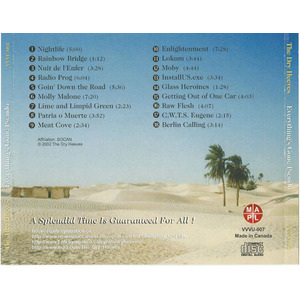
CD-Dry Heeves - Everything's Gone Pseudo INLAY
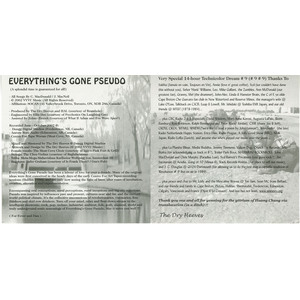
CD-Dry Heeves - Everything's Gone Pseudo INSIDE
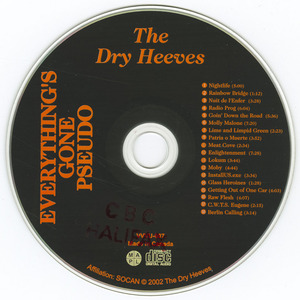
CD-Dry Heeves - Everything's Gone Pseudo CD
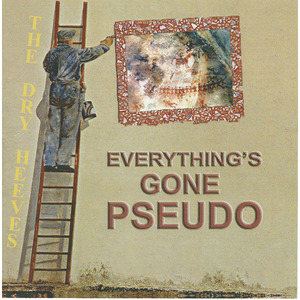
Everything's Gone Pseudo
Media
Videos
0 videos
No videos available for this title.
Credits
In Transit
No Comments