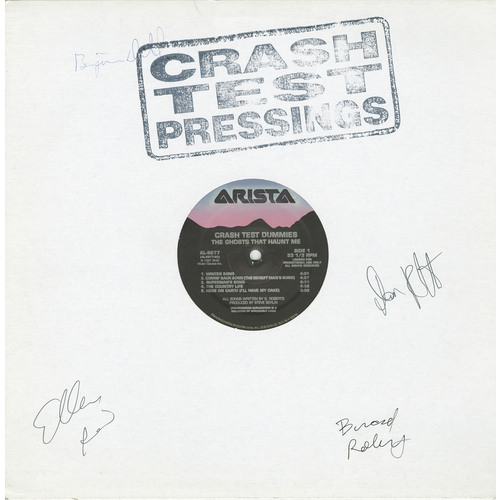
Album / Title
The Ghosts That Haunt Me (promo)
Insight
Crash Test Dummies emerged from Winnipeg’s dense and quietly competitive folk scene of the late ’80s, a period when small rooms, coffeehouses, and university stages often produced artists with far bigger ambitions than their surroundings suggested. The group took shape around singer and songwriter Brad Roberts, whose baritone became their defining hallmark long before the band had a record deal or radio presence. With Ellen Reid on keyboards and harmonies, Benjamin Darvill on harmonica and guitar, Dan Roberts on bass, and Mitch Dorge later solidifying the lineup on drums, the Dummies established themselves as a thoughtful, literate alternative to the prevailing rock currents of the era.
Their debut album, The Ghosts That Haunt Me, released in 1991, did not sound like a first record from an untested band. It arrived fully formed — folk-rooted but arranged with a kind of orchestral imagination that set them apart. “Superman’s Song,” a meditation on myth, mortality, and moral exhaustion, became an unlikely national hit, climbing charts at a time when Canadian artists rarely broke through with material so reflective and unconventional. The album went on to multi-platinum status in Canada, revealing that the public was ready for a band willing to risk earnestness over swagger.
The international breakthrough came with God Shuffled His Feet in 1993, produced by Jerry Harrison of Talking Heads, who understood how to sit Roberts’ basso profundo voice inside arrangements that were equal parts folk, pop, and art-rock. The single “Mmm Mmm Mmm Mmm” — an odd, hypnotic narrative about childhood alienation and social strangeness — became one of the decade’s most instantly recognizable songs, reaching the Top 5 in both the U.S. and U.K. The album earned three Grammy nominations and anchored the band’s global success, propelling them into a level of visibility few Canadian alternative acts had ever reached.
Rather than replicate the formula, Crash Test Dummies took a left turn with A Worm’s Life (1996), a guitar-driven, denser record that divided critics but demonstrated a willingness to explore darker textures and rhythmic experiments. They followed with Give Yourself a Hand (1999), which pushed even further into electronic pop, falsetto vocals, and groove-oriented production, with Reid increasingly stepping into the vocal spotlight. These shifts kept the Dummies unpredictable; they resisted branding themselves around a single sonic idea, even when the industry would have preferred it.
In the 2000s the band continued to evolve with I Don’t Care That You Don’t Mind (2001), recorded with a group of Atlantic Canada musicians known as the Great Atomic Power, followed by Puss ’n’ Boots (2003), Songs of the Unforgiven (2004), and Oooh La La! (2010), each exploring different corners of folk, roots, and vintage pop stylings. Roberts’ songwriting grew more introspective and idiosyncratic, with lyrical turns that drifted between spiritual inquiry, sly humour, and the surreal. The group’s later live performances often revealed just how deeply their early songs had settled into the cultural memory of listeners across Canada and beyond.
Ellen Reid and Benjamin Darvill pursued their own parallel paths — Reid as a solo artist and composer, and Darvill finding success as Son of Dave, the harmonica-driven one-man blues experiment that carried him across Europe for much of the 2000s. Yet the core identity of Crash Test Dummies remained tied to their singular chemistry: Roberts’ unmistakable voice, Reid’s luminous harmonies, and a songwriting approach that favoured narrative craft over trends.
More than three decades after their debut, Crash Test Dummies continue to hold a unique place in Canadian music. They were never an easy band to categorize, which is part of why their catalogue still feels distinctive — built on literary sensibilities, unexpected production choices, and a willingness to sound different from everyone else on the radio. Their songs remain fixtures of Canadian cultural memory, standing as reminders that a band from Winnipeg, led by one of the most unusual voices in popular music, could become one of the signature sounds of the 1990s while never surrendering their quirks.
-Robert Williston
Brad Roberts: lead vocals, guitar
Ellen Reid: keyboards, backing vocals
Benjamin Darvill: harmonica, mandolin, guitar, percussion
Dan Roberts: bass
Mitch Dorge: drums, percussion
Guest Musicians:
Bill Zulak: violin
Garth Reid: banjo
Lynn Selwood: cello
Greg Leisz: pedal steel guitar
Bob Doige: recorder
Vince Lambert: drums
Steve Berlin: percussion
Produced by Steve Berlin
Engineered by Bob Doige
Second engineer: Chris Brett
Mixed by Bob Shaper
Mixed by Mark Linett (B5)
Second engineer, mixing: Sarah Browder
Recorded at Wayne Finucan Studios
Mixed at O’Henry Sound Studios
Executive producer: Thomas Sparling
Pressed by Sonopress
Gallery
Images
3 images

Crashtest Dummies - Crashtest Pressings LABEL 02
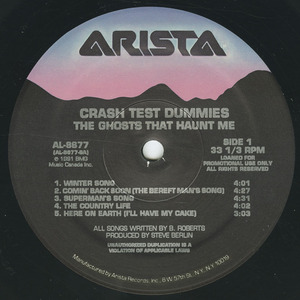
Crashtest Dummies - Crashtest Pressings LABEL 01

The Ghosts That Haunt Me (promo)
Media
Videos
0 videos
No videos available for this title.
Credits
In Transit
No Comments