Insight
The Churls came together in Toronto in 1967 around singer Bob O'Neill and rhythm guitarist Nick McCombie, with Hal Ames on lead guitar, John Barr on bass and Brad Fowles on drums. McCombie had left school in Grade 10 to play in the band, and he was one of its songwriters. Bill Riley found the group playing at Charlie Brown's in Yorkville and took them on as their manager.
That summer and fall they held an eight-week stand as house band at the Penny Farthing on Yorkville Avenue, with further dates at the Strawberry Patch, Charlie Brown's and the Rock Pile. A&M's Bob Garcia caught the life in his sleeve note for their first album: music "loud and low in smoky Toronto clubs," "Kraft cheese Dinners, Peanut Butter and stroboscopic Freakouts," "Washing Dishes for Crashing privileges," and gigs that paid under two dollars an hour.
According to the band, the Everly Brothers saw them while playing Toronto's King Edward Hotel and sent word to Pie Productions in New York. A scout came north, and in the winter of 1967 the Churls signed with Glotzer and Katz, the New York management company behind Blood, Sweat & Tears.
Their first New York gig was at the Café Au Go Go on Bleecker Street in Greenwich Village. They became regulars at Steve Paul's The Scene, the after-hours club where visiting musicians gathered to jam. Band members later recalled encouragement from John Lennon and Paul McCartney, who were at The Scene during their May 1968 visit to New York, and a night on stage with Jimi Hendrix, who jammed there often that year.
In 1968, before the band's first album sessions, McCombie, who had been with them for more than a year and toured with them, was let go. "I had the unfortunate job of firing him as the manager on the rest of the band's instructions," Riley told CitizenFreak. "Only then was Sam Hurrie hired as an 18 year old guitarist."
The band worked its way to Hollywood, played the Whisky a Go Go and signed with A&M Records in 1968. Paul A. Sloman and Andy Muson produced the first album at A&M's studios, with Artie Schroeck arranging brass and strings and Muson, Schroeck and Jim Molinari on percussion. O'Neill and Ames wrote most of the songs. Hurrie, new to the band, wrote 'The Weeks Go By' and shared credits on three more, and Barr co-wrote 'Crystal Palace' with O'Neill.
The Churls reached record stores at the turn of 1969. US promotional copies are dated 1968 and Canadian labels carry a 1969 Quality Records copyright. 'City Lights', backed with 'Where Will You Be Tomorrow', was issued as a single in Canada and climbed to No. 8 on CKXL in Calgary in March 1969. The group kept touring on both sides of the border, including an October 1968 bill with Moby Grape and Procol Harum at SUNY Stony Brook.
In May 1969 Billboard caught the Churls at Ungano's in New York, sharing the bill with the MC5. Newton Garwood had come over from the Toronto band Leigh Ashford, and his Hammond organ now filled the place a rhythm guitar had held. Billboard singled out his playing on 'Too Many Rivers' and 'Fish On A Line', and a long US tour lay ahead.
Riley later said the band had worked up a heavier blues sound in the British style that their A&M deal never let them record. "Old Herbie Alpert wanted a sort of rocky yet not too harsh sound from a Canadian band," he wrote, but "in order to get the studio time and hope for some exposure, we took the deal."
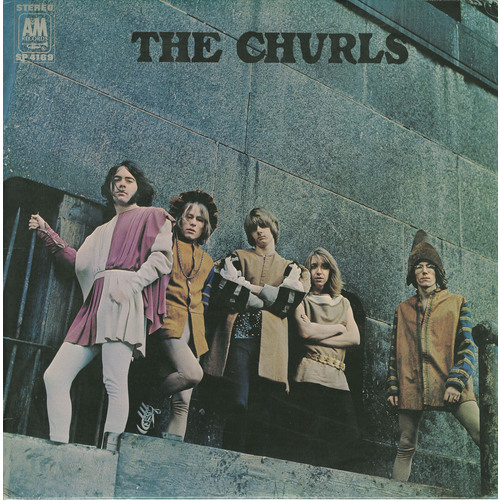
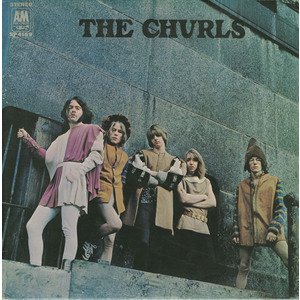
From July 16 to 20, 1969, the Churls played the Whisky a Go Go with the Flying Burrito Brothers, and they went back into A&M's Hollywood studios with Sloman and Muson to make Send Me No Flowers. The lineup was now O'Neill, Ames, Barr, Fowles and Garwood, with Muson adding piano, vibraphone and percussion. Garwood co-wrote five of the eight songs, among them 'See My Way' and 'Too Many Rivers'. Henry Lewy, Dick Bogert and Peter Pilafian engineered, and Tom Wilkes and Barry Feinstein, who had also worked on the first album, photographed the five lying in a row, shot from their boots up.
Send Me No Flowers came out around the turn of 1970, with US copies dated January 1970. 'I Can See Your Picture', backed with 'Long, Long Time', was the single, and in December 1969 RPM showed it picking up play at CJCH Halifax and CJFX Antigonish.
The relationship with A&M soured, and the Churls' time with the label came to an end. The band returned to Toronto early in 1970, played on for a few more months and broke up later that year.
One of their songs had already found a second life. The Texas band Bloodrock recorded O'Neill and Ames's 'Time Piece' as 'Timepiece' on their debut album, produced by Terry Knight for Capitol and released in February 1970.
Brad Fowles went on to drum with Copperpenny. Sam Hurrie moved to British Columbia, where he led the Sam Hurrie Band in the 1970s and has played blues guitar ever since. Nick McCombie worked as a labourer and truck driver, studied part time, and in 1978 joined Ontario's Injured Workers' Consultants clinic as a case worker. He spent the rest of his life in workers' compensation law, joined the Workers' Compensation Appeals Tribunal when it opened in 1985, became the first worker member named a vice-chair in 1991 and co-wrote Workers' Compensation in Ontario, the first published treatise on the subject. He died of cancer in 2003. Newton Garwood died on November 4, 2005.
In 2012 Pacemaker Entertainment put both albums on a single CD, licensed from Universal Music Canada.
CitizenFreak first posted The Churls in April 2011. In 2020 Bill Riley added his own account of the band to the page, and in 2024 the album was named to CitizenFreak's Top 1000 Canadian Albums of All Time.
-Robert Williston
Gallery
Images
4 images
Churls - ST BACK
Churls - ST LABEL 01
Churls - ST LABEL 02
ST
Media
Videos
0 videos
No videos available for this title.
Credits
Musicians
Robert Louis O’Neill: vocals
Hal Ames: guitar
John Barr: bass
Brad Fowles: drums
Sam Hurrie: guitar
Additional musicians
Artie Schroeck: percussion
Andy Muson: percussion
Jim Molinari: percussion
Songwriting
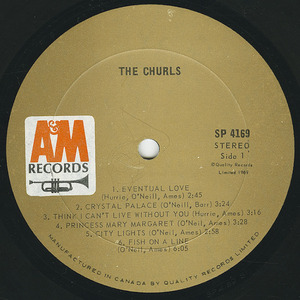
‘Eventual Love’ written by Sam Hurrie, Robert Louis O’Neill and Hal Ames
‘Crystal Palace’ written by Robert Louis O’Neill and John Barr
‘Think I Can’t Live Without You’ written by Sam Hurrie and Hal Ames
‘Princess Mary Margaret’ written by Robert Louis O’Neill and Hal Ames
‘City Lights’ written by Robert Louis O’Neill and Hal Ames
‘Fish on a Line’ written by Robert Louis O’Neill and Hal Ames
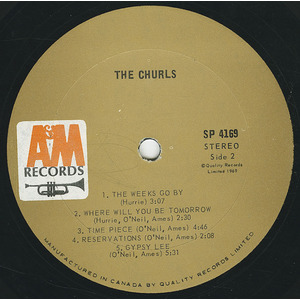
‘The Weeks Go By’ written by Sam Hurrie
‘Where Will You Be Tomorrow’ written by Sam Hurrie, Robert Louis O’Neill and Hal Ames
‘Time Piece’ written by Robert Louis O’Neill and Hal Ames
‘Reservations’ written by Robert Louis O’Neill and Hal Ames
‘Gypsy Lee’ written by Robert Louis O’Neill and Hal Ames
Production
Produced by Paul A. Sloman and Andy Muson
Strings and brass arranged by Artie Schroeck
Technical
Engineered by Dick Bogert, Larry Levine, Ray Gerhardt, Bill Halverson and Gene Radice
Special effects by S. Sills and D. Adonis
Artwork
Photography by Barry Feinstein
Art direction by Tom Wilkes
Liner notes by Bob Garcia
Release
LP, stereo
Canada
Manufactured and distributed in Canada by Quality Records Limited
© Quality Records Limited 1969
Publishing
All selections published by Paij Music Corp. / Irving Music Inc. – BMI
Special thanks
Marge Fowles, Linda Bender, Bill Riley, The Ramrowf’s, Ozy, Phil Sharman and Nick McCombie
Matrix numbers
Side 1: SP 4169 S1
Side 2: SP 4169 S2
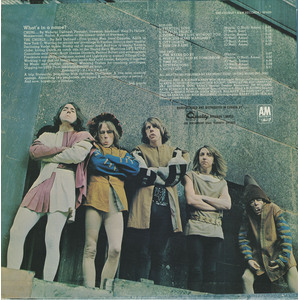
Liner notes
What’s in a name?
CHURL...By Webster Defined: Peasant; freeman-husband. Alain To Fellow Manservant, Varlet. A member of the lowest order of freemen.
THE CHURLS...By Self Defined - Five young Men from Canada. Adrift in New York C. Waiting for record test pressings to Further Enforce their reality. Declining Varlet tights. Rising out of music loud And low in smoky Toronto clubs. Living Catch as catch can in the Young Rock Musician LIFE STYLE. Canadian existence - Kraft cheese Dinners. Peanut Butter and stroboscopic Freakouts musically under one, naked red Lightbulb in a small Village Club. Working it up and out before cool mods And acid freaks. Keeping it together by Music and creditor requests. Washing Dishes for crashing privileges. Gigging for LESS Than $$$$$$$$$$$$$$$2 an hour.
Eventually - a live
A trip Stateside brimming with optimum Optimism. A live-man musical sponge, Absorbing two producers, an agent, A record company, a record. And now, hopefully a listener.
Bob Garcia
This was a great album to find! This is like the Canadian cross of Cream and The Rolling Stones but with enough of a personal stamp to not be derivative. You will catch the bass riff to "Sunshine of Your Love" in one song and a guitar riff that sounds a lot like "Jumpin' Jack Flash" in another, but these guys rock their own through the rest of the album. One delightful surprise was to hear "Time Piece". It's a heavy, downer rock kind of song, and I had heard it before as Bloodrock from Texas covered it on their 1970 debut. The Churls' version is just as heavy and ominous. This is a great hard rock album that doesn't spend much time on the light side, nor does it play around with drug-induced jams sessions. These boys get straight to the point!