Insight
Four years after Heritage, Christmas returned with a record so different that even the band's name had changed. By the time work was underway on Lies to Live By, Preston Wynn had joined on vocals, piano and guitar, Bob Bryden had stepped away from the role of principal singer, and Christmas had become The Spirit of Christmas. There was apparently no grand strategy behind the alteration. Bryden later laughed that he did not really remember why they changed the name at all. What he did remember was the musical change: the group had gone “very dark and progressive”, while remaining as free and unconventional as ever.
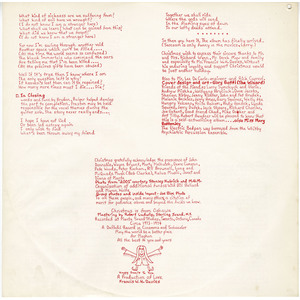
Getting the album finished was another matter. The project became entangled in Daffodil Records' financial difficulties, and production was suspended while label founder and producer Francis W.H. Davies searched for new money. Davies later recalled that once additional financing had been secured, Daffodil was finally able to resume work on the record. That history gives one seemingly incidental credit on the original insert much greater significance: “Organisation of additional funds: Wild Bill Ballard and Myron Wolfe.” These were not simply names buried in the acknowledgements; their investment helped get the album across the finish line.
The album finally appeared in late 1974, and what emerged was far more elaborate than Heritage, both musically and sonically. Davies remembered Lies to Live By receiving a much larger recording budget, with sessions taking place at the recently opened Manta Sound Studios in Toronto. Lee DeCarlo and Rick Capreol engineered the record, and Robert Ludwig mastered it at Sterling Sound in New York. Bryden later made a point of noting that the album contains a real Mellotron, another indication of how far the group had travelled from the improvised circumstances of its first Paragon LP. Davies considered the result more ambitious sonically and, despite its complexity, more accessible than what Christmas had done before.
Just as important was Preston Wynn. Davies felt that Wynn brought greater melody and carefully constructed vocal harmonies to the band, and the original credits make clear how deeply involved he had become. Bryden remained the principal writer and conceptual force, Robert Bulger the lead guitarist, Tyler Raizenne the bassist and Helge Richter the drummer and percussionist, but Wynn's voice and piano changed the emotional character of the music. Heritage had often sounded like Bryden pushing four young musicians toward the limits of what they could manage. Lies to Live By feels more collective, with ideas being passed around, expanded and reshaped by the entire band.
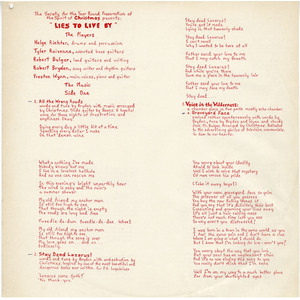
The album is nominally divided into six tracks, but that hardly describes what is happening. The first two pieces stand alone; everything after them opens into suites, subdivisions and interconnected scenes. The handwritten insert even introduces the record theatrically: “The Society, for the Year Round Preservation of the Spirit of Christmas presents: LIES TO LIVE BY.” From there, the band explains its own intentions with a mixture of seriousness, sarcasm and strange humour that is almost as revealing as the music.
‘All the Wrong Roads’ is described by Bryden as a hopeful song for nights of frustration and emptiness, and it provides one of the album's relatively direct entrances. There is still darkness underneath, but the song retains enough conventional shape to ease the listener into what follows. ‘Stay Dead Lazarus’ immediately moves somewhere more unsettling, taking resurrection and faith and turning them into something doubtful and frightened. Bryden's narrator does not welcome Lazarus back from death; he pleads with him to remain where he is. That inversion says much about the world of Lies to Live By: familiar ideas continually return in strange and unsettling forms.
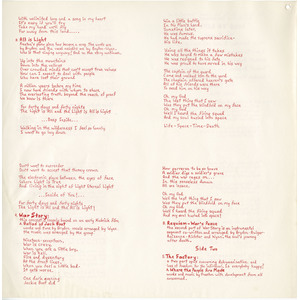
‘Voice in the Wilderness’ is the first full indication of how unusually constructed the album has become. The band calls it a chamber piece in two parts, beginning with ‘Graveyard Face’, which the insert says developed rather spontaneously from Bryden's words and a melody shared with Wynn, with chords supplied by Bulger. The second section, ‘All Is Light’, grew from a Preston Wynn piano piece into a full song, with Bryden supplying the words and Bryden and Wynn developing the vocal melodies together. Rather than sounding like one writer dictating a finished composition to a backing group, the album repeatedly shows ideas changing shape as they move between the musicians.
Then comes ‘War Story’, nearly nine minutes divided between ‘Ballad of Jack Boot’ and the instrumental ‘Requiem - War's Peace’. The insert says the concept was loosely based on an early Stanley Kubrick film, but the band's interest is less in recreating a movie than in following an individual through war and beyond it. Jack Boot begins as a nineteen-year-old soldier and ends before a firing squad; the instrumental second half is explicitly described as the soul's journey after death. The military unease already present throughout Heritage has become something much more theatrical here. Instead of commenting on war from outside, Christmas places a human being inside it and follows him to the end.
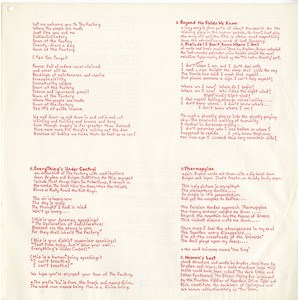
Side two becomes darker still with ‘The Factory’, which the band themselves described as “a two part opus concerning dehumanization and loss of freedom for the individual.” That subject was not abstract for Bryden. He had spent his teenage years in what he later called the General Motors-dominated factory town of Oshawa and specifically connected that environment with the creation of ‘The Factory’. The piece moves from Wynn's ‘Where the People Are Made’ into ‘Everything's Under Control’, where human beings become products moving through an institutional machine. Orders, supervisors, production, obedience and individuality begin collapsing into one another until the entire thing feels deliberately claustrophobic.
That Oshawa connection gives Lies to Live By a quality that is easy to miss if it is treated simply as another obscure progressive rock album. The elaborate structures, strange effects and philosophical language may suggest a band looking far beyond Southern Ontario, but some of its deepest anxieties come directly from the world around them: factories, authority, advertising, war, religion, conformity and the fear of becoming whatever society has already decided you should be. The music may wander into fantasy, but much of its unease is grounded remarkably close to home.
The eleven-minute ‘Beyond the Fields We Know’ is the album's final and most expansive statement, a four-part journey the insert describes as a search for the missing piece in the human puzzle. Even its title reaches outside rock music, borrowed respectfully from the work of fantasy writer Lord Dunsany. ‘Prelude (I Don't Know Where I Am)’ establishes the uncertainty immediately; ‘Thermopylae’ reaches backward into ancient history; ‘Heaven's Lost’ turns toward work, spirituality and displacement; and ‘In Closing’ deliberately refuses a neat conclusion. The musicians themselves write that the story never really ends, which may be the most appropriate possible ending for an album built almost entirely from questions.
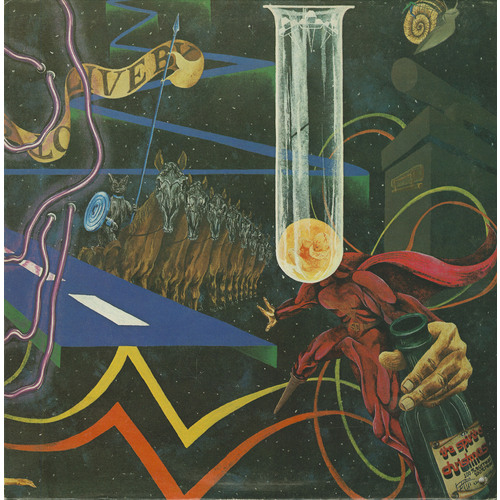
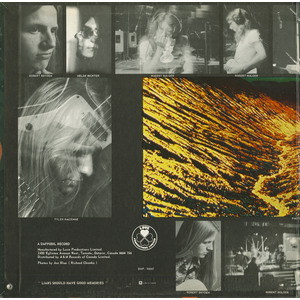
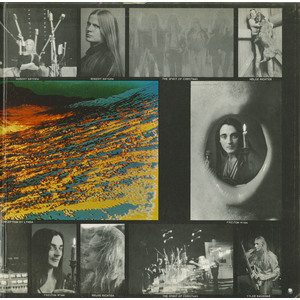
The packaging reinforces that sense of entering another world. Gary Gatti's cover design and artwork, the photographs and inside layout by Joe Bloe, Lynda Squires' photo conception and the dense handwritten insert make the LP feel less like a conventional record sleeve than a collection of evidence from some private universe the band had constructed. A still from 2001: A Space Odyssey appears with the permission of Stanley Kubrick and MGM, while photographs of the musicians are scattered among abstract colour images and studio scenes. Even the back cover carries the wonderfully ominous line “LIARS SHOULD HAVE GOOD MEMORIES.”
For all its ambition, Lies to Live By was not simply ignored. Davies remembered that AM radio essentially wanted nothing to do with it, but American progressive and FM press responded much more enthusiastically. The influential Walrus radio tip sheet made it a Merit Pick, praising the group's musicianship and concluding simply that “They succeed intensely.” Davies was unable to secure a contemporary American release, however, so much of that enthusiasm had nowhere commercially to go.
There was also more Canadian interest than the band's later obscurity might suggest. In February 1975, Billboard reported surprisingly strong demand for Lies to Live By, describing it as Daffodil's second-biggest album in terms of incoming interest, behind only A Foot in Coldwater's All Around Us. RPM was still listing the record in Canadian radio activity during March. For an album this uncompromising, that was significant. The problem was not that nobody noticed it; the problem was turning that interest into the kind of sustained audience that could keep The Spirit of Christmas moving forward.
By 1975, The Spirit of Christmas had reached the end of the road. Despite the ambition of Lies to Live By and the interest it attracted in progressive circles, the album never found the broader audience the band needed. Davies had been unable to secure the U.S. release he wanted, and commercial radio remained a difficult fit for music this complex. Not long afterward, the group broke up.
Time eventually solved the problem that radio and distribution could not. Bryden has said that it was particularly outside Canada that listeners gradually began to understand what Christmas had been doing, and subsequent CD reissues gave Lies to Live By a life its original Canadian pressing never had. What had once seemed dark, difficult and out of step became precisely what later listeners valued about it.
-Robert Williston
Gallery
Images
10 images
View All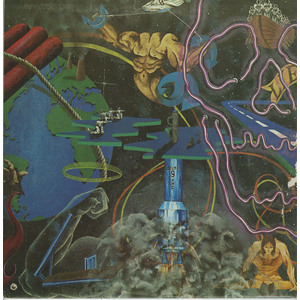
Christmas (Spirit Of)-Lies to Live By BACK
Christmas (Spirit Of)-Lies to Live By INSIDE 01
Christmas (Spirit Of)-Lies to Live By INSIDE 02
Christmas (Spirit Of)-Lies to Live By INSERT SIDE 01
Christmas (Spirit Of)-Lies to Live By INSERT SIDE 02
Christmas (Spirit Of)-Lies to Live By INSERT SIDE 03
Christmas (Spirit Of)-Lies to Live By INSERT SIDE 04
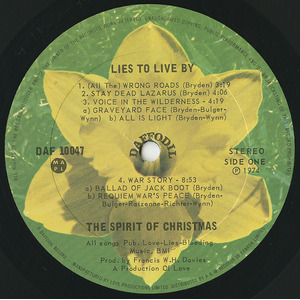
Christmas (Spirit Of)-Lies to Live By LABEL 01
Media
Videos
0 videos
No videos available for this title.
Credits
Musicians
Bob Bryden: rhythm guitar
Robert Bulger: lead guitar
Tyler Raizenne: bass guitar
Helge Richter: drums, percussion
Preston Wynn: main voices, piano, guitar
Beans: slide guitar on ‘All the Wrong Roads’
Preston Wynn: organ on ‘Thermopylae’
Songwriting
‘All the Wrong Roads’ words and music by Bob Bryden; arranged by Christmas
‘Stay Dead Lazarus’ words and music by Bob Bryden; orchestrated by Christmas
‘Voice in the Wilderness’
‘Graveyard Face’ words and music by Bob Bryden, with additional music by Preston Wynn and chords by Robert Bulger
‘All Is Light’ words and music by Bob Bryden, with piano piece and vocal melodies by Preston Wynn
‘War Story’
‘Ballad of Jack Boot’ words and music by Bob Bryden; arranged by Christmas; vocals arranged by Preston Wynn
‘Requiem - War’s Peace’ music by Bob Bryden, Preston Wynn, Helge Richter, Robert Bulger and Tyler Raizenne
‘The Factory’
‘Where the People Are Made’ words and music by Preston Wynn
‘Everything’s Under Control’ words and music by Bob Bryden, Preston Wynn and Robert Bulger
‘Beyond the Fields We Know’
‘Prelude (I Don’t Know Where I Am)’ words and music by Bob Bryden
‘Thermopylae’ words and music by Bob Bryden
‘Heaven’s Lost’ words and music by Bob Bryden, with additional music by Preston Wynn
‘In Closing’ words and music by Bob Bryden
Publishing
Published by Love-Lies-Bleeding Music
Production
Produced by Francis W.H. Davies
A Production of Love
Recording
Recorded at Manta Sound Studios, Toronto, Ontario, circa 1973-1974
Engineering
Engineered by Lee De Carlo and Rick Capreol
Mastering
Mastered by Robert Ludwig at Sterling Sound, New York, USA
Artwork
Cover design and art by Gary Gatti
Photo conception by Lynda Squires
Photography and layout by Joe Bloe
Manufacturing
Manufactured by Love Productions Limited
Distributed by A&M Records of Canada Limited
Physical Release
Vinyl LP
Fold-out cover
Four-page lyrics and credits insert included
Canada
Additional Credits
Organisation of additional funds: Wild Bill Ballard and Myron Wolfe
Acknowledgements
Christmas gratefully acknowledge the presence of John Donabie, Wayne Bryant, Marty Melhuish, Deane Cameron, Pete Woods, Peter Rochon, Bill Brownell, Joann and McQuade Music (Bob Clarke), Kalua Music, Janet and Diana of Manta.
Photo from “2001” courtesy Stanley Kubrick and M.G.M.
To all of these people, and the others, a citation of merit for patience above and beyond the fields we know.
Liner Notes
Christmas is from Oshawa
May the world be a better place.
for Meghan
All the best to you and yours
Happy Snails to You
No Comments