Insight
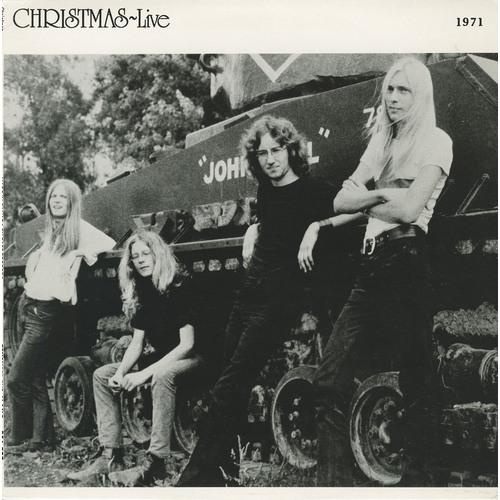
On September 23, 1971, Christmas took the stage at Massey Hall in Toronto opening for Crowbar. Less than a year had passed since Heritage, but the band was already moving beyond the album that had established its heavy, progressive direction. Bob Bryden, Robert Bulger, Tyler Raizenne and Rich Richter were still the core four-piece, and for one night the group found itself on one of Canada's most prestigious stages with a set that mixed familiar material with music that had yet to find its way onto a record.
The surviving tape captures a very different side of Christmas from the carefully assembled studio recordings. Bryden later remembered someone describing it as early punk and suggested that “prog-punk” might be closer to the mark. It is an unlikely label, but there is something to it. The music is progressive in structure and ambition, yet the performance has an aggression and looseness that keeps it from sounding mannered or overly polished. Christmas could be complicated without ever sounding cautious.
The retrospective booklet issued with the recording remembers the Massey Hall appearance in even stronger terms, describing an “explosive and volatile” performance that further polarized an already conservative audience. That reaction seems entirely believable when hearing the tape today. Christmas did not sound like a band trying to win over a room. They pushed forward on their own terms, stretching songs, following unexpected turns and allowing the guitars and rhythm section to become considerably rougher than they had been on Heritage.
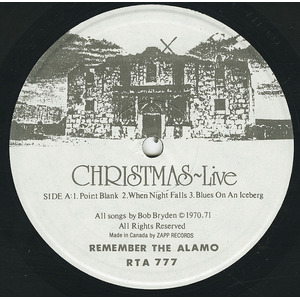
‘Point Blank (It Scares Me)’ opens the record and provides the clearest connection to Heritage. One of Bryden's shortest and most direct compositions becomes an appropriately tense introduction before the set begins opening outward. ‘When Night Falls’, running more than nine minutes, is the first real surprise. Never included on a contemporary Christmas studio album, it shows just how much material the group was developing beyond what had already been released.
‘Blues on an Iceberg’ brings the set briefly back to Heritage, but side two is where the historical importance of the recording becomes especially clear. The original 1989 release presents ‘Beyond the Fields We Know’ together with ‘Field of Honour’ as an extended performance lasting nearly seventeen minutes. Several years before Lies to Live By finally appeared, Christmas was already exploring the ideas and longer structures that would eventually become central to that album. The progression from Heritage to Lies to Live By was not a sudden leap made years later in a recording studio; some of it was already taking shape onstage in 1971.
That makes Live at Massey Hall much more revealing than a simple concert document. It catches Christmas at a point of transition. ‘Point Blank’ and ‘Blues on an Iceberg’ belong to the world of Heritage, while ‘When Night Falls’, ‘Field of Honour’ and the developing ‘Beyond the Fields We Know’ point toward music that was becoming longer, darker and increasingly difficult to fit into conventional rock formats.
The performance also came during a frustrating period for the band. Following Heritage, Christmas had recorded the Neil Sedaka composition ‘I'm A Song, Sing Me’ under pressure to produce something more commercial. The later booklet makes no attempt to hide the band's feelings about that episode. At Massey Hall, however, there is little evidence of anyone trying to make Christmas more conventional. If anything, the band sounds determined to move in the opposite direction. Not long afterward they retreated to a country barn to continue developing their music, Preston Wynn joined the group, and the long process that eventually produced Lies to Live By began.
For nearly eighteen years, the Massey Hall performance remained unreleased. The source was a raw cassette board tape, which Bryden eventually edited and mixed at Woodside Productions in Hamilton. With Frank Davies' authorization, the recording was issued in 1989 through Remember The Alamo, initially in a tiny run of roughly 100 cassettes and just over 300 vinyl copies. Bryden added room ambience to the original board recording in an attempt to restore some of the atmosphere that had been lost by recording directly from the mixing desk.
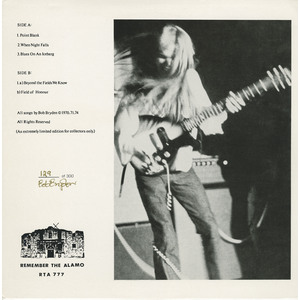
The resulting LP was never disguised as anything other than an archival release. The sleeve announces “An extremely limited edition for collectors only,” and copies were individually numbered and signed by Bryden. The package also included an eight-page booklet and two inserts, turning the record into a small history of a band whose reputation had grown considerably during the years since its breakup.
That booklet looked back on the Massey Hall concert as one of the pivotal moments in the Christmas story. What had apparently confused or antagonized part of the audience in 1971 sounded very different when finally released in 1989. By then the band's original albums had begun attracting collectors well beyond Canada, and a performance once remembered for polarizing a crowd had become important enough to preserve in a numbered edition.
-Robert Williston
Someone once told me they thought that this was early punk. Well, perhaps prog-punk might be more accurate. This is the original studio mix I did of the raw board (cassette) tape from our Sept. 23, 1971 concert at Massey Hall opening for Crowbar. This is not to be confused with the inferior, unmixed version released on CD by Unidisc records. This version was authorized by Frank Davies of Daffodil Records in 1989 for release on a limited edition cassette and vinyl run. (100 cassettes and approximately 315 vinyl albums on the RTA ['Remember the Alamo'] label). This version is superior to the Unidisc rendering due to editing and adding of 'room' sound to more accurately reflect the ambience of a concert performance. The bandcamp edition only contains the 'live' tracks. It does not contain the Daffodil studio recordings listed on the original packaging.
-Bob Bryden
Gallery
Images
12 images
View All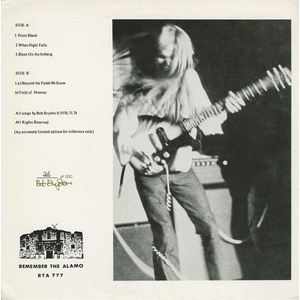
Christmas - Live BACK
Christmas - Live BACK 2nd copy
Christmas - Live LABEL 01
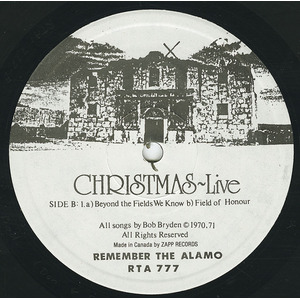
Christmas - Live LABEL 02
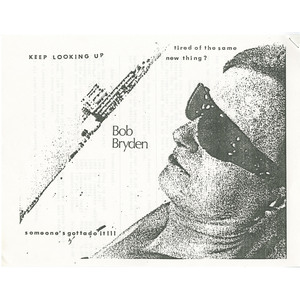
Christmas - Live INSERT 01 PAGE 01
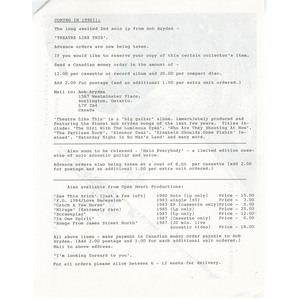
Christmas - Live INSERT 01 PAGE 02
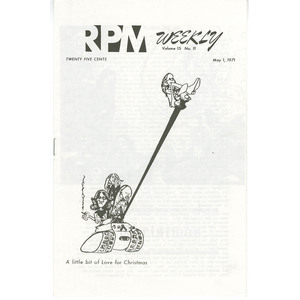
Christmas - Live RPM WEEKLY PAGE 01 FRONT
Christmas - Live RPM WEEKLY PAGES 02-03
Media
Videos
0 videos
No videos available for this title.
Credits
Musicians
Bob Bryden: vocals, guitar
Robert Bulger: lead guitar
Tyler Raizenne: bass
Rich Richter: drums
Songwriting
‘Point Blank’ written by Bob Bryden
‘When Night Falls’ written by Bob Bryden
‘Blues On An Iceberg’ written by Bob Bryden
‘Beyond the Fields We Know’ written by Bob Bryden
‘Field of Honour’ written by Bob Bryden
Recording
Recorded live at Massey Hall, Toronto, Ontario, 1971
Physical Release
Vinyl LP
Limited edition
Hand-numbered edition of 316 copies
USA & Canada
1989
Made in Canada by Zapp Records
Eight-page booklet and two inserts included
Copies individually numbered and signed by Bob Bryden
Copyright
All songs © Bob Bryden, 1970, 1971, 1974
All rights reserved
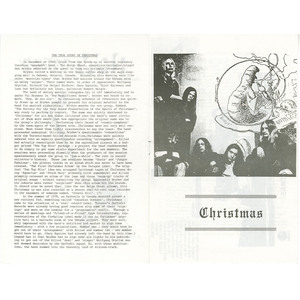
THE TRUE STORY OF CHRISTMAS
In December of 1969, fresh from the break-up of another legendary Canadian 'basement' band - The Reign Ghost, songwriter/guitarist/singer Bob Bryden embarked on the quest to form his ultimate 'dreamband'.
Bryden called a meeting in the Sears coffee shop at the main shopping mall in Oshawa, Ontario, Canada. Attending this meeting were five other 'musician-types' that Bryden had noticed around the Oshawa area as being 'unique'. Their names were, in order of appearance: Wolfgang Hryciuk, Richard (or Helge) Richter, Gary Squires, Tyler Raizenne and last but definitely not least, guitarist Robert Bulger.
The band of motley musical renegades hit it off immediately and to quote Yul Brynner in 'The Magnificent Seven', Bryden was heard to remark, 'Now, we are six'. An exhausting schedule of rehearsals was quickly drawn up as Bryden sought to present his original material to the band for musical elaboration. Within months the new group, dubbed, 'The Society For the Year Round Preservation of the Spirit of Christmas', was ready to perform in concert. The name was quickly shortened to 'Christmas' for all but those initiated into the band's inner circle, all of whom were aware just how appropriate the original name was to the group's philosophy. Performing their brand of 'cosmic-symphony' to the teen-agers of the Oshawa area, Christmas were not very well received. Most found them highly inaccessible to say the least. The band proceeded undaunted. Utilizing Bryden's questionable 'connections' with the Toronto-based Allied Records firm, Christmas were quickly ushered into an equally questionable recording 'arrangement'. Allied had actually conscripted them to be the uncredited players on a budget priced 'Ten Top Hits' package - a project the band condescended to do simply to get some studio experience for the new members. The sessions were proceeding dismally when the producers of the session spontaneously asked the group to 'jam-a-while'. The rest is record collector's history. Those jam sessions became 'Oasis' and 'Jungle Fabulous', two pivotal tracks on an album which was never to have been created, 'The First Christmas Album' on the Paragon label. The original 'Ten Top Hits' idea was scrapped (although tapes of Christmas doing 'Aquarius' and 'Proud Mary' probably exist somewhere) and Allied promptly released an album of the jams and three 'warm-up' tracks of original songs - without consulting the group. Apparently Bryden and his cohorts were rather 'surprised' when this album hit the stands. It should also be noted that, like the two Reign Ghost albums, this Christmas lp was also recorded on a stereo reel-to-reel tape recorder in the basement of someone named, 'Cousin Bill'. (?)
In the summer of 1970, as hysteria in Canada mounted around a new cultural fad, something called 'Canadian Content', Christmas came to the attention of a 'real' record label. Toronto's Daffodil Records were already having good reaction with some of their 'signings' and were on the lookout for a 'progressive' outfit. Through a series of meetings and 'friend-of-a-friend' type introductions, representatives of the fledgling label made it out to Christmas' practice hall in a barracks room of the Oshawa airport. They were suitably impressed with the band's abilities and wanted to sign them immediately - with a few stipulations. Number one - they would have to get out of their 'arrangement' with Allied and number two - one member would have to go. (Gary Squires had already left the band by this time.) Legend has it that Bryden had to sign over all rights to his publishing to get out of the Allied 'deal' and 'singer' Wolfgang Hryciuk was not deemed desirable by the Daffodil squad. So, with these modifications, the band zoomed into the heavenly land of sixteen-track.
In the fall of 1970 Christmas recorded their album 'Heritage'. The young group of musicians were clearly overwhelmed by this sudden immersion into multi-track wonderland. The production situation was not helped by the amount of 'smokable inebriants' which were apparently 'floating round the studio'. However, this ambitious and laudable work was completed and released in December,1970 along with a single not contained on the lp. Released by distributor Capitol Records ON THE SAME DAY as George Harrison's 'All Things Must Pass', 'Heritage' was swamped in the promotional melee surrounding the Harrison release. Although receiving some good press and regional airplay in Canada, the album did not change the world as expected. The band were devasted, the record company frustrated - and everybody went back to their respective drawing boards.
A three year nightmare was about to begin for the idealistic young band. Under record company pressure, Christmas recorded and released a commercial 45. A saccharine, bubble-gum anthem called 'I'm A Song, Sing Me', written by Neil Sedaka*%$#$$$$$$!!! This blatant attempt to grab a dollar failed without a whimper. At the same time, the band played a now legendary set opening up for another band in Toronto at Massey Hall. Taking the stage in an explosive and volatile stand of musical anarchy, somewhat prophetic of the punk 'rebellions' to come, Christmas only succeeded in further polarising an already complacent and conservative Massey Hall audience. Incensed, the band retreated to a barn in the country to pursue their creative visions unbothered. A new vocalist was added, Preston Wynn, and in 1972 the band began recording their landmark opus, 'Lies To Live By'. It says a lot for Daffodil records that throughout all these ups and downs the record company did not abandon or lose faith in the group's abilities.
The 'Lies To Live By' project in itself was a lesson in endurance. Several times'the project and the whole record company stood at the brink of bankruptcy. At one point, due to financial instability, the project was shelved for a total of eight months. From what we have been able to gather it seems a miracle that the album ever did see the light of day. Nevertheless, in spite of all adversity, towards the end of 1974 Christmas' last and greatest work reached the record stores. Reaction in both the media and the public - with the exception of a few good reviews - ranged from stone cold to dismay. This bold work was just too long, too dark, too foreboding, too metapysical to be received joyously by a culture dizzy from singing along with 'Sweet City Woman'. Even so-called 'progressive' fm stations gave the lp token airplay then backed off entirely. Obviously, intimidated by the introverted, brooding stance of the lp.
With this final blow, the band could not recover. After five years of making every attempt not to compromise their creative integrity, it was clear that 'no one was listening'. The group disbanded in early 1975 and never regrouped. At last report Robert Bulger was teaching guitar somewhere, Tyler Raizenne was still living at home, Richard Richter was a born again Christian 'working on the railroad'and Preston Wynn was on the road in a 'Rocky Horror' Roadshow band. Only Bryden seems to have carried on making records, producing punk bands, releasing a solo lp, performing and releasing some 'new wave' records. As interest in the Christmas lp's escalates among collector's the world over let us hope that 'The Spirit of Christmas' will never be forgotten but kindled afresh with every new generation of vinyl devotees.
-Jay S. Wraggs
No Comments