Insight
Cat: A Canadian Rock Band (1968–1972)
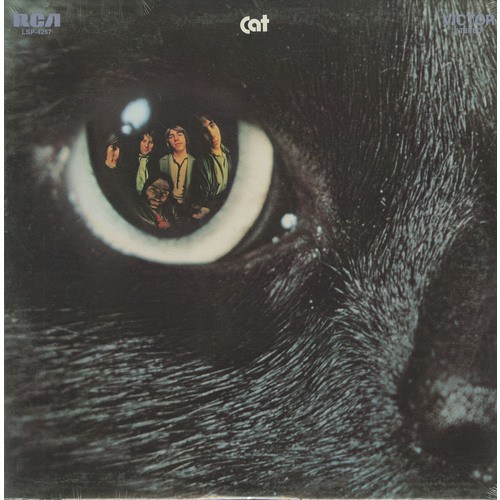
Cat was a Toronto-based rock band active from 1968 to 1972, featuring vocalist Jim Campbell and guitarist/songwriter Mike McQueen, alongside Graham Fidler (bass, vocals), Phil Mulholland (drums), and Gary O’Conner (guitar, piano, organ).
Before Cat, Campbell and McQueen had played together in The Spasstiks, a mid-1960s Toronto group that issued a lone Apex single in 1967.
By 1968, Cat had become a familiar live draw in Ontario, with occasional dates in the northeastern United States.
Their growing reputation led to their reported association with the legendary Festival Express tour in 1970, where they shared the stage with renowned acts such as Janis Joplin, The Grateful Dead, and The Band. This period coincided with the release of their self-titled album.
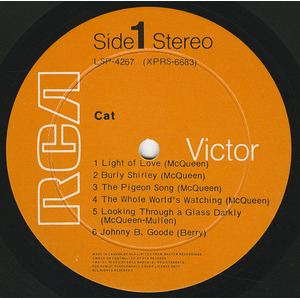
Cat’s only album, Cat (1970), was recorded in Chicago and produced by Jack Richardson, best known for his work with The Guess Who. As on the Spasstiks single, McQueen remained the principal songwriter on Cat: he wrote almost every original track, except for “Looking Through a Glass Darkly,” co-written with former Spasstiks rhythm guitarist Rob Mullen, and the Chuck Berry cover “Johnny B. Goode.” The album includes the Nimbus single “Light of Love” and “We’re All in This Together,” one of the band’s better-known songs in Canada.
On the album, four tracks — “Light of Love,” “Looking Through a Glass Darkly,” “Blank Space,” and “Solo Flight” — were arranged by Canadian studio musician Ben McPeek, with the remaining songs arranged by the band.
Before and after the LP, Cat issued five singles: one on Apex in 1968 (“Doing the Best We Can,” Apex 77080) and four on Nimbus 9 between 1969 and 1971 (“Light of Love,” “Solo Flight,” “Funky Sunflower,” and “Honey in the Sky”).
Despite their initial success, Cat disbanded in 1972. Following the breakup, Gary O’Connor embarked on a solo career in the early 1980s under the name Gary O', releasing singles such as “Pay You Back with Interest” and “All the Young Heroes,” while also gaining recognition as a songwriter for artists like 38 Special and Eddie Money. Jim Campbell transitioned into the music business, becoming a record executive with WEA in 1974. The remaining members went on to form the band Fast Eddy, which recorded a single on Nimbus.
-Robert Williston
Musicians
Jim Campbell: lead vocals, percussion
Gary O’Conner: guitar, piano, organ
Mike McQueen: guitar
Graham Fidler: bass, backing vocals
Phil Mulholland: drums
Songwriting
All songs written by Mike McQueen, except:
‘Looking Through a Glass Darkly’ written by Mike McQueen and Rob Mullen
‘Johnny B. Goode’ written by Chuck Berry
Arranged by Ben McPeek on ‘Light of Love,’ ‘Looking Through a Glass Darkly,’ ‘Blank Space,’ and ‘Solo Flight.’
Arranged by Cat on ‘Burly Shirley,’ ‘The Pigeon Song,’ ‘The Whole World’s Watching,’ ‘Johnny B. Goode,’ ‘I’m Gonna Hijack a Plane to Cuba,’ ‘We’re All in This Together,’ and ‘Goodbye'
Publishing
All selections published by Septima Music, Inc.
except ‘Johnny B. Goode,’ published by Arc Music Corp.
Production
Produced by Jack Richardson and Nimbus 9
Recorded at RCA’s Mid-America Recording Center, Chicago, Illinois
Recording engineer: Brian Christian
Recording technician: Ed Schnabl
Mastering engineer: Randy Kling
Notes
Special thanks to Barry Racippo, Billy Cosgrave, Bob Abbott, and Mr. and Mrs. McQueen
Liner notes (1970)
A New Kind of Cat
Calculate the number of records released every week, and calculate the percentage of them that actually have anything to say, and you will have some idea of how surprised I was when I heard this one. It was one day a few months ago when I was at RCA in Don Burkheimer’s office and he played Light of Love, which completely flipped me out.
The name of the group was Cat and they came from Canada. Light of Love was going to be their first single.
Canada as a source of rock talent is a relatively new phenomenon in this country. It began with These Eyes by The Guess Who and has made its presence heard ever since. Canada exists.
Nevertheless, Canada is scarcely a major name. The record business has a habit of copying the superficial characteristics of every hit record and coming out with fifty imitations — none of which work.
Cat, then, is as important for what it’s not as for what it is.
What it is is leader Mike McQueen, who plays guitar and writes most of the original material; Phil Mulholland, who plays drums; Gary O’Conner, who plays guitar, piano and organ; Graham Fidler, who plays bass and does backup vocals; and Jim Campbell, who plays percussion and is the lead singer of the group.
I have never really gotten along with cats before this (in the animal version — not the hip meaning of the word). They seemed to slink around, oblivious to noise and action, reacting on some crazy other vibration which I just couldn’t understand. Hard to hold, impossible to keep away, unemotional but temperamental. They would never bark, but they’d always scratch. Now, however, I’m beginning to see the light. This group has shown me. Ranging from odd rock ’n’ roll to smooth universal ballads to revolution. And it always flows and sounds good no matter what the content hits my ear. Important.
If you’ve always hated cats, these cats might turn you on to something new. If you’ve liked the calicoes, Cheshires, Persians and alleys — well here’s a Canadian. Love.
-Dan Goldberg
Record World
Gallery
Images
4 images

Cat - ST SEALED BACK
Cat - ST SEALED LABEL 01

Cat - ST SEALED LABEL 02
ST
Media
Videos
0 videos
No videos available for this title.
Credits
In Transit
No Comments