
Album / Title
Johnny Burt's Arrangements for Five Trombones
By: Johnny Burt
Origin: London, England, 🇬🇧 → Toronto, Ontario, 🇨🇦
Insight
Born: March 31, 1914 – London, England
Died: September 21, 1980 – Toronto, Ontario, 🇨🇦
Johnny (John Edward) Burt was the arranger, conductor and pianist who gave the Canadian Talent Library its sound. For ten years he chose its artists, ran its sessions and wrote many of its charts, and in the process helped prove that Canadian players and Canadian studios could make records as good as anything coming out of New York or London.
Born in London, England, Burt was brought to Toronto as an infant. He studied piano as a child and later took composition lessons, briefly, with John Weinzweig. By the early 1930s he was playing piano in the city's dance bands under Luigi Romanelli, Jack Slatter and George Wade, working the hotel ballrooms and Lake Ontario moonlight cruises that radio carried across the country. Summers with Romanelli meant a residency at the Manoir Richelieu in Murray Bay, Quebec. On CFRB he led his own jazz trio with Murray McEachern on clarinet and saxophone and Danny Perri on guitar, and he was already writing orchestrations for dance bands, radio shows and singers, including charts for Jack Shaindlan and Paul Whiteman in the United States.
In 1937 the English bandleader Ray Noble came to hear Trump Davidson's band, with Burt at the piano, at Toronto's Club Esquire. Noble had made hundreds of records in England but had never led a band in public there, and he hired fourteen Canadians, largely from Davidson's band, for a tour of the British Isles. They sailed from New York on the Normandie in May 1938 and opened in Glasgow on June 6. Each show began with a spotlight on Noble at the piano playing his theme, 'The Very Thought of You', before Burt slipped onto the bench for the rest of the set. When the tour ended in September, Burt stayed behind. Being London-born, he could join the British musicians' union on the spot, and he went to work as pianist and arranger for Canadian bandleader Billy Bissett at the Café de Paris.
Back in Toronto in 1939 he joined Joe DeCourcy's dance band. In 1941 and 1942 he arranged for Paul Whiteman's orchestra in the United States, then spent three years as a Royal Canadian Navy bandsman at HMCS York in Toronto.
After the war Burt became one of the busiest arrangers at the CBC, writing for the orchestras of Geoffrey Waddington, Jean Deslauriers, Samuel Hersenhoren, Paul Scherman and John Adaskin, whose talent show Opportunity Knocks commissioned three of his compositions. His trio, now with Stan Wilson on guitar and Sam Levine on bass, played CBC Radio from 1946 to 1948. He led his own orchestra on Johnny Burt and Company in 1952 and on network shows starring Elwood Glover, Wally Koster and Gisèle MacKenzie, and when television arrived he wrote many of the arrangements Joyce Hahn and Wally Koster sang on the weekly Hit Parade. His orchestra's theme was his own 'Theme for Susan', and he also scored films for the National Film Board.
The Canadian Talent Library was a non-profit trust launched in 1962 by Lyman Potts and Standard Broadcasting, owner of CFRB Toronto and CJAD Montreal, to record Canadian musicians for radio at a time when almost no one else would. Burt conducted its first session on July 27, 1962, at RCA Victor's studio on Mutual Street in Toronto: two orchestras of top Toronto players and two dozen of his arrangements, all taped in stereo in about six hours. His Johnny Burt Strings album from that day became CTL 5001, the first record in the library. In 1963, after his third CTL album, he was put in charge of the library's next 150 productions, and he served as music director until 1972. He picked the artists and supervised their recordings, working with players and singers such as Peter Appleyard, Moe Koffman, Henry Cuesta, Rob McConnell's Boss Brass and a young Gordon Lightfoot. Some 240 Canadian stations subscribed, and the BBC and broadcasters in the United States and Australia used the records too.
His own CTL albums moved through every setting the library offered. CTL 5004 and CTL 5014 paired strings, French horn and woodwinds with the trombone of Teddy Roderman and carried his originals 'Theme for Susan' and 'Mike Fright'. Johnny Burt Trombones (CTL 5042) put five trombones in front of vibes, marimba and celeste. CTL 5055 set twelve strings, harp, flute and accordion loose on 'Bali Ha'i' and 'Sweet Leilani'. In 1968 he fronted a full pop-concert orchestra with harpsichord and celeste on CTL 5100, issued by RCA as CTLS-1100, with Erich Traugott, Guido Basso, Moe Koffman, Eugene Amaro and Peter Appleyard among the players and 'From This Moment On' leading off. There was a Christmas album with orchestra and chorus (CTL 5154), and he wrote the string settings behind Bert Niosi's alto saxophone (CTL 5044) and John Perrone's Spanish guitar (CTL 5120). For RCA he also recorded Dance to the Trombones (RCA Camden CAS-997), Around the World (RCA PCS-1199) and a second big band album (RCA CAS-2406).
In 1972 he made the most unexpected record of his career. …Come Summer (CTL 5160), credited to The Johnny Burt Society, put six singers (Stephanie Taylor, Lynne McNeil, Kathy Collier, Les Leigh, Harvey Paterson and Vern Kennedy) in front of a twelve-piece band featuring Moe Koffman, Ed Bickert, Peter Appleyard, Guido Basso and Eugene Amaro. Their bright, harmony-stacked takes on 'Cherish', 'The Candy Man', 'Speak Softly Love' and 'Is This the Way to Amarillo' turned the 58-year-old big band arranger into a sunshine pop producer.
Burt kept recording for the library into the late 1970s, ending with an orchestral album (CTL 5213) that took on 'Evergreen', 'We're All Alone' and the theme from Star Wars, and he arranged and conducted Canadian sessions for Muzak. More than 20 of his compositions were recorded for the Chappell Library of Background Music.
Burt grew up in Toronto alongside Percy Faith and Robert Farnon, and both left for careers in the United States and England. He stayed, and spent five decades building the bands, broadcasts and records that let Canadian musicians be heard in their own country. He died of cancer in Toronto on September 21, 1980, at the age of 66.
-Robert Williston
Gallery
Images
2 images

Johnny Burt - Johnny Burt's Arrangements For Five Trombones FRONT
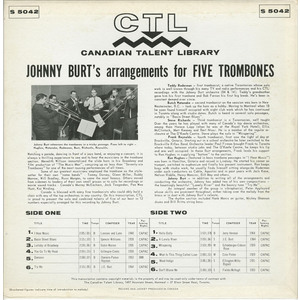
Johnny Burt's Arrangements for Five Trombones
Media
Videos
0 videos
No videos available for this title.
Credits
JOHNNY BURT’s arrangements for FIVE TROMBONES
Johnny Burt rehearses the trombones in a tricky passage. From left to right – Hughes, Watanabe, Roderman, Burt, Richards, Reynolds.
Watching a parade, dancing in front of a jazz band, or enjoying a concert, it is always a thrilling experience to see and to hear the musicians in the trombone section. Meredith Willson immortalized the slide horn in his Broadway and film production of “The Music Man”, conjuring up no less than “Seventy-six Trombones” for one of the most rousing performances of all time.
After World War II, many musicians joined the big bands – others studied, settee for their own jazz, dance bands – Tommy Dorsey, Glenn Miller, Buddy Morrow, Bill Harris, Kai Winding and many more. Some of the soloists graduated from sidemen to leaders of their own small groups and to solo recordings of major international renown. Canada’s top musicians are just as famous. Over the years we would single out faces of Murray McEachern, Jack Teagarden, Pee Wee Hunt, Kai Winding.
Today Canada is blessed with many fine trombonists who could ably hold a chair with one of the solo chairs on any front row in this profession. CTL is proud to bring to the speakers and microphones of Canada a section of six musicians specially arranged for this recording by Johnny Burt.
Teddy Roderman – first trombonist; a native Torontonian whose solo work is well known through his many TV and radio performances and his CTL recordings with the Johnny Burt orchestra (S 5044). Teddy’s grandmother gave him his first trombone and Bob Farnon his first big break. He’s been in demand ever since.
Butch Watanabe – second trombonist in the session was born in New Westminster, B.C. – took up the horn as a hobby. Moving to Montreal when 18 he soon found himself occupied with night club work which he has continued in Toronto during student studies. Butch is heard in several solo passages, notably in “Basin Street Blues”.
Steve Richards – third trombonist is a Torontonian, self taught, over the years he has played with many bands and is one of the most sought among trombone loop men when he has a day off from work at the Royal York Hotel. Ellis McClintock, Mark Kenney and Bert Niosi. He is also a rock ‘n roll star.
The O’Keefe Centre stage plays host to the “Whispering Giant” of trombone Frank Reynolds – artist in school orchestra before he left for Brockville, Ontario. Starting out as a public French horn he studied music in Brockville Rifle Band Orchestra then Paul (Freeman) brought Frank to Toronto and he occupied a chair in several arrangements. Frank lends his support to Johnny Burt’s brilliant blend of “Don’t Blame Me”.
Ron Hughes (featured in solo and in the passage “I Hear Music”) was born in London, Ontario. He studied at Detroit Conservatory and now supports the renowned Johnny Burt orchestra in many TV assignments. Jack Kane was trumpet, which he usually finds himself doing along side recent recording sessions. We hope to find many of his solos in years to come.
Nelson Hinds the last member of the trombone team was born in Jamaica and came to Canada in 1960. Although still in his twenties, Nelson has studied conducting and orchestration. Johnny has guided some of his own compositions and personally selected his career. Along with Johnny’s team are Ted Moses (piano); Mike Allen (bass); Dennis Pendrith (bass); and Eric Robertson (organ) – in the rhythm section, with Don Thompson taking over the melody from the orchestral numbers. On many of these arrangements we hear Peter Appleyard on vibes and guitar. Johnny has added Hank Monis on guitar, Mickey Shannon drums and Bill Britto string bass.
No Comments