Insight
Brutus were a Toronto rock band formed in April 1969 by singer and keyboardist Walter Zwolinski, initially billed as Wally Soul, and bassist and booking agent Tom Wilson, formerly of Little Caesar and the Consuls. Active in two main periods, from 1969 to 1971 and again from 1973 through the late 1970s, Brutus evolved from a horn-driven mixture of soul, funk, pop and rock into a heavier and increasingly theatrical band built around Zwolinski’s commanding stage presence.
The original lineup featured Zwolinski on lead vocals and keyboards, Wilson on bass, Eldon “Sonny” Wingay on guitar, Michael Magann on trumpet, Bill Robb on saxophone and trombone, and Len Sembaluk on drums. The personnel changed quickly. Wilson soon concentrated on managing and booking the band, with Sandy White taking over on bass, while Bruce Gordon replaced Magann around Christmas 1969 after Magann left to complete his university studies. Gordon contributed trumpet, organ, guitar and bass.
Wilson booked Brutus extensively throughout Ontario, reportedly filling approximately six months of engagements in advance. The band worked the province’s clubs and summer venues, including the Key to Bala, The Pav in Orillia, Peterborough and Sauble Beach, while also expanding into the eastern United States. They appeared with major touring groups including The Guess Who, The Staccatos and Chicago Transit Authority, shortly before that group shortened its name to Chicago.
The band’s name was inspired by Marcus Junius Brutus, the Roman conspirator involved in the assassination of Julius Caesar. This also led to the occasional billing Brutus and the Assassins, a playful reference to Little Caesar and the Consuls.
Brutus were already developing a theatrical live identity during their earliest period. A 1970 RPM feature described Zwolinski’s movements and stage clothes as reminiscent of Elvis Presley, showing that visual presentation and showmanship were important to the group long before its later glam-influenced incarnation.
The group’s first single, “Funky Roller Skates” backed with “Flyer,” was issued by Quality Records around the beginning of 1970. Written respectively by Wally Soul and Sonny Wingay, the record captured the band’s early combination of brass, organ, dance rhythms and light rock. “Funky Roller Skates” reached number seven on RPM’s Canadian Content chart, but did not cross over to the magazine’s national Top 100.
Quality Records mounted a strong promotional campaign behind the single, which received airplay at stations across Ontario. Further early recordings included “Duck Pond” and “Help Me, Free Me,” the latter issued on Yorkville. Although the band attracted attention and remained active on the live circuit, the first version of Brutus ended in 1971 after Zwolinski wanted the members to commit to the group full-time.
Brutus also appeared on several ambitious festival bills. They were booked for the Freak Out festival at Rock Hill, north of Orangeville, held from August 29 to September 1, 1969, alongside The Guess Who, Lighthouse, Rhinoceros, Motherlode, The Brass Union and Buckstone Hardware. The following summer they were advertised for the Midsummer Night’s Rock Fest in Michigan, with a lineup that included Rotary Connection, The Poor Souls and Chimo!.
Zwolinski revived Brutus in 1973 with a substantially different musical and visual approach. The early shirts and conventional stage clothes gave way to glitter, makeup, jumpsuits and provocative theatrical routines influenced by the flamboyant British rock performers of the period. The music also became heavier, with guitars and keyboards gradually replacing the original emphasis on horns.
The 1973 lineup featured Zwolinski with guitarist Gino Scarpelli, bassist Dennis Pinhorn and drummer Lance Wright. Their performances generated both excitement and controversy. The band was reportedly barred from several Toronto high schools, while Zwolinski was arrested following a performance in North Bay after the local press raised accusations of devil worship. The matter was resolved after the group explained that the imagery was part of its theatrical stage presentation.
The controversy only strengthened Brutus’s reputation as a live attraction. The band eventually headlined a sold-out performance at Ontario Place, sharing the bill with The Stampeders, April Wine and the Greaseball Boogie Band, later renamed Shooter.
Another reconstruction brought guitarist Woody West, drummer Dan Smith and keyboardist Frank Ludwig into the group alongside Zwolinski and Pinhorn. In late 1975, Brutus signed with GRT Records and began recording at Soundstage in Toronto with producer Jack Richardson, whose work with The Guess Who had made him one of Canada’s leading record producers.
The first GRT single was “(Let Me Down) Slow and Easy” backed with “Tonight Tonight.” Creative disagreements between Richardson and Zwolinski brought the larger recording project to an end, but “Ooh, Mama, Mama” survived from the sessions. Featuring Frank Ludwig on keyboards, the song was released as the follow-up single in September 1975 and became the band’s strongest regional success.
“Ooh, Mama, Mama” reached the Top 10 at a number of Canadian radio stations and reportedly climbed as high as number three on at least one local chart. It was also named the year’s top Canadian single in a Montreal Star readers’ poll.
GRT then sent Brutus to Tempo Studios in Toronto with producer Ralph Murphy. By this point, Dennis Pinhorn and Frank Ludwig had left, and the recording lineup consisted of Zwolinski, Woody West, Dan Smith, bassist Doni Underhill and keyboardist Laurie Del Grande. Pinhorn and Ludwig remained on “Ooh, Mama, Mama,” while the revised lineup recorded the remainder of the album.
The basic tracks were completed with remarkable speed. According to the later reissue liner notes, recording began on a Monday and was largely finished by Wednesday, followed by approximately two weeks of additional work refining and mixing the material. “King of the World” was also recorded during the sessions but was left off the original album.
The self-titled Brutus album was released by GRT in 1976. Zwolinski wrote all nine songs and performed lead vocals, electric accordion, synthesizer, piano and organ. West contributed electric, slide and acoustic guitars, while Underhill played electric and fretless bass and sang backing vocals. Del Grande added string synthesizer, piano, organ and backing vocals, with Smith on percussion.
Although the band had become notorious for its theatrical concerts, the album did not attempt to recreate the most outrageous aspects of its stage presentation. Instead, it combined straightforward rock songs, melodic pop writing and longer progressive passages, supported by layered keyboards and carefully arranged guitar work.
The album opened with “Ooh, Mama, Mama” and continued with “Tango,” “3:30 Came,” “Who Wants to Buy a Song?,” “Sailing,” “Search for Tomorrow,” “Lookin’ So Good,” “Break My Heart Again” and the extended closing track “For the People.”
“Who Wants to Buy a Song?” became Brutus’s only entry on the national RPM Top 100, reaching number 65 in 1976. Released toward the end of the year, the single helped generate renewed attention for the album during the first week of November. “Sailing” backed with “Search for Tomorrow” followed as another single but did not chart nationally.
Brutus continued touring across Ontario, Québec and the United States, appearing on bills with major acts including Boston, Southside Johnny and Peter Gabriel. On March 22, 1977, the band appeared with Gabriel at Maple Leaf Gardens in Toronto during his first North American solo tour.
The membership continued to change. Doni Underhill left to join Trooper and was replaced by Chris Brockway, formerly of Pepper Tree. Brockway was later succeeded by Breen LeBoeuf, whose earlier groups included Chimo!, Motherlode and Studebaker Hawk. LeBoeuf later became a prominent member of Offenbach and April Wine.
Dan Smith was eventually replaced by Moxy drummer Bill Wade. Woody West’s successors on guitar included Paul Dean, later of Streetheart and Loverboy, and Jerry Doucette, who went on to a successful solo career. Other musicians associated with Brutus during the band’s various incarnations included John Bride of the Cameo Blues Band, Gino Scarpelli of Goddo, Frank Ludwig and Doni Underhill of Trooper, Dennis Pinhorn of the Downchild Blues Band, and Len Sembaluk, who later worked with Alabama.
Following the end of Brutus, Zwolinski shortened his professional name to Zwol and began a solo career. He released the album Zwol in 1978, followed by Effective Immediately in 1979. He later formed Walter Zwol and the Rage, whose album Thrillz appeared in 1981.
The Brutus album was remastered and reissued by Bullseye Records of Canada in 2000 as For the People: The Best of Brutus. The expanded edition added “Let Me Down Slow and Easy,” the “Ooh, Mama, Mama” B-side “Ride Cowboy Ride,” and the previously unreleased “King of the World.”
Brutus occupied an unusual place in Canadian rock. Their earliest recordings combined soul, funk and brass-oriented rock, while the revived group embraced heavier guitars, synthesizers and an extravagant theatrical presentation. Their recordings and controversial live shows captured a distinctive moment in Canadian music, while the band’s constantly changing membership connected Brutus to Trooper, Goddo, Streetheart, Loverboy, Offenbach, April Wine, Moxy, Downchild and several other important Canadian groups.
-Robert Williston
Gallery
Images
2 images
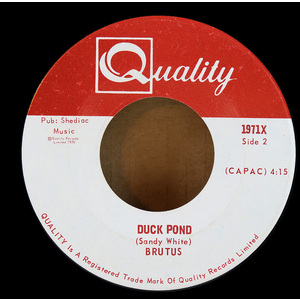
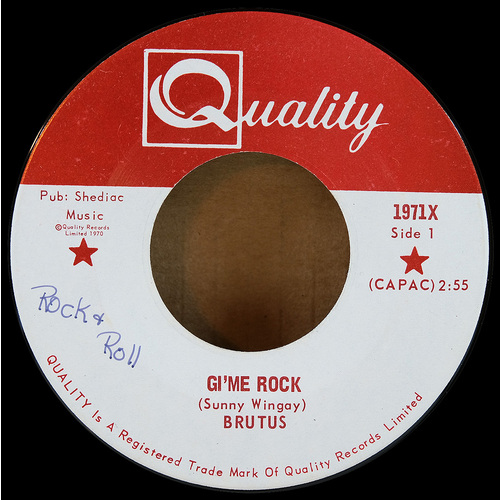
BRUTUS QUALITY SIDE 2-1
Gi'me Rock b/w Duck Pond
Media
Videos
0 videos
No videos available for this title.
Credits
Musicians
Walter Zwolinski, billed as Wally Soul: lead vocals, organ
Eldon “Sonny” Wingay: guitar
Sandy White: bass
Len Sembaluk: drums
Bruce Gordon: trumpet, organ, guitar, bass
Bill Robb: saxophone, trombone
Songwriting
‘Gi’mе Rock’ written by Sunny Wingay
‘Duck Pond’ written by Sandy White
Publishing
Published by Shediac Music
Rights: CAPAC
Companies
Quality Records Limited
Copyright © 1970 Quality Records Limited
Release date
May 1970
Technical / format notes
7-inch vinyl
45 RPM
Single
Made in Canada
Audio and Artwork Restoration
Audio Transfer/Restoration by Scott Edward
spinningmywheelsinternational@gmail.com
226-235-6005
No Comments