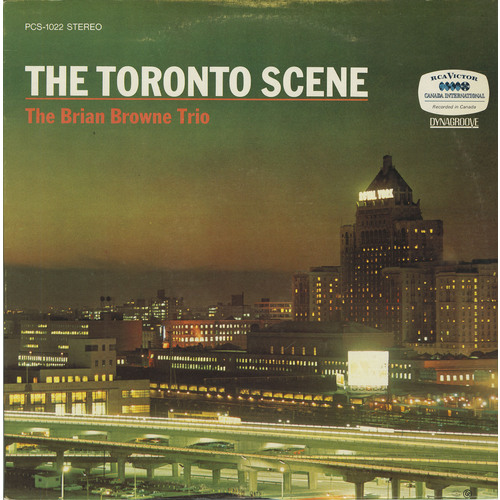
Insight
Brian Browne Trio – Listen, People!
Brian Browne was born in Montréal on March 16, 1937, into a musical household shaped by his father Leo, an accomplished Irish fiddler. Music filled the Browne home, and young Brian gravitated to the piano. He was largely self-taught, learning by ear from the recordings of Art Tatum, George Shearing, and Oscar Peterson. By his teens he was already entertaining patients in hospitals and residents of seniors’ homes, developing a gift for making music personal and direct.
When the family relocated to Ottawa in the early 1950s, Browne’s education broadened. He graduated from Fisher Park High School in 1955, studied briefly in law at the University of Ottawa, then switched to music, realizing that composition and harmony were his true calling. He went on to Berklee in Boston and won a scholarship to Oscar Peterson’s Advanced School of Contemporary Music in Toronto, a formative experience that deepened both his technique and confidence.
In 1957 he formed the first Brian Browne Trio with bassist Sol Gunner and drummer Glenn Robb, playing Ottawa’s Beacon Arms Hotel and other clubs in the region. Selective about where he performed, Browne positioned himself squarely within serious jazz circles. He hosted a short-lived Ottawa radio show that caught the attention of CBC producer Peter Shaw, who transformed it into The Browne Beat, a weekly national program that helped make Browne a recognizable name.
By 1963 Browne had moved to Toronto, rebuilt his trio with bassist Skip Beckwith and drummer Donald Vickery, and quickly became a fixture on the Ontario club circuit. RCA Victor signed him in 1965, resulting in the trio’s debut LP, which mixed standards with Browne originals like “Browne Sugar” and “Blue Hair.” The album sold modestly but established him as a thoughtful arranger and inventive pianist.
The mid-1960s were a whirlwind. A second RCA album, Listen, People (1966), again paired covers with original compositions, while a Canadian Talent Library release showcased the trio alongside clarinetist Henry Cuesta. The group also issued singles for Quality and Academy Records in the U.S. and became fixtures on CBC programs such as Adventures in Rhythm, Nightcap, and Jazz Canada.
Personnel changes came and went—Vickery was succeeded by drummer Alex Lazaroff, then Bruce Philip—but Browne’s lyrical, harmonically rich piano style anchored the trio. In 1967 he recorded with the Douglas Randle Orchestra for CBC’s LM Series and later that year signed with Capitol Records. His witty turn on the 1969 CBC-TV special Jazz Piano—appearing with Erroll Garner, Bill Evans, and Marian McPartland—cemented his reputation. When he quipped, “If you play for people drinking cocktails, it’s called cocktail music. If you play for people who can’t afford cocktails, that’s jazz,” the line became part of his legend.
Capitol released Morning, Noon and Night-Time Too in 1969, featuring the original “Morning, Moon and Night-Time-Too,” which earned BMI Song of the Year when the album was reissued in 1974. Around the same time he collaborated with Anne Murray, recording on her early albums and appearing on her CBC television special.
Like many jazz musicians, Browne battled the grind of the business and personal demons. Alcohol and drug use shadowed the 1970s, slowing his career even as he kept performing and cut a live album, At the Park Plaza. In the mid-1980s he revived his career through CBC projects, including an album of Beatles interpretations, and a solo piano concert later issued decades afterward.
In 1989 he moved to New York City, stepping away from music to run a pool hall, then gradually found his way back to the piano, performing in clubs and finally kicking his drug habit. Returning to Ottawa in 1999 to care for his parents, he re-established himself as a central figure on the city’s jazz scene, recording CDs, teaching, and playing restaurants and clubs well into his seventies.
Brian Browne’s career was marked by brilliance, wit, and resilience. His playing combined the harmonic sophistication of his idols with a deeply personal touch that could move any audience, whether in a cocktail lounge, on national television, or in the intimacy of a trio setting. He passed away in 2018, remembered not just as a gifted pianist but as a musician who poured honesty and humour into every performance.
-Robert Williston
Musicians
Brian Browne: piano
Pearson Skip Beckwith: bass
Donald Vickery: drums
Songwriting
‘Careless Love’ traditional, arranged by Brian Browne
‘Baubles, Bangles and Beads’ written by Robert Wright and George Forrest
‘Home Again’ arranged by Brian Browne
‘Browne Sugar’ written by Brian Browne
‘Toot That Whistle’ written by Brian Browne
‘Waltzing Matilda’ written by Marie Cowan and Rolf Harris
‘Georgia on My Mind’ written by Hoagy Carmichael and Stuart Gorrell
‘Blue Hair’ written by Brian Browne
Production
Produced by S. B. Hains
Engineered by Wm. Giles
Lacquer cut by George Semkiw
Liner notes
Montreal-born Brian Browne started studying and playing piano during his early high school years, at which time Brian and his family moved to Ottawa. Within a short period of time, Brian decided to make music his career, realizing fully that he had to acquire a solid foundation in harmony and theory to be successful. To achieve this end, Brian studied in Canada and the USA, specializing in composition.
Upon his return to Ottawa, Brian embarked on a series of engagements in the Ottawa-Hull area, playing only the clubs where jazz was acceptable and emphatically refusing all other club dates. For two years he broadcast locally until CBC producer Peter Shaw came up with “The Browne Beat” which was broadcast weekly on the CBC radio network.
It was only a short jump from there to the “class” rooms in Toronto’s Westbury and Park Plaza Hotels with an occasional side-trip to the lavish Park Motor Hotel in Niagara Falls.
While Brian quotes his favourite pianists as being the late Art Tatum, Teddy Wilson, Hank Jones and Oscar Peterson, he freely admits that he manages to be influenced one way or another by practically every capable pianist he has heard. Married with a charming wife and a half old son, Brian now resides in a smart Lawrence Avenue apartment in Toronto. Eventually he would like to make a European tour and of course, he hopes to establish himself as a recording artist.
The two sidemen on this album are Pearson “Skip” Beckwith on bass and Don Vickery on drums. Oddly enough, both these young musicians hail from Halifax where they played together in their earlier years. Brian met Skip in Toronto where he was studying bass with Ray Brown. Skip brought Don to Brian’s attention and the Brian Browne Trio as it is today was formed.
As Peter Shaw has said so many times on the network, “Here then, is the Brian Browne Trio”.
Careless Love
The old standard starts off here in a somewhat sonorous manner, picking up to a moderately rhythmic tempo, with Brian ad-libbing to the accompaniment of a great bit of walking bass which becomes more predominant as the choruses continue. Then back to a sequence of block chords and a return to the sonorous opening — this time in tempo.
Baubles, Bangles and Beads
A beautiful treatment of the song from “Kismet”, with Brian setting a “late evening mood” in the first chorus, broken by a bass solo at the end of the first 32 measures. The mood set in the beginning follows through to the end of the cut.
Home Again
A real flag-waver instrumentally by few measures of easy snare drum work by Donald Vickery. The Johnny theme, so well known to all, moves along at an easy pace to a gradual retard.
Browne Sugar
A bass figure coupled with an interesting melodic figuration in the right hand opens this Brian Browne original which moves along to a point where the bass partially picks up the figure originally begun on the piano. Browne invents a few variations to complete the take.
Toot That Whistle
Another original by Brian wherein the drums do a bit of work in the first chorus, settling down with the bass to work out a great rhythmic background permitting Browne to display his technical ability to considerable advantage.
Waltzing Matilda
From “down under” comes the old 3/4 tempo melody so popular with the various members of the armed services during World War II. Brian sets a pretty mood in the introductory measures, moving along to a rhythmic structure, still in a “pretty mood”. Ad lib piano follows with the consistent bass and piano rhythm setting up a steady beat that is not to be denied. The cut ends, as it began, with a trio reverting to the pretty mood which features some nice bowing by bassist “Skip” Beckwith.
Georgia On My Mind
The longest cut on the album during which the old Hoagy Carmichael standard comes out very nicely indeed. The Ray Brown influence is very evident in the bass work of “Skip” Beckwith, while Brian illustrates very tastefully why he is becoming so popular in places such as the Plaza Room of the Park Plaza Hotel. A great “wee small hours” recording.
Blue Hair
This one really moves and once again it’s Brian Browne’s composition. Obviously the trio is inspired in this cut and the whole thing turns out to be a swingin’ affair.
Gallery
Images
4 images
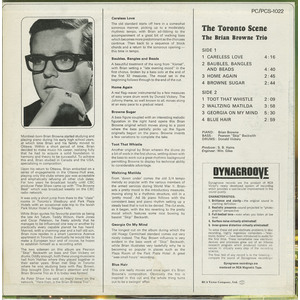
Brian Browne Trio-The Toronto Scene BACK
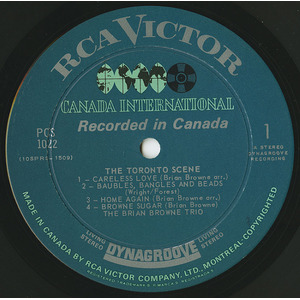
Brian Browne Trio-The Toronto Scene LABEL 01
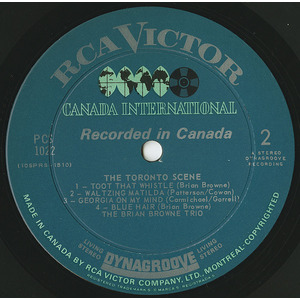
Brian Browne Trio-The Toronto Scene LABEL 02
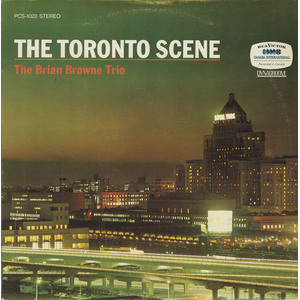
The Toronto Scene
Media
Videos
0 videos
No videos available for this title.
Credits
In Transit
No Comments