Insight
Brèche were a Sherbrooke-based Québec folk-rock group whose brief lifespan coincided with the fertile late-1970s intersection of folk, progressive music, and regional identity. Formed circa 1976, the band initially performed under the name Bolduc and brought together musicians from several parts of the province, including Saguenay–Lac-Saint-Jean, regions south of the Saint Lawrence River, and the Eastern Townships. From the outset, the group’s music reflected a collective rather than individual vision, shaped through extensive rehearsal, touring, and shared composition.
For roughly two years, the band toured across Québec while developing a sound that resisted easy categorization. Drawing equally from folk traditions, classical structures, jazz inflections, and progressive rock, their arrangements emphasized instrumental interplay and shifting textures rather than conventional song forms. In 1978, feeling that their music represented a rupture from prevailing norms, the group adopted the name Brèche, a word chosen to suggest a “breach” or opening in the musical timeline they inhabited.
Brèche became regular participants in Québec’s trad-folk festival circuit, an environment that offered visibility but did not always align with the band’s more exploratory tendencies. Their lineup featured Daniel Roussel on acoustic guitar and lead vocals, Marc Bolduc on piano, flute, saxophone, and vocals, Jacques Joubert on violin and vocals, and Paul Bolduc on electric bass, trombone, and vocals. The unusual inclusion of trombone alongside violin, flute, and keyboards became one of the group’s defining sonic traits.
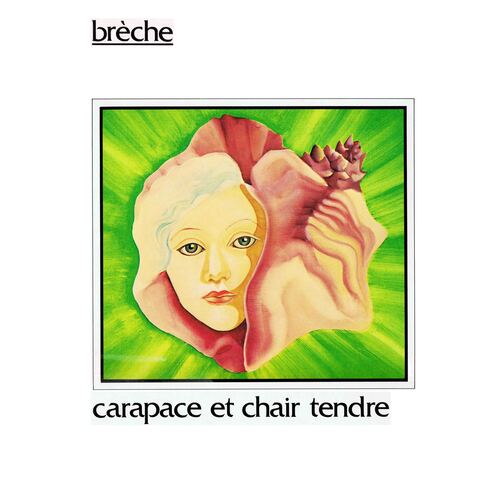
In the summer of 1979, Brèche released their only album, Carapace et chair tendre, on the Le Tamanoir label. Recorded at Studio St-Charles in Longueuil, the album captured the band’s hybrid aesthetic, moving fluidly between lyrical folk passages, extended instrumental sections, and more ambitious progressive structures. Despite its originality, the record suffered from limited distribution within Québec and a lack of sustained promotional support, and it struggled to reach an audience beyond the festival circuit in which the band was known.
By late 1979, documented performances ceased, and Brèche appear to have quietly disbanded in early 1980. Although their recorded output is limited to a single LP, Carapace et chair tendre has since come to be regarded as a subtle but distinctive artifact of Québec’s late-1970s folk-progressive movement, reflecting both the creative ambition and the structural challenges faced by independent regional artists of the era.
-Robert Williston
Musicians
Daniel Roussel: acoustic guitar, lead vocals
Marc Bolduc: piano, flute, saxophone, vocals
Paul Bolduc: electric bass, trombone, vocals
Jacques Joubert: violin, vocals
‘L’hymne’ – written by Marc Bolduc and Paul Bolduc
‘Marianne’ – written by Marc Bolduc
‘La légende de Jos Kébék’ – written by Daniel Roussel and Marc Bolduc
‘Vent du midi’ – written by Marc Bolduc
‘La fuite’ – written by Thérèse Bérubé and Daniel Roussel
‘De justesse’ – written by Marc Bolduc
‘Grandir’ – written by Daniel Roussel and Marc Bolduc
‘Les p’tites cuillers’ – written by Paul Bolduc
Production
Produced by Brèche, Jean-Guy Tremblay
Recorded by Peter Tessier
Recorded and mixed by Michel Ethier
Mastered at Disques SNB Ltée.
Artwork
Design concept (conception graphique) by Gilles Tibo
Illustration by Marie Bouchard
Photography by Pierre Fillion
Distribution
Distributed by Alta Musique Distribution Ltd.
Gallery
Images
5 images
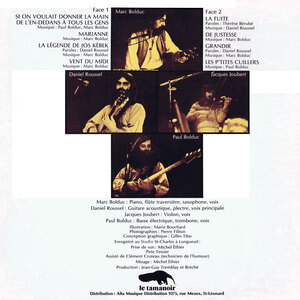
Brèche / Carapace et chair tendre BACK

Brèche / Carapace et chair tendre INSIDE
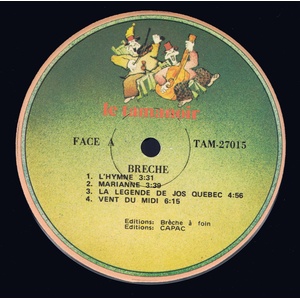
Brèche / Carapace et chair tendre LABEL 01
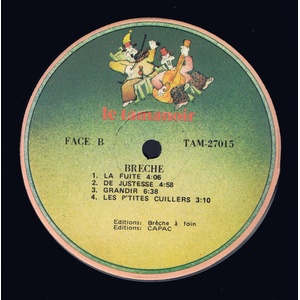
Brèche / Carapace et chair tendre LABEL 02
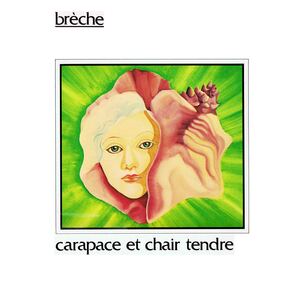
Carapace et chair tendre
Media
Videos
0 videos
No videos available for this title.
Credits
In Transit
No Comments