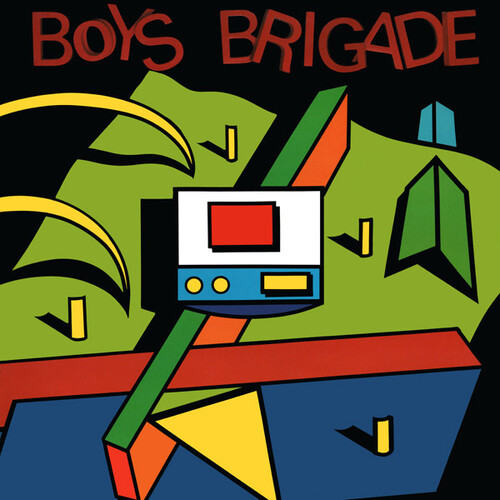
Insight
Boys Brigade were one of the more distinctive bands to emerge from Toronto’s early-1980s new wave scene, a six-piece outfit whose sound fused synthesizers, guitars and an expanded percussion section. Formed in Toronto around 1980, the band featured Malcolm Burn on lead vocals and keyboards, Tony Lester on guitar and vocals, Wayne Lorenz on bass, Billie Brock on drums, and David Porter and Jeff Packer on percussion and vocals. With Brock on drums and Porter and Packer forming an additional percussion section, Boys Brigade stood apart from many of their Toronto contemporaries, creating a rhythmic, atmospheric sound built on guitar and synthesizer textures, layered percussion and dance-floor momentum.
From the beginning, there was a mystique around the band. Rather than simply grinding through Toronto’s regular rock circuit, Boys Brigade initially developed through semi-organized rehearsals, jam sessions and appearances in illegal late-night clubs and after-hours spaces. Some of the musicians were already working professionally, while others still held day jobs. The group only began to take shape as a band after its early sessions produced a first version of “Mannequin.”
That song became the first major turning point. “Mannequin” found its way into Q107’s annual Homegrown contest, and when the group needed a name to identify the submission tape, one of the members casually suggested Boys Brigade. The name stuck. To everyone’s surprise, “Mannequin” became a local radio success, was selected for Q107 Homegrown Volume 3 in 1981, and pushed the group to take itself seriously. What had started as a loose creative circle suddenly had a name, a song on the radio and a reason to move forward.
The newly surfaced demo cassettes help fill in a valuable missing chapter from the band’s formative period, capturing Boys Brigade at the point where their early rehearsal-room ideas were beginning to circulate beyond the group itself, before the Anthem album fully defined their recorded identity. One cassette, carrying the singular spelling Boy Brigade, lists “Saigon,” “Voices,” “Portrait,” “Black + White,” “Exodus,” “Cut Up,” “Touch Glass” and “Shadows.” A second cassette, marked Boys Brigade, contains “Mannequin,” “Cut Up,” “Touch Glass,” “Shadows” and “Saigon.” Together, they connect the band’s early breakthrough with the material still taking shape before the album. “Mannequin” points back to the Q107 Homegrown success, while “Saigon,” “Exodus” and “Cut Up” preserve familiar songs in early form. The remaining titles, “Voices,” “Portrait,” “Black + White,” “Touch Glass” and “Shadows,” are otherwise unreleased.
Although the late-night club scene gave Boys Brigade room to develop outside Toronto’s conventional rock circuit, Malcolm Burn later recalled that it offered little money, limited exposure and few opportunities for advancement. The musicians were often performing for people who were more interested in staying out late and drinking than listening closely to a new band. A major change came through Howard, Rush’s road manager and lighting director, who recognized Boys Brigade’s potential and encouraged them to move beyond the dingy after-hours rooms. He helped get the group into a studio to record demos and became instrumental in bringing its music to the attention of the Rush organization.
Those recordings also helped push Boys Brigade beyond the local club circuit. According to later accounts, a raw live, off-the-floor demo reached Arthur Fogel, who was impressed enough to book the still-unsigned group as an opening act for The Pretenders at the CNE during the summer of 1982. At the same time, Howard was repeatedly playing the band’s tapes for the members of Rush and keeping them informed about its progress.
Geddy Lee recalled that the tapes immediately stood out for their songs, melodies and musical ideas, even before he knew how many musicians were in the band. Alex Lifeson and Neil Peart were also listening to the recordings and liked what they heard. While Rush were appearing at Maple Leaf Gardens, an after-show party was arranged, and the members suggested that Boys Brigade perform. Impressed by the group’s live set, Lee approached the musicians afterward and asked whether there was anything he could do to help them. That offer eventually developed into his role as producer of their debut album and brought Boys Brigade into the Anthem Records orbit through the broader Rush management connection.
Burn jokingly placed Boys Brigade somewhere between Mel Tormé and early Black Sabbath, with influences extending from Miles Davis to The Rolling Stones. His point was not that the group sounded exactly like any of those artists, but that its identity emerged where the contrasting ideas and backgrounds of six musicians met. The band resisted easy comparisons and did not measure its success by how closely it resembled Ultravox, The Rolling Stones or any other established act. Its music came from the point at which those different influences collided and became something shared.
The expanded percussion section was central to that identity. It was not simply a visual novelty or an unusual addition to a conventional rock lineup. Burn regarded the interaction among Brock, Porter and Packer as essential to the feeling created by the six musicians. Packer described their playing as an intuitive exchange built on eye contact, personal familiarity and an understanding of one another’s capabilities. As the band developed, the three players established increasingly distinct roles, moving between dense rhythmic activity, eccentric accents and passages in which percussion became the leading edge of the arrangement.
The same collective approach shaped the songwriting. Burn generally introduced a theme, lyrical idea or musical motif, which the other members interpreted and developed from their own perspectives. He described the resulting songs as personal through several people rather than the expression of a single writer. Each musician could understand the same song differently, and those individual interpretations became part of the finished arrangement.
Lee approached the recordings in much the same way. He believed that the lyrics, melodies, guitar textures, percussion, drums and overall atmosphere needed to reinforce one another. Sounds were not added simply because they were fashionable or had worked on another record. Every guitar tone, keyboard part and rhythmic detail needed a reason to exist within the song and had to relate to the spirit of the music and the meaning of the lyric.
Produced by Geddy Lee, Boys Brigade’s self-titled debut album was released by Anthem Records in 1983. Recorded at Nimbus 9 Studio in Toronto, mixed and digitally mastered at McClear Place, and engineered by Nick Blagona, the album presented the group in a more focused studio form while preserving its rhythmic urgency and moody new wave character.
During overdubs for “The Passion of Love,” the musicians discovered an unexplained sound on one of the tracks that resembled a generator or a ghostly voice. The section had apparently already been erased, and no one could determine where the sound had come from. Howard remained convinced that it said “hello,” while Lee was less certain. They ultimately left it in the recording because its strange atmosphere suited the song.
The album also included “Melody,” which became the group’s signature track. Burn described the song as a story drawn from a situation he had witnessed rather than a direct personal account. Its narrator watches helplessly as a woman remains in an abusive relationship, giving the song’s graceful melody an underlying sadness and tension.
“The Cut Up” reflected the group’s more experimental side. Burn traced its concept directly to the cut-up method associated with writer William S. Burroughs and artist Brion Gysin, in which written passages were physically divided and rearranged to create unexpected combinations and new meanings. He applied a similar approach to the English language, using ambiguity, symbolic phrases and distorted meanings to construct what he described as a combined love scene and hate scene.
The album produced the singles “The Passion of Love” and “Melody.” The group’s official 1983 output also included the promotional 12-inch Into the Flow, pairing that track with “The Passion of Love,” and the radio-only Interview with Boys Brigade and Producer Geddy Lee, which featured “Melody” and “The Cut Up (Breaking Glass)” alongside discussions with Burn, Packer and Lee about the band’s formation, songwriting and recording methods.
Burn described Boys Brigade as both a live band and a songwriting band. The album documented the structure, atmosphere and detail of the songs, while the stage show emphasized movement, sweat, humour and the interaction among the six musicians. Even when the material became serious or intense, the performances retained a playful quality. The vitality of the live show had been the band’s principal calling card before the album was made, and “Into the Flow” became a cornerstone of its performances.
The band toured nationally and also played dates along the U.S. eastern seaboard, including a performance at The Chance in Poughkeepsie, New York, that was recorded for The King Biscuit Flower Hour. Despite the momentum, Boys Brigade’s original run was short-lived. By the mid-1980s, internal tensions and the practical strain of sustaining a large six-piece lineup pulled the group apart.
Several members continued in music after the breakup. Malcolm Burn began a solo career before becoming an internationally respected producer and engineer, working with artists including Blue Rodeo, Bob Dylan, The Neville Brothers, Midnight Oil, Patti Smith and Emmylou Harris. His work on Harris’s Red Dirt Girl earned him a Grammy Award. Tony Lester also remained active as a musician, producer and songwriter, including work with Strange Advance and later solo recordings.
-Robert Williston
Gallery
Images
5 images
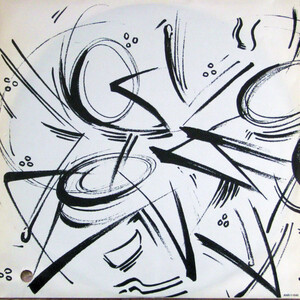
Boys Brigade - ST
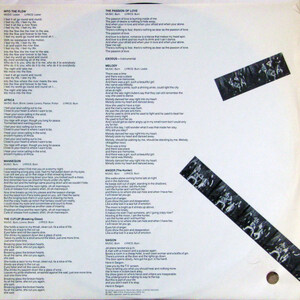
Boys Brigade - ST
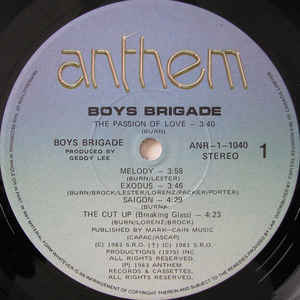
Boys Brigade - ST
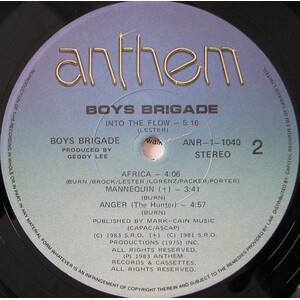
Boys Brigade - ST
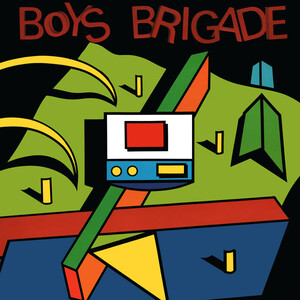
ST
Media
Videos
0 videos
No videos available for this title.
Credits
Musicians
Malcolm Burn: lead vocals, keyboards
Billie Brock: vocals, drums
Tony Lester: vocals, guitar, guitar synthesizer
Wayne Lorenz: bass
David Porter: vocals, percussion
Jeff Packer: vocals, percussion
John Tucker: Fairlight CMI
Rob Yale: Fairlight CMI
Songwriting
'The Passion Of Love' written by Malcolm Burn
'Melody' written by Malcolm Burn and Tony Lester
'Exodus' written by Billie Brock, David Porter, Jeff Packer, Malcolm Burn, Tony Lester and Wayne Lorenz
'Saigon' written by Malcolm Burn
'The Cut-Up (Breaking Glass)' written by Billie Brock, Malcolm Burn and Wayne Lorenz
'Into The Flow' written by Tony Lester
'Africa' written by Billie Brock, David Porter, Jeff Packer, Malcolm Burn, Tony Lester and Wayne Lorenz
'Mannequin' written by Malcolm Burn
'Anger (The Hunter)' written by Malcolm Burn
Production
Produced by Geddy Lee
Engineered by Nick Blagona
Recorded by Jon Erikson, Ken Magerman, Robert Digioia and Vic Pyle
Mixed by Joe Finlan and Jon Erikson
Recorded at Nimbus 9 Studio, Toronto, Ontario
Mixed at McClear Place
Digitally mastered at McClear Place
Technical
Technical engineering by Andrew Condon and Roger Ginsley
Lacquer cut by RL at Masterdisk
Artwork / Photography
Art direction, graphics and artwork by David Porter
Art direction and photography by Rodney Bowes
Management
Managed by Howard Ungerleider and Ray Daniels
Companies
Manufactured by Anthem Records Of Canada
Distributed by Capitol Records-EMI Of Canada Limited
Published by Mark-Cain Music
Printed by Shorewood Packaging Corp. Of Canada Ltd.
Label and matrix/runout
Anthem: ANR-1-1040
Rights society: CAPAC / ASCAP
Side A runout, variant 1: ANR-1040-A RL [Capitol target logo] MASTERDISK
Side B runout, variant 1: ANR-1040-B-3 RL MASTERDISK
Side A runout, variant 2: ANR-1040-A-1 RL [Capitol target logo] MASTERDISK
Side B runout, variant 2: ANR-1040-B-4 RL MASTERDISK
Side A runout, variant 3: ANR-1040-A MASTERDISK RL [Capitol target logo]
Side B runout, variant 3: ANR-1040-B-4 MASTERDISK RL ST-2-12278-[scratched out] [Capitol target logo]
No Comments