Insight
Reg Bouvette (1923–1992) was one of the defining Métis fiddlers of twentieth-century Manitoba, a self-taught musician whose playing grew out of the dance halls and community gatherings of the Red River country and eventually travelled across Canada and around the world. A four-time Manitoba fiddling champion, prolific composer and longtime recording artist, Bouvette became known for a vigorous, immediately recognizable style that remained firmly rooted in Métis tradition even as he absorbed elements of country, old-time and bluegrass music.
Raised in St. Vital, Manitoba, Bouvette came from a musical family. One of his earliest musical memories involved watching his cousin Bill play and attempting to imitate him with a makeshift fiddle and a bow fashioned from string and a stick. He began playing seriously at seventeen and learned largely by ear, developing his music in the same way generations of Prairie fiddlers had before him: by listening, remembering, playing for dancers and learning what worked in a room full of people.
By 1950 Bouvette was already performing with Tommy “Roy” Gibson, beginning a period that included four years of radio broadcasts on various stations and some twelve years entertaining at country dances and shows. Long before commercial records made his name familiar across Western Canada, he had spent years learning the practical craft of the working fiddler — playing for people who expected the music to move a dance floor rather than simply impress a contest judge.
For many years music existed alongside the demands of making a living. During the 1960s Bouvette operated his own trucking business while continuing to play dances, clubs and hotel engagements, including performances with the Rhythm Rangers. He was also writing fiddle tunes of his own, and one of those early compositions, ‘Reginald’s Waltz’, travelled considerably farther when it was recorded by two of the most prominent names in Canadian fiddling, Don Messer and Andy DeJarlis.
In 1972 Bouvette sold his trucking business and committed himself to music full time. The decision marked the beginning of the period for which he became best known. He dominated Manitoba fiddle competitions through the middle of the decade, winning the provincial championship in 1973, 1974 and 1975 and ultimately becoming a four-time Manitoba champion. As his reputation grew, he moved naturally from contestant to judge, but competitions never defined the whole of his playing. His strongest musical instincts had been formed at dances, socials and radio shows, where rhythm, drive and the ability to communicate with an audience mattered as much as technical precision.
His recording career took shape in the mid-1970s with albums such as Home Brew and Red River Jig for Winnipeg’s Sunshine Records. The first of these captured both sides of Bouvette’s musical personality: the composer of new country and old-time fiddle tunes and the performer of music rooted in the Prairie dance tradition. Its liner notes described composing and recording country and old-time fiddle music as his greatest ambition, and the decades that followed would show how completely he fulfilled it.
Red River Jig brought Bouvette together with the Road House Gentlemen, with Reg Kelln on drums, Gene Bretecher on five-string banjo, Jim Flett on lead acoustic guitar, Ron Halldorson on steel guitar, Ray Rodgers on boss guitar and Eugene Tessier on rhythm guitar. Recorded at Century 21 Studios in Winnipeg, the album mixed traditional material with Bouvette originals including ‘Tear-Drop Waltz’, ‘Petuis Breakdown’, ‘Wild Bill Reel’, ‘Burning Diesel’, ‘St. Laurent Breakdown’, ‘Ross Cook Reel’, ‘Beverly’s Waltz’ and ‘Road-House Ramble’. Sunshine Records was already describing him as a performer whose name was becoming familiar across North America, and the album helped establish the driving, strongly rhythmic sound that listeners increasingly associated with him.
Bouvette’s interpretation of the ‘Red River Jig’ became particularly identified with his name. Other fiddlers eventually spoke of playing the tune in the “Reg Bouvette style,” recognition that his version had developed an identity of its own. In a tradition built on variation rather than fixed arrangements, that was a significant distinction. Bouvette had not simply learned one of the central pieces of Métis fiddle repertoire; he had added another recognizable branch to its history.
He was equally important as a composer. More than 200 tunes have been attributed to Bouvette, and their titles reveal how closely his music remained tied to people, places and Métis history. ‘St. Laurent Breakdown’, ‘Back to Batoche Breakdown’, ‘Gabriel Dumont Reel’, ‘Fur Trader’s Reel’, ‘Bloodvein Breakdown’, ‘Cross Lake Reel’, ‘Ebb and Flow Waltz’ and many others transformed communities, friends, historical figures and travelling memories into fiddle music.
Taken together, those compositions form a musical map of Bouvette’s world. Batoche, St. Laurent, northern Manitoba and the Red River country appear not as distant historical references but as living places still inhabited, visited, celebrated and danced in. His originals fit naturally beside traditional pieces because he approached composition in much the same spirit as the older fiddlers whose music he inherited: a new tune could commemorate a person, a place, a journey or simply a memorable moment and then begin circulating among other musicians.
That circulation mattered deeply to him. Bouvette did not treat his compositions as private possessions to be performed only by their author. He wanted other fiddlers to learn them. His recordings therefore became another way of passing music from player to player, extending the same oral tradition through which he had first learned to fiddle.
Albums such as Lookin Buck continued this mixture of original composition and Prairie fiddle music. The record included pieces such as ‘Reg Bouvette Breakdown’, ‘Smoky Island Breakdown’, ‘Gateway Rag’, ‘Ralph’s Breakdown’, ‘Red Rose Country Breakdown’, the title track and ‘Maytwaysing Waltz’, further demonstrating the speed at which Bouvette could generate new repertoire while remaining grounded in familiar dance forms.
By the end of the decade he was also using recording projects to explore the relationship between different fiddle traditions. Fiddling Across the Border paired Bouvette with American fiddler Jr. Daugherty in a deliberate meeting of Canadian and American styles. The album placed Bouvette’s playing alongside Daugherty’s on standards and newer material, including ‘Liberty Two Step’, ‘Orange Blossom Special’, ‘Faded Love / Maiden’s Prayer’, ‘Maytwayasing Waltz’, ‘California Hornpipe’, ‘Dancing Fiddle’ and ‘Maple Sugar’. Rather than smoothing out their differences, the record emphasized that both men had developed strongly individual approaches to the fiddle and allowed those styles to meet on equal terms.
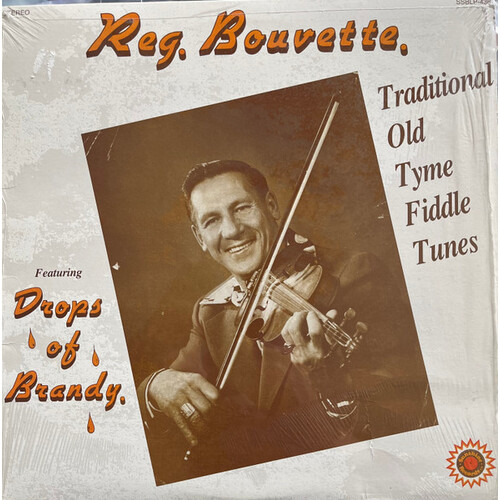
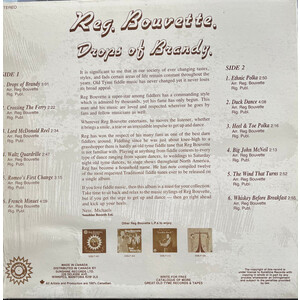
Bouvette’s openness to American country and bluegrass influences never displaced the older repertoire at the centre of his playing. On Drops of Brandy he devoted an entire album to traditional old-time fiddle tunes, including ‘Crossing the Ferry’, ‘Lord McDonald Reel’, ‘Waltz Quadrille’, ‘French Minuet’, ‘Duck Dance’, ‘Heel & Toe Polka’, ‘Big John McNeil’, ‘The Wind That Turns’ and ‘Whiskey Before Breakfast’. The album made clear how broad his command of traditional material had become after decades of playing contests, square dances, weddings, old-time dances and stage shows throughout North America.
His music also reflected the changing sound of Prairie country music. Bouvette was comfortable using electric guitar, steel guitar, bass, drums and five-string banjo around a fiddle repertoire that had originated in much older social settings. Rather than treating those sounds as incompatible with Métis tradition, he folded them into a working dance-band vocabulary. His music could therefore remain unmistakably connected to the Red River while sounding completely at home in the country clubs, hotels and recording studios of the 1970s and 1980s.
Bouvette’s personal and professional life became closely intertwined with Beryl Knott, a Métis country musician from Grand Marais, Manitoba. They met in 1972 and later married, with Beryl becoming both his partner and musical companion. She accompanied him on rhythm guitar and vocals, and together they spent much of their lives on the road.
Their travels carried Métis fiddle music far beyond Manitoba. Bouvette performed throughout Canada, from the Prairies to the coasts and north into the Northwest Territories, while also touring extensively in the United States. Later travels took the music overseas, including appearances in Europe, Australia and New Zealand. Yet even as his audience widened, he remained closely connected to Métis cultural gatherings at home, particularly Back to Batoche and Winnipeg’s Festival du Voyageur.
Batoche was especially fitting territory for his music. Bouvette performed at Métis cultural celebrations there and became sufficiently identified with the fiddle tradition that a Reg Bouvette Trophy was established within the Back to Batoche fiddle competition during his lifetime. His name had moved beyond that of a successful entertainer and become a standard against which younger Métis fiddlers could measure themselves.
By then Bouvette was also shaping the musicians who would carry Manitoba fiddling into another generation. Garry Lepine regarded him as an important influence and close friend. Garry’s son Jason Lepine, later a major fiddler in his own right, remembered Bouvette giving him a small plastic fiddle when he was a child, one of those seemingly modest encounters capable of directing a young musician toward a lifelong instrument. Ryan Keplin likewise grew up listening to recordings by Bouvette, Andy DeJarlis and other foundational Prairie players.
Few stories illustrate Bouvette’s stature more clearly than that of Patti Kusturok. As a young girl she saw him performing at the Garden City Mall fiddle contest in Winnipeg and became fascinated with his playing. She spent hours listening to his records and regarded him as one of the great figures of the fiddle world she hoped someday to enter. Years later, after Kusturok herself had emerged as an extraordinary competition fiddler, the two recorded together on The King and the Princess. What had begun with a child trying to see Bouvette over a crowd became a meeting between two generations of Manitoba fiddling.
His blue fiddle became almost as recognizable as the man himself, appearing repeatedly in photographs and recollections and eventually becoming part of his public identity. It suited a musician who had developed into more than a local dance fiddler: sharply dressed, constantly travelling, recording, competing and performing, yet always carrying with him a repertoire deeply connected to the communities from which he came.
By the late 1980s Bouvette had spent decades accomplishing precisely what he had once identified as his great ambition. He had become a provincial champion, bandleader, composer and international touring musician while leaving behind a substantial recorded catalogue of traditional music and original fiddle tunes. His records preserved not only his playing but an entire network of Prairie musicians, studios, dance bands and Métis musical traditions that might otherwise have remained largely undocumented.
Reg Bouvette died in 1992, at the age of 69, from complications of diabetes. His influence was already embedded in the playing of other musicians and in the hundreds of tunes and recordings he left behind. Recognition continued after his death, including induction into the Porcupine Awards Hall of Fame in 2000 for his contribution to Canadian traditional culture and the Red River Valley fiddle style, followed by his induction alongside Andy DeJarlis into the Manitoba Aboriginal Music Hall of Fame in 2006.
His family and musical community continued to keep his name alive. A memorial Reg Fest held in Winnipeg in 2013 brought together musicians including Garry Lepine and Sierra Noble with the Asham Stompers, while renewed efforts were made to recover recordings that had originally circulated on LP and cassette.
Bouvette’s legacy ultimately rests on more than championships, records or the number of tunes he composed. He belonged to a generation that carried Métis fiddle music through an important transition. The tradition he inherited had travelled primarily through families, dances and communities; Bouvette helped carry that same music into radio, commercial recording and international performance without severing it from the people and places that gave it meaning.
He could play an old Métis dance tune, write a new breakdown about Batoche, bring bluegrass banjo and steel guitar into the studio, trade fiddle styles with an American champion and then return to the ‘Red River Jig’ with an approach other musicians immediately recognized as his own. That ability to expand the music without losing its roots is what made Reg Bouvette one of the central figures in the recorded history of Métis fiddle music.
-Robert Williston
Gallery
Images
2 images
Reg Bouvette – Drops Of Brandy (1)
Drops of Brandy
Media
Videos
0 videos
No videos available for this title.
Credits
Musicians
Reg Bouvette: fiddle
Songwriting
‘Drops of Brandy’ traditional; arranged by Reg Bouvette
‘Crossing the Ferry’ traditional; arranged by Reg Bouvette
‘Lord McDonald Reel’ traditional; arranged by Reg Bouvette
‘Waltz Quadrille’ traditional; arranged by Reg Bouvette
‘Romeo’s First Change’ traditional; arranged by Reg Bouvette
‘French Minuet’ traditional; arranged by Reg Bouvette
‘Ethnic Polka’ traditional; arranged by Reg Bouvette
‘Duck Dance’ traditional; arranged by Reg Bouvette
‘Heel & Toe Polka’ traditional; arranged by Reg Bouvette
‘Big John McNeil’ traditional; arranged by Reg Bouvette
‘The Wind That Turns’ traditional; arranged by Reg Bouvette
‘Whiskey Before Breakfast’ traditional; arranged by Reg Bouvette
Publishing
All selections published by Rig Publishing
Physical Release
Stereo
Vinyl LP
Canada
1980
Made in Canada
Distributed in Canada by Sunshine Records Ltd., 228 Selkirk Ave., Winnipeg, Manitoba R2W 2L6
All artists and production are 100% Canadian
Liner Notes
It is significant to me that in our society of ever changing tastes, styles, and fads certain areas of life remain constant throughout the years. Old Tyme fiddle music has never changed yet it never loses its broad appeal.
Reg Bouvette a super-star among fiddlers has a commanding style which is admired by thousands, yet his fame has only begun. This man and his music are loved and respected wherever he goes by fans and fellow musicians as well.
Wherever Reg Bouvette entertains, he moves the listener, whether it brings a smile, a tear or an irresistible impulse to get up and dance.
Reg has won the respect of his many fans as one of the best darn fiddlers around. Fiddling since he was just about knee-high to a grasshopper there is hardly an old tyme fiddle tune that Reg Bouvette is not familiar with. Playing at anytime from fiddle contests to every type of dance ranging from square dances, to weddings to Saturday night old tyme dances, to stage shows throughout North America, Reg has become a household name. He has now compiled twelve of the most requested Traditional fiddle tunes ever to be released on a single album.
If you love fiddle music, then this album is a must for your collection. Take time to sit back and relax to the music stylings of Reg Bouvette, but if you get the urge to get up and dance — then go right ahead and kick up your heels.
Ness Michaels
Sunshine Records Ltd.
No Comments