
Insight
Salome Bey came to Toronto as one third of an American jazz trio and stayed for more than half a century. Audiences knew her as Canada’s First Lady of the Blues. She sang in the city’s jazz clubs, starred on and off Broadway, wrote and produced revues about the history of Black music, and brought a generation of young Black Canadian performers onto the stage with her.
She was born Salome Wideman-Bey in Newark, New Jersey, on October 10, 1933, the sixth of nine children of Victoria and Andrew Wideman. Her mother kept house and her father cleaned skyscraper windows in Manhattan. Around the time of her birth he joined the Moorish Science Temple of America, and the family took Bey as its surname. At 14 she slipped out with her older sisters to the Apollo Theater in Harlem and won Amateur Night, then had to forfeit the prize, a week of shows, because she had performed without her parents’ permission. Her father wanted a lawyer in the family, and she studied law at Rutgers University for two years before music won out.
Her younger brother Andy left Newark’s Arts High School, the school that also produced Sarah Vaughan and Wayne Shorter, to form a vocal trio with Salome and their sister Geraldine. As Andy and the Bey Sisters they worked clubs across North America and spent sixteen months touring Europe, where they became regulars at the Blue Note in Paris. Chet Baker was among their admirers there, and footage of the trio delighting a Paris crowd later appeared in Let’s Get Lost, the 1988 documentary about him. The group recorded Andy and the Bey Sisters for RCA Victor in 1961, followed by Now! Hear! and ’Round Midnight for Prestige, with Kenny Burrell among the accompanists. The trio broke up in 1967.
The trio played Toronto’s Colonial Tavern in 1961. After the show Salome went looking for a jazz drummer at the First Floor Club, the after-hours room run by Howard Berkeley Matthews. Matthews told her she was the most beautiful Black woman he had ever seen. They married on April 7, 1964, and she made Toronto her home, with Matthews managing her solo career. In February 1969 he and three partners, the drummer Archie Alleyne and the Toronto Argonauts John Henry Jackson and Dave Mann, opened the Underground Railroad, a soul food restaurant in the basement of 406 Bloor Street East. It moved to 225 King Street East in 1973 and ran until 1988. Between the restaurant and the couple’s home, Bey and Matthews kept a gathering place for Toronto’s Black community, the entertainment business and visiting stars such as B.B. King.
Bey built her name on the Toronto club circuit, singing jazz, blues and spirituals, and that is where the First Lady of the Blues title took hold. In the mid-1960s she sang at one of the first Caribana festivals on the Toronto Islands and held a crowd that had come for calypso. In 1969 she was a featured performer at the Canadian National Exhibition grandstand.
The stage opened up for her at Toronto’s Global Village Theatre, where she appeared in Robert Swerdlow’s Blue S.A. in 1969 and his musical Justine in 1970. In 1970 she joined that year’s edition of the long-running revue Spring Thaw, where her performance of Gilles Vigneault’s ‘Mon Pays’ stopped the show. A review in the February 28, 1970 issue of RPM Weekly criticized the production but singled out Bey’s powerful singing for praise. It also identified the Toronto group Icarus as the revue’s backing band.
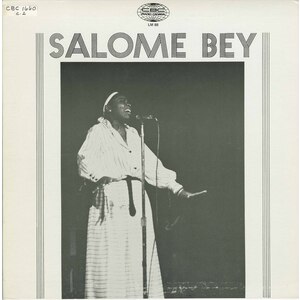
She made two albums in 1970, both titled Salome Bey. The first was a Canadian Talent Library production for Quality Records, recorded at Eastern Sound Studios with producer and engineer Roy Smith and arrangements by Russ Little and Rick Wilkins. Alongside ‘Stardust’ and ‘But Not For Me’ she sang new Canadian songs, four of them by Little, the former Lighthouse trombonist, plus Rick Kardonne’s ‘Hit The Nail Right On The Head’, Arthur Schaller’s ‘Underground Railroad Station’ and ‘Mon Pays’. The second was recorded for CBC Radio Canada at CBC Studio G in Toronto that June, with the Phil Nimmons Group backing her on half the songs and a group led by Peter Nichol on the rest. She sang two Swerdlow songs, ‘Song From Blue S.A.’ and ‘Carry Your Colors’, and Schaller wrote ‘Times We Live In’ for her to sing at a Biafran peace rally. Pickwick reissued the Quality album in 1980, by which time Bey had a far larger audience.
Justine went to New York in 1971 as Love Me, Love My Children, and Bey won a 1972 Obie Award for her performance. She also sang on two albums by the pianist Horace Silver, recorded for Blue Note at Rudy Van Gelder’s studio: Total Response, the second part of his United States of Mind trilogy, and All, the third, cut in early 1972 with Andy Bey also on vocals. In October 1972 she made her Broadway debut as Mother Earth in Dude, the new musical by Gerome Ragni and Galt MacDermot, the writers of Hair. The show closed quickly, but before it opened she recorded Salome Bey Sings Songs From Dude at A&R Studios in New York, with MacDermot on piano, Cornell Dupree on guitar, Gordon Edwards on bass, Bernard Purdie on drums and Cissy Houston among the backing singers. Kilmarnock Records issued it in Canada ahead of the cast album.
She starred in Don’t Bother Me, I Can’t Cope in Toronto in 1973 and Washington in 1974, then joined Vinnette Carroll’s gospel musical Your Arms Too Short to Box with God, with music and lyrics by Alex Bradford and Micki Grant. She stayed with the show from 1975 into its Broadway run, which opened in 1976, and the cast album earned a Grammy nomination.
In 1979 Radio Canada International sent Bey on a tour of European jazz festivals. Her set at the 13th International Jazz Festival in Montreux, Switzerland, was released in 1981 as Salome Bey In Montreux. Her musical director Denzil A. Miller Jr. led a band with Don Thompson on bass, Terry Clarke on drums and P.J. Perry on saxophone, and the programme ran from Rodgers and Hammerstein and Duke Ellington to a Beatles song, two medleys of blues and Billie Holiday material that included her own ‘Chief Engineer’, and ‘Untitled Love Song’, which she wrote with Miller. She received a Nellie nomination for a television variety performance in 1980 and a Juno nomination for Most Promising Female Vocalist in 1982.
Her most important creation was Indigo, a cabaret history of Black music that she conceived, wrote and starred in. It opened at Basin Street in Toronto in 1978 and ran for more than a year, moving through blues, spirituals, jazz and gospel with the songs set in the story of the people who made them. Bette Howard directed, Miller was musical director, and the bassist and assistant conductor was Larry Smith, who went on to produce Run-DMC. Bey told her cast, “This is our shot.” Indigo won two Dora Mavor Moore Awards in 1981, one for her performance and one for outstanding production of a cabaret or revue, and it was filmed for television, airing on Superchannel and on CBC in 1984.
She followed it at Basin Street with Shimmytime in 1983, about Ethel Waters, and Madame Gertrude in 1985, about Ma Rainey. Bey wrote and directed Madame Gertrude and cast Jackie Richardson as Rainey, having pushed Richardson toward the blues in the first place. In 1985 she also appeared in Thunder, Perfect Mind at Toronto Free Theatre and Mother Goose at the Royal Alexandra Theatre, and in 1989 in Coming Through Slaughter at the Silver Dollar.
In February 1985 she was one of the singers on ‘Tears Are Not Enough’, recorded by Northern Lights for Ethiopian famine relief, and she appears in its video. On December 8, 1985, she was guest soloist when the Montreal Jubilation Gospel Choir recorded its first album at St. James United Church. Released by Justin Time Records in 1986 as Jubilation I – Highway To Heaven, it features Bey on ‘Yes, God Is Real’ and alongside Kathleen Dyson on ‘I Love to Praise His Name’, and it launched the choir internationally. Its director, Trevor Payne, said, “She not only hit the notes – she embodied the music.”
Bey spent much of her later career making room for younger performers. She once spotted the percussionist Anthony Pierre at Theatre Fountainhead, invited him onstage and steered him from piano and pan to percussion. Her children’s musical Rainboworld, a story about injustice told through music, dance and drama, played Young People’s Theatre in 1988, and its young casts included Deborah Cox, Divine Brown, Orin Isaacs, Simone Denny and Shantall Young. A 1993 production starred her younger daughter. With her daughters tUkU and SATE, and later the multi-instrumentalist Bruce Skerritt, who joined in 1989, she performed as Salome Bey and the Relatives. Bey sang Canada Day concerts at Ontario Place, on Parliament Hill and at Expo 86 in Vancouver. The Relatives represented Canada at Expo 92 in Seville, and Bey sang for Nelson Mandela during his 1990 visit to Canada and for Queen Elizabeth II.
In 1992 she returned to the studio for I Like Your Company on Duke Street Records, produced by Andrew S. Hermant and Doug Riley, with Riley’s arrangements and a band of Toronto jazz players including Ed Bickert, Russ Little and Michael Stuart. In 1995 she released Christmas Blue with the Relatives and hosted Salome Bey’s Christmas Soul on CBC Television, with guests Maureen Forrester, Billy Newton-Davis, Molly Johnson, Jackie Richardson and the Faith Chorale. She also earned a Gemini nomination in 1999 for a guest role in a dramatic series.
She received a Toronto Arts Award for the performing arts and, in 1996, the Martin Luther King Jr. Award for lifetime achievement from the Black Theatre Workshop of Montreal. In 2005 she was appointed an honorary Member of the Order of Canada, the form of the honour given to non-citizens, and she was invested on October 26, 2006. She never took Canadian citizenship. She received the Queen Elizabeth II Diamond Jubilee Medal in 2012 and a Great Canadian Blues Award from CBC’s Saturday Night Blues in 2013. A mural of her went up at 423 Yonge Street in 2017, and in 2018 she was named to the 100 Accomplished Black Canadian Women project.
Bey began showing signs of dementia in 2004, and by 2011 she could no longer perform. Howard Matthews died in 2016. Salome Bey died in a long-term care home in Toronto on August 8, 2020, at the age of 86, survived by her daughters SATE and tUkU, her son Marcus, whom she and Matthews adopted as a newborn in 1978, her brother Andy and her sister Geraldine de Haas. She was inducted into Canada’s Walk of Fame in 2021, and on April 22, 2022, Canada Post issued a stamp in her honour.
-Robert Williston
Gallery
Images
2 images

Salome Bey
ST
Media
Videos
0 videos
No videos available for this title.
Credits
Musicians
Salome Bey: vocals
The Phil Nimmons Group: instrumental accompaniment on five selections
Peter Nichol: conductor and arranger on five selections
Songwriting
‘This Is The Life’ written by Irving Berlin
‘Song From Blue S.A.’ written by Robert Swerdlow
‘What The World Needs Now’ written by Burt Bacharach and Hal David
‘Abraham, Martin And John’ written by Dick Holler
‘Try’ written by Russ Little
‘Carry Your Colors’ written by Robert Swerdlow
‘Mon Pays’ written by Gilles Vigneault
‘Paper Man’ written by Russ Little
‘Times We Live In’ written by Arthur Schaller
‘Honeysuckle Rose’ written by Fats Waller and Andy Razaf
‘Ain’t Misbehavin’’ written by Fats Waller, Harry Brooks and Andy Razaf
‘I’m Gonna Sit Right Down’ written by Young and Ahlert
‘Bridge Over Troubled Waters’ written by Paul Simon
Production
Produced by Jack Budgell
Music arranged and conducted by Phil Nimmons, except five selections arranged by Julian Priester and conducted by Peter Nichol
‘Paper Man’ arranged by Russ Little
‘Try’ arranged by Russ Little
Technical
Recorded at CBC Studio G, Toronto, June 23 and 24, 1970
Recording engineers Ian Jacobson and Larry Morey
Audio consultants Rick Wilkins and Roy Smith
Liner Notes
Written by Bruce Marsh
French liner notes by Bruce Marsh
Release
Released 1970 by CBC Radio Canada
Catalogue number LM 88
LP, stereo, Canada
Publishing
‘This Is The Life’: ABC Standard Music Pub. Inc.
‘Song From Blue S.A.’: CAPAC
‘What The World Needs Now / Abraham, Martin And John’: Blue Seas, Jac Music, 20th Century
‘Try’: Rulit, BMI
‘Carry Your Colors’: CAPAC
‘Mon Pays’: Editions Vent Qui Vire
‘Paper Man’: Deer Park Music, CAPAC
‘Times We Live In’: BMI
‘Honeysuckle Rose’: Santly Bros., Joy, ASCAP
‘Ain’t Misbehavin’’: Mills Music, ASCAP
‘I’m Gonna Sit Right Down’: Crawford Music
‘Bridge Over Troubled Waters’: Charing Cross Music, BMI
Liner notes – English (Bruce Marsh)
Salome Bey is a remarkably talented young lady. Within the space of a few years she has mastered the complexities of singing in clubs, on radio and television and acting on stage and radio. Her every venture has met with success BECAUSE Salome Bey is a very talented young lady.
Two seasons back, she made her onstage debut as a member of the cast of Spring Thaw. Critics panned the show but raved about Salome’s rendition of Gilles Vigneault’s Mon Pays. That show-stopper is recreated on this recording.
Salome has appeared many times with the Phil Nimmons Group and Phil has done several arrangements for this recording. In one medley: What the World Needs Now and Abraham, Martin and John, you’ll hear my favourite Salome Bey sound, but don’t overlook the Nimmons-arranged medley on the flip side. That’s gently swinging Salome Bey type music.
Her appearance on stage the past season in the musical Justine verified her stage talent and also brought Salome in contact with Robert Swerdlow, creator of Justine. Two of his songs are represented here and you sense yet another facet of Salome Bey’s talent as you listen to Song from Blue S.A. and Carry Your Colours.
You’ll shortly be aware that more than one musical group is represented on this recording. Half the songs were played by the Phil Nimmons Group and the other half by a group led by Peter Nichol. It’s interesting to hear the different approach of the two groups and three arrangers.
Phil Nimmons is, of course, one of the three arrangers. Another is Julian Priester a member of the trombone section of Duke Ellington’s band and the third is Russ Little, trombone player and leader on the Toronto music scene. Little is also the composer of two of the songs: Try and Paper Man.
Times We Live In was written especially for Salome Bey by Arthur Schaller on the occasion of a Biafran Peace Rally. Biafra is no longer in the headlines, in fact it no longer exists, but the song’s message is as relevant now as when it was first performed.
Relevant is a word often applied to Salome’s work . . . another word is versatile. Just listen to the BIG sound of Mon Pays and the lilting mischievous quality she achieves in the two Fats Waller tunes, and most especially “I’m Gonna Sit Right Down and Write Myself a Letter.” Then take a deep breath as the needle tracks over, and listen to Simon and Garfunkel’s Bridge Over Trouble Waters. That’s the end of side two, and a virtuoso performance. I’ll say it again. Salome Bey is a remarkably talented young lady!
Bruce Marsh
Liner notes – French (Bruce Marsh)
Salomé Bey naquit avec de nombreux talents. En quelques années, elle devint une excellente chanteuse de cabarets, une très bonne interprète à la radio et à la télévision et une remarquable actrice de théâtre et à la radio. Grâce à ses nombreux talents tout ce qu’elle entreprit aboutit à un succès complet.
Il y a deux ans, elle fit ses débuts au théâtre, avec la troupe de “Spring Thaw”. Les critiques furent assez sévères au sujet de la pièce, mais ne tarirent pas d’éloges pour son interprétation de la chanson de Gilles Vignault “Mon Pays”. Vous pourrez écouter ce petit chef-d’œuvre sur ce disque
Salomé Bey s’est produite à de nombreuses reprises avec l’Ensemble de Phil Nimmon et Phil Nimmon a fait plusieurs arrangements enregistrés sur ce disque.
L’interprétation du pot-pourri “What the World Needs Now” et de la chanson “Abraham, Martin and John” par Salomé Bey, est celle que je préfère; mais n’oubliez pas d’écouter le pot-pourri arrangé par Nimmon sur la deuxième face, c’est le genre de musique swing douce dans laquelle Salomé Bey excelle.
Sa part, dans le rôle de la musicale Justine a confirmé ses talents d’actrice et lui a permis de rencontrer l’auteur de la pièce Robert Swerdlow. Sur ce disque, vous trouverez deux chants composés par Robert Swerdlow “Song from Blue S.A.” et “Carry Your Colours” qui relèvent un autre aspect des talents de Salomé Bey.
Vous remarquerez que plusieurs groupes sont représentés sur ce disque. La moitié des chansons sont jouées par l’Ensemble de Phil Nimmon et l’autre moitié par un groupe sous la direction de Peter Nichol. Il est intéressant de comparer les styles des deux groupes et des trois arrangeurs.
Phil Nimmon fait naturellement partie des trois arrangeurs; le second est Julian Priesten qui appartient à la section des trombones de l’Orchestre Duke Ellington et le troisième est Russ Little qui est tromboniste et chef d’orchestre du “Toronto music scene”. Russ Little est aussi le compositeur de deux chants “Try” et “Paper Man”.
A l’occasion d’un rassemblement pour la paix au Biafra, Arthur Schaller composa spécialement pour Salomé Bey, la chanson “Times We Live In”. Bien que le Biafra ne fasse plus la manchette des journaux et bien qu’en fait il n’existe plus, le contexte de la chanson est aussi vrai maintenant qu’il l’était quand elle fut interprétée pour la première fois.
L’interprétation de Salomé Bey peut être qualifiée de pertinente, ou si l’on veut employer un autre adjectif on peut dire qu’elle est souple. Nous vous invitons à écouter Mon Pays ou l’interprétation malicieuse et gaie qu’elle donne aux deux chants de Fats Waller, et spécialement quand elle chante “I’m Gonna Sit Right Down and Write Myself a Letter”. Ecoutez ensuite, “Bridge Over Troubled Waters” de Simon et Garfunkel à la fin de la face deux. Elle y déploie des qualités remarquables et je suis sûr que vous direz comme moi que Salomé Bey possède un talent remarquable.
Bruce Marsh
No Comments