Insight
The Ardels began in Etobicoke, just west of Toronto, in 1963, when pianist David Burt, guitarist Robin Scott, and bassist Fred Masson met at a church dance and gravitated toward the R&B and early rock they heard from west-end groups on the Toronto circuit. At first they were learning as much from other bands as from the records themselves, picking up arrangements and stagecraft from local fixtures along the Lakeshore. With the addition of singer Bruce Saracini and drummer Gary Brennan, the Ardels played their earliest jobs—small restaurants, house parties, and university dances—slowly finding their footing in a neighbourhood scene that also included The Checkmates and The Lucernes.
Everything shifted when Doug Dixon joined the group. A driven neighbourhood singer with a growing interest in writing original material, Dixon replaced Saracini and quickly became the Ardels’ focal point, contributing songs that helped define their sound, including the moody minor-key “Piece of Jewellery.” When Scott stepped away to concentrate on school, the band auditioned guitarists and brought in Jim Pernokis, whose musical lineage extended to his brother Ken in Little Caesar and the Consuls. The addition of tenor saxophonist Bob McKay further broadened the group’s punchy R&B orientation and gave their stage set a sharper identity.
By 1964 the Ardels had developed enough repertoire to record at CBC studios, where a dozen tracks were captured live off the floor. With access to the tapes, the band privately issued Rhythm & Blues through Quality Records—a scarce run of roughly 500 LPs, sold primarily at dances and to promoters. The record leaned heavily on the band’s influences, with versions of “Unchain My Heart,” “I’ll Go Crazy,” “Georgia On My Mind,” “Night Time is the Right Time,” and Ronnie Hawkins’ “Lonely Hours,” alongside their instrumental “Theme.” Today, original pressings are among the rarest Canadian private-press R&B/rock LPs of the era.
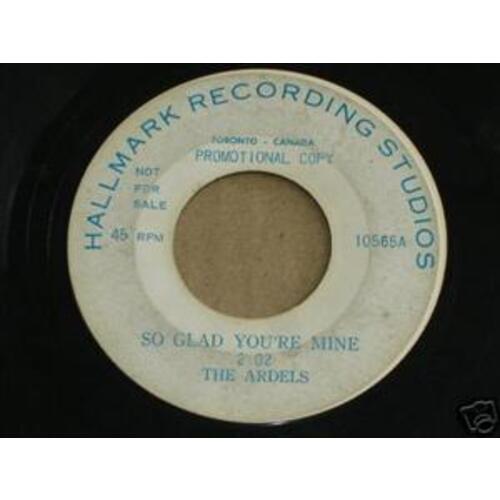
An audition with ARC Records’ Bill Gilliland at Toronto’s Met Dance Hall yielded a studio session but no contract, so the Ardels forged ahead on their own. They booked time at Hallmark Studios to cut a 45 intended to impress Stan Klees and Walt Grealis of the newly founded RPM as well as booking agent Ron Scribner of Bigland Agencies. The resulting single—“So Glad You’re Mine” backed with “Comin’ Down”—secured them Bigland representation and their next label relationship with Cancut Records.
Cancut released two Ardels singles during 1965–66. The first, issued variously as “I Love You” and “But I Love You,” received immediate support in RPM, where DJs praised its strength in the teen market. “I Love You,” the A-side of their first Cancut single, was an original written by Doug Dixon, while the flip, “So Glad You’re Mine,” was their take on the Arthur Crudup classic; both sides were produced by Wayne Chilton. Their final Cancut single, “Run Hully Gully Boy” backed with “Piece of Jewellery,” featured two Doug Dixon originals — a pairing that helped cement the record as their most sought-after release among garage-rock collectors.
The Ardels spent their active years on the teenage dance-hall circuit rather than in bars, playing the Mimicombo roller rink, Krang Plaza, the Masonic Temple, The Met, Myzeric Hall, and innumerable school and university dances. They shared the wider Toronto landscape with Jackie Shane at the Sapphire, Frank Motley’s band, the Bossmen and Shays at the Zanzibar, and Ronnie Hawkins’ bands at Le Coq d’Or. Their influence stretched farther north as well: for young musicians growing up in Sault Ste. Marie, the Ardels were one of the first groups to show that a handful of determined teenagers could build a credible, working band.
Throughout their run the Ardels recorded more than they released. Early versions of “Piece of Jewellery,” Dixon’s “I Should Have Known,” and a take of “Stronger Than Dirt” were all cut but left in the vaults. For years collectors mistook a Thor label pressing by a Pennsylvania group called The Ardells for the missing Canadian single, but this has since been debunked—the Ontario Ardels’ version has never been issued.
By 1968 the band dissolved gradually as members moved toward school, day jobs, and new musical directions. Dixon and Pernokis next formed The Bed Time Story, recording two Columbia singles that pushed their sound into a more contemporary pop-soul space. Several years later Dixon, Russ Crerar, and Doug Duff of The Lucernes created The Green Apple Quickstep, blending alumni from two of Etobicoke’s early garage bands. Dixon also later fronted The Original Replay Band and sang as one of the three vocalists in The Majestics, extending his presence on the Toronto R&B circuit well into later decades.
In 1988 Masson, Dixon, Pernokis, and Crerar reunited under the name Pastime, a group that effectively served as a continuation of the Ardels. They revived old material, recorded new versions of “But I Love You,” “A Piece of Jewellry,” and “I Should Have Known,” and continued performing until around 2000. A formal Ardels reunion followed in 2007, with several original members returning briefly to the stage.
What survives of the Ardels’ recorded legacy is small—one scarce private LP and a handful of 45s—but it captures an essential part of Etobicoke’s early contribution to the Toronto R&B and garage-rock explosion. Their trajectory also radiates outward through the bands they spawned: The Bed Time Story, The Green Apple Quickstep, Pastime, The Original Replay Band, and The Majestics. Through these offshoots, the Ardels’ musical DNA carried forward long after the group itself stepped away from the spotlight, leaving a distinct imprint on the Toronto sound of the 1960s and beyond.
-Robert Williston
Doug Dixon: vocals
Jim Pernokis: guitar
David Burt: piano
Fred Masson: bass
Gary Brennan: drums
Bob McKay: tenor saxophone
Gallery
Images
1 image
So Glad You're Mine b/w Comin' Down
Media
Videos
0 videos
No videos available for this title.
Credits
In Transit
No Comments