Insight
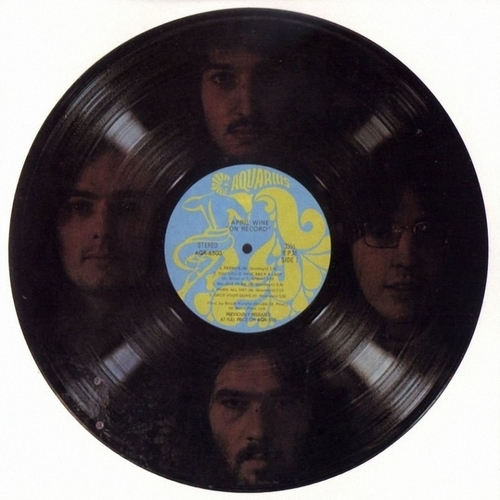
On Record captures April Wine at a moment when the band was learning how to translate early promise into something more disciplined, more commercial, and far more in step with the changing sound of early-1970s Canadian rock. Their debut album had hinted at several possible futures, but the unexpected success of “Fast Train” convinced Aquarius Records that April Wine could become a national force if the writing became sharper and the arrangements more focused. The label paired the group with producer Ralph Murphy — a move that would alter the band’s trajectory and help define the next decade of their career.
The album also marks the arrival of bassist Jim Clench, whose heavier tone and confident presence immediately reshaped the rhythm section. His playing brought a tougher edge, anchoring the arrangements in a way that allowed the guitars to move more freely and the vocals to sit forward in the mix. With Clench on board, the band sounded firmer, more grounded, and more capable of delivering the kind of radio-friendly material Murphy was aiming to coax from them.
Murphy’s influence is felt throughout On Record. He pushed the band toward cleaner song structures, brighter tones, and arrangements that moved with a sense of purpose — a marked shift from the psychedelic looseness of the debut. His most famous touch was “You Could Have Been a Lady,” a reworking of Hot Chocolate’s UK single. April Wine tightened the rhythm, toughened the guitars, and drove Goodwyn’s vocal into the spotlight. The result was a career-making hit: Number 1 in Canada and a breakout Top 30 entry in the U.S. on the Big Tree label. The track became a staple of April Wine’s live shows, and Murphy’s own voice — providing the unmistakable “na-na-na-na” refrain — embedded him permanently into the band’s lore.
But the deeper story of On Record lies in the tension between commercial clarity and the band’s earlier experimental instincts. Myles Goodwyn, quickly becoming the strongest melodic writer in the group, used the album to refine the concise, radio-ready approach hinted at on “Fast Train.” Songs like “Believe in Me” and “Flow River Flow” demonstrate a growing discipline in his phrasing and structure, while “Work All Day” and the spirited “Carry On” place the band squarely in the emerging early-’70s rock mainstream. Murphy understood that Goodwyn’s instincts would be the band’s engine, and the sessions subtly nudged him toward the front.
At the same time, the Henman brothers continued to bring the atmospheric sensibility that had shaped their debut. David Henman’s “Drop Your Guns” stands among the strongest tracks on the album — its central riff inspired by Humble Pie’s “Shine On” — offering a bridge between the exploratory feel of the first record and the tightening direction of the second. His contribution “Refuge” preserves some of the moodier, more introspective tone of their earlier work. Ritchie Henman’s percussion and keyboard touches soften the transition, helping the band retain its identity despite the move toward a more commercial sound.
One of the album’s peculiar signatures is the series of strange electronic noises Murphy spliced between tracks — a producer’s flourish added without the band’s knowledge. The members were reportedly startled when they first heard the finished album, unsure of the intention or meaning behind the segues. Odd as they are, the sounds have become part of the record’s character, a reminder of the experimental spirit lingering at the edges of a more structured effort.
The album is dedicated to Harrison Tabb, a respected Montréal R&B singer and close friend of David Henman who died tragically in a car accident. His presence in the credits reflects the interconnectedness of early-’70s Montréal music circles, where rock, soul, folk, and studio culture all overlapped in tight community.
On Record solidified April Wine’s position as a rising Canadian act, proving that their success was not a fluke and setting the template for the sharper, harder, and more commercially ambitious sound that would define their mid-’70s output. The album sits at the hinge point between the exploratory nature of their debut and the confident, arena-ready band they were about to become. It remains one of the essential documents of early-’70s Québec rock, capturing April Wine just as their identity — and their future — came into focus.
-Robert Williston
Musicians
Myles Goodwyn: lead vocals, guitar, keyboards
David Henman: guitar
Jim Clench: bass
Ritchie Henman: percussion
Keith Jollimore: flute (track ‘Bad Side of the Moon’)
Rick Morrison: saxophone (track ‘Carry On’)
Songwriting
‘Farkus’ written by M. Goodwyn
‘You Could Have Been a Lady’ written by E. Brown, T. Wilson
‘Believe in Me’ written by M. Goodwyn
‘Work All Day’ written by M. Goodwyn
‘Drop Your Guns’ written by D. Henman
‘Bad Side of the Moon’ written by E. John, B. Taupin
‘Refuge’ written by D. Henman
‘Flow River Flow’ written by M. Goodwyn
‘Carry On’ written by M. Goodwyn
‘Didn’t You’ written by J. Clench
Strings arranged by Bhen Lanzaroni
Production
Produced by Ralph Murphy
Engineered by Art Pohemas and Terry Brown
Management by Terry Flood
Artwork
Photography by Ian Robertson and Peter Geary
Printed by Ever Reddy
Bio:
April Wine emerged at the end of the 1960s out of the fertile east-coast music community that stretched between Halifax and St. John’s. Brothers David and Ritchie Henman had played together since their teens in Newfoundland, eventually regrouping in Nova Scotia with their cousin Jim Henman in various lineups. Around the same time, Myles Goodwyn — born in Woodstock, New Brunswick and raised in a tough working-class household — was working through his own bands in the Halifax scene, including Woody’s Termites, Squirrel, and East Gate Sanctuary. When those projects dissolved in late 1969, the four musicians brought their strengths together under a new name that simply sounded right: April Wine.
Real opportunity lay outside the Maritimes. The group made a demo and sent it to Montréal’s fast-rising Aquarius Records; a polite rejection was misread as an invitation. On April 1, 1970, with little money and plenty of nerve, April Wine arrived unannounced in Montréal. Aquarius partners Donald K. Tarlton and Terry Flood heard something promising and signed them, putting the young band up in a rural chalet to write and rehearse while touring the region opening for Mashmakhan.
Their debut album April Wine (1971) introduced Goodwyn’s songwriting voice, and its standout track “Fast Train” became a Canadian Top 40 hit. With momentum building, April Wine returned to the studio with a new bassist — Montréal musician Jim Clench, who had replaced the departing Jim Henman — and English-born producer Ralph Murphy to craft On Record (1972). It became their first breakthrough: a muscular reworking of Hot Chocolate’s “You Could Have Been a Lady” shot to No. 2 in Canada and cracked the U.S. charts, while their cover of Elton John’s “Bad Side of the Moon” became a fixture at rock radio. The band quickly graduated from bars to theatres and arenas, opening for The Guess Who, Jethro Tull, Badfinger, Stevie Wonder, and Ike & Tina Turner, gaining the road experience that would define their next decade.
During the making of their third album Electric Jewels (1973), the Henman brothers exited the group; Goodwyn and Clench rebuilt the lineup with two crucial arrivals: drummer Jerry Mercer, already nationally known from Mashmakhan, and guitarist Gary Moffet. The chemistry was immediate. Electric Jewels became a formative record, showcasing songwriting depth in tracks such as “Weeping Widow,” “Just Like That,” and “Lady Run, Lady Hide,” and solidifying the band’s dramatic stage show, complete with lights and pyrotechnics, on their ambitious Electric Adventure tour.
Through the mid-1970s, April Wine became one of Canada’s most reliable and inventive rock bands. Stand Back (1975) pushed them into double-platinum territory with “Tonight Is a Wonderful Time to Fall in Love” and “I Wouldn’t Want to Lose Your Love,” while harder-edged tracks like “Oowatanite” turned into signature concert moments. When bassist Steve Lang replaced Jim Clench in 1976, the band entered its most commercially dominant phase. The Whole World’s Goin’ Crazy arrived with unprecedented platinum advance orders, followed in 1977 by the ballad-driven Forever for Now, whose single “You Won’t Dance with Me” became their best-selling Canadian record of the era.
In March 1977, April Wine unwittingly stepped into one of the most famous episodes in Canadian rock. Booked as headliners for a pair of Toronto charity concerts at the El Mocambo, they discovered that their “opening act,” listed as The Cockroaches, was in fact The Rolling Stones, secretly recording material for Love You Live. April Wine’s own set was captured and released as Live at the El Mocambo, a raw snapshot of a band hitting its stride just as guitarist-vocalist Brian Greenway joined the lineup. With Goodwyn, Moffet, and Greenway, April Wine became a formidable three-guitar outfit; Goodwyn could now move between guitar, keys, and vocals without leaving gaps in the band’s sound.
Their U.S. breakthrough came with First Glance (1978), recorded at Montréal’s Studio Tempo and Québec’s famed Le Studio in Morin-Heights. “Roller” unexpectedly surged on FM rock stations in Michigan, spreading across the U.S. and giving April Wine their first gold album outside Canada. The band was soon touring American arenas with Rush, Journey, Styx, and other major acts, no longer an opening act from the north but a rising international name.
They entered the 1980s at full strength. April Wine performed at the inaugural Monsters of Rock festival at Castle Donington in August 1980 before tens of thousands of fans, signalling their arrival onto the global hard-rock stage. Their next studio album, The Nature of the Beast (1981), recorded partly again at Le Studio, became the pinnacle of their international success. The soaring ballad “Just Between You and Me” broke the U.S. Top 20, while their explosive reimagining of Lorence Hud’s “Sign of the Gypsy Queen” became a defining FM rock staple. The album went multi-platinum in Canada, platinum abroad, and spent months on the Billboard 200, cementing April Wine’s presence across North America and Europe.
The follow-up, Power Play (1982), produced additional airplay with “Enough Is Enough” and “If You See Kay,” but the workload of back-to-back touring and recording cycles took its toll. Animal Grace (1984) and the more fragmented Walking Through Fire (1985) revealed a band under strain, and by the mid-1980s April Wine quietly dissolved. Goodwyn released a solo album on Aquarius and Atlantic; Greenway issued Serious Business; Mercer moved into session work and new collaborations.
By the end of the decade, however, classic-rock radio had revived interest. Goodwyn returned to Montréal in 1988 and began discussing a reunion with Greenway, Mercer, and Jim Clench. A renewed April Wine debuted live in 1992, playing to sold-out crowds across Canada and the United States. Their 1993 studio return, Attitude, went gold in Canada with the single “If You Believe in Me,” followed by Frigate (1994). The band spent much of the 1990s and early 2000s touring widely, sharing stages with Def Leppard, Foreigner, Meat Loaf, Nazareth, Blue Öyster Cult, and other cornerstone classic-rock acts.
Goodwyn brought the group back to its roots for Back to the Mansion (2001) and later the analog-leaning Roughly Speaking (2006). Lineups shifted as the years passed: Clench left and later passed away in 2010; beloved long-time bassist Steve Lang died in 2017; drummer Jerry Mercer retired after more than three decades. Their successors — notably bassist Richard Lanthier and drummer Roy “Nip” Nichol — kept the group’s live power intact alongside Greenway’s enduring presence.
Goodwyn’s 2016 memoir Just Between You and Me shed new light on his early life and the band’s long arc, and in 2018 he was inducted into the Canadian Songwriters Hall of Fame. April Wine themselves received the Canadian Music Industry Hall of Fame’s Lifetime Achievement Award in 2009 and entered the Canadian Music Hall of Fame at the 2010 Juno Awards.
In late 2022, facing ongoing health issues, Goodwyn announced his retirement from touring, but remained involved in writing and guiding the band. He performed one final live concert with April Wine in March 2023, joined by original bassist Jim Henman for a poignant reunion. Myles Goodwyn died in Halifax on December 3, 2023, at the age of 75.
April Wine continues to tour into the present with Brian Greenway, Richard Lanthier, Roy Nichol, and Marc Parent, carrying a legacy built on powerhouse guitars, durable songwriting, and more than fifty years of Canadian rock history — a catalogue that never left the airwaves, and a name that remains synonymous with the rise of Canadian rock on the international stage.
-Robert Williston
Gallery
Images
1 image
On Record
Media
Videos
0 videos
No videos available for this title.
Credits
In Transit
No Comments